🔄 Updated 21 Jun 2026
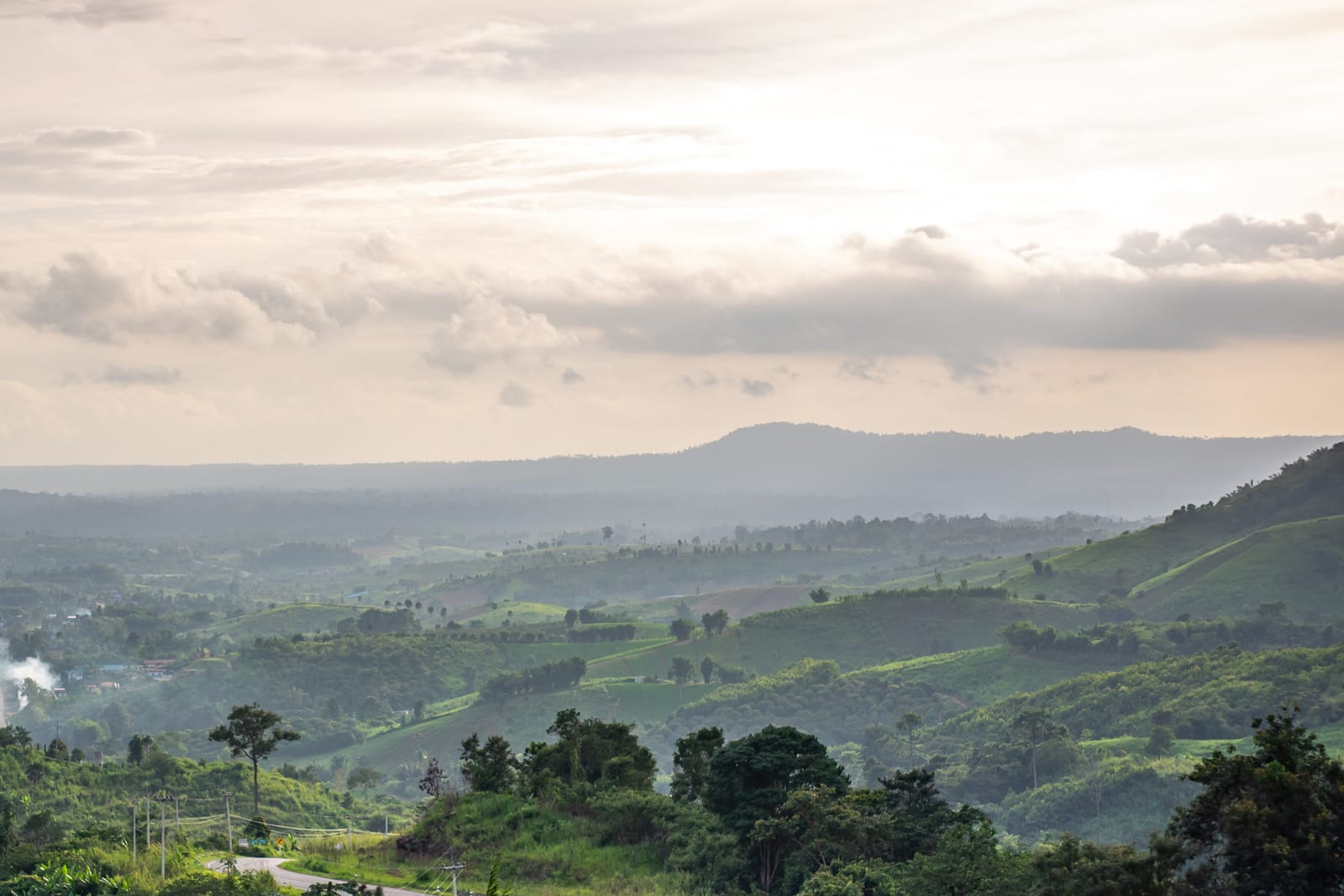
First, get the lay of the land. Phetchabun sits in the upper Central region, ringed by mountains, and the main sights split into three zones: Phetchabun town (the flat valley — restaurants and local souvenirs), Khao Kho (mountain-view stays, cafes, Wat Pha Sorn Kaew), and Phu Thap Boek (the highest, coldest point — sea of fog and cabbage terraces). All three are in different directions and a fair drive apart, so planning ahead matters more here than in most provinces.
Which month is best for Phetchabun
Phetchabun works year-round, and each stretch has a distinctly different feel. Pick based on what you want to see.
- September–October (late rains, early cool) — the cabbage terraces on Phu Thap Boek are green across the whole hillside, and there's a good chance of a high morning fog. The air is pleasantly cool but not yet bitterly cold; rain still falls now and then, so some stretches of road get slippery.
- November–December (full winter) — it turns genuinely cold from early November, and the fog is at its prettiest, but this is the busiest stretch of all. Rooms fill fast and prices climb, so book well ahead.
- January (coldest) — some mornings on Phu Thap Boek dip close to single digits, and the wild Himalayan cherry (Thailand's "sakura") starts to bloom. The best atmosphere of the year.
- March–August — fewer people, rooms open, prices lower. Khao Kho stays lush through the rainy season — a good pick if you're not set on the sea of fog.
What to understand about the fog
The sea of fog doesn't roll in every morning — it depends on humidity and wind. If it rained the night before or the air is humid and the morning wind is calm, your odds of thick fog are high. But if the cold wind is blowing hard, the fog gets swept away. Nobody can guarantee it. Staying several nights or catching several mornings raises your chances.
How cold does it get, and how to pack
This is where people slip up most. Plenty assume it's about as cold as Chiang Mai, but Phu Thap Boek sits roughly 1,768 metres above sea level — one of the coldest spots in the Central region. From December to January the wind from late night to before dawn gets fierce, and campers tend to agree: if you come underprepared, you barely sleep. Khao Kho is milder because it's lower — midday can be warm enough for just long sleeves — but mornings and nights are noticeably chilly.
- One heavy jacket — down or thick fleece for pre-dawn on Phu Thap Boek. A thin layer won't cut it.
- Layers — a long-sleeve top plus a windbreaker over it, so you can add or shed as the day goes, because midday sun warms things up fast.
- Beanie, scarf, gloves — the coldest parts are your ears, hands and neck; these help more than you'd think.
- Thick socks and closed shoes — the ground is cold and damp in spots; flip-flops won't do in the morning.
- If you're camping — a sleeping bag rated for 0–5°C, or check with your stay whether they provide heavy bedding. Some places throw in a sleeping bag and a heater.
A regular's trick
Bring a few hot packs — two or three. Stick one on your back or tuck it in a pocket while you wait for sunrise; it helps a lot. And don't forget lip balm and a moisturiser — the cold, dry air chaps lips easily.
How far ahead to book your stay
Rooms at Khao Kho and Phu Thap Boek in winter are hard to come by, especially over long holidays like New Year. The good-view stays often fill a month or more in advance. Here's a booking timeline that actually holds up.
- New Year / long December holidays — book 1–2 months ahead or more. Some prime-location stays are full from October.
- Regular winter weekends — book at least 2–3 weeks ahead to be safe.
- Winter weekdays — booking a week ahead usually still finds a spot, and rates run noticeably cheaper than weekends.
- Outside winter — you can walk in almost anywhere, but booking online ahead still tends to get a better rate.
Campsites on Phu Thap Boek in high season mostly only take their own rental tents (a small tent runs around 500 THB, a large one around 800 THB, bedding included). If you want to pitch your own tent, call the campsite first — some don't allow it when it's busy.
See our hand-picked Phetchabun stays — great views, real reviews
See Top 10 Phetchabun Stays →How to get to Phetchabun
Phetchabun is about 540 km from Bangkok — roughly 5–6 hours by car or coach.
- Self-drive — the most convenient way to get around Phetchabun, since the sights are spread out and public transport up the mountains is awkward. The roads up to Khao Kho and Phu Thap Boek are steep and winding in places; a small car can manage, but check your brakes first. Some Phu Thap Boek stretches are steep enough to need low gear.
- Coach — from Mo Chit 2 to Phetchabun town / Lom Sak, fares start around 300–420 THB per leg, then you connect with a local ride or rent a car for the climb.
- Car rental / chartered songthaew — if you're not driving, the common move is to charter a van or songthaew up Khao Kho and Phu Thap Boek for the day. Price is negotiable based on route and group size — good for a larger group splitting the cost.
Driving up Phu Thap Boek — take care
The final stretch up Phu Thap Boek is very steep and narrow. If you're not confident in your car or your driving, it's safer to park at the bottom and charter a local driver who knows the road. That goes double when fog drops and visibility falls.
Roughly what does a Phetchabun trip cost
Your budget depends on how many of you go, where you sleep, and when. Here's a realistic per-person frame for a 2-day, 1-night trip (based on a group of 2–4 splitting costs, driving or sharing transport).
Budget (camping / sub-1,000-THB stays)
Sleep at a campsite or a Khao Kho stay at 500–700 THB/night, eat at local spots, drive or take the coach yourself, and focus on free sights like Wat Pha Sorn Kaew and the viewpoints.
Comfortable middle (mountain-view resort)
Stay at a scenic Khao Kho resort around 1,500–2,800 THB/night, eat at cafes and popular spots, factor in fuel or a chartered ride up the mountain, and cover both Khao Kho and Phu Thap Boek.
Treat yourself (luxury stay, glamping, onsen)
A glamping tent or a stay with an onsen / sweeping views, good meals every sitting — ideal for a special weekend or a celebration. At this level a trip can add up to five figures for the whole group.
The costs people forget: fuel for the climb up and down the mountain (it burns more than flat-road driving), a chartered local ride if you're not driving, and souvenirs (Phetchabun's sweet tamarind is the local specialty — nearly everyone buys some to take home). Pad your budget for these.
Pre-trip checklist
- Room booked and confirmed (don't risk a winter walk-in)
- Heavy jacket + beanie, scarf, gloves + hot packs
- Check the car, brakes and tyres especially, if you're driving up yourself
- Fill the tank before the climb — fuel stations up the mountain are scarce
- Download offline maps — the phone signal is weak in spots
- Cash on hand — many local shops and campsites still don't take transfers or cards
- Regular medications + motion-sickness pills (the mountain road is winding)
The short version
To enjoy Phetchabun in winter, remember three things: book your stay early, pack enough warm clothing, and keep an open mind about the fog that doesn't show every morning. Nail those three and the trip runs far smoother than you'd expect.
Plan a full trip across all of Phetchabun
See the Phetchabun Travel Guide →