🔄 Updated 21 Jun 2026
Most people who come to Phetchaburi head up Khao Wang and then carry on to the coast. But if you take the time to step inside even one of the old temples in town, you'll understand why this place calls itself a city of artisans. Stucco gable reliefs, carved temple doors, mineral-pigment murals that are hundreds of years old — all of it is here to see up close, with no glass barriers in the way. We've laid this out as a route that runs from the temple with the most remarkable craftsmanship to the ones that visitors haven't fully discovered yet. Pick and choose depending on how much time you have.
What is Phetchaburi craftsmanship, and why is it famous?
Phetchaburi is an old town with an unbroken line of artisans dating back to the Ayutthaya period. The standout that people talk about most is stucco work: Phetchaburi craftsmen sculpt wet plaster by hand, without molds, so every piece has life to it and no two are alike. Next come the wall murals, painted in mineral pigments mixed with glue, and the gilded-lacquer woodwork — gold leaf laid over black lacquer. All three are gathered in just a few temples around town, and you can see them in a single day.
- Stucco — sculpted by hand on gables, door arches, and boundary-stone bases, with kanok flame motifs, deities, giants, and garudas. See it at Wat Mahathat, Wat Sa Bua, and Wat Phai Lom.
- Wall murals — scenes of the Traiphum cosmology, the life of the Buddha, and Jataka tales, painted in mineral pigments across whole walls. The genuine 200-plus-year-old work is at Wat Ko Kaeo Suttharam.
- Gilded-lacquer woodwork — temple doors, pulpits, and teak halls finished in gold leaf over black lacquer. The finest is at Wat Yai Suwannaram.
Want more out of Phetchaburi? Book tours & activities
Booking online ahead on Klook or GetYourGuide is usually cheaper than the gate and skips the queue. Pick only the experiences you actually want — prices and availability are shown live on each site.
The craft-temple route, ordered by the best work
We've arranged this from the temples with the most complete craftsmanship and the most visitors, then closed with the ones people haven't fully discovered but where the stucco work is incredibly dense. Every temple is within the town district, and the drive between any two is no more than 10–15 minutes.
Wat Ko Kaeo Suttharam (Wat Ko)
Locals just call it Wat Ko. The thing to see is the ordination hall, built in the maha-ut style with solid walls and no windows, only doors. That keeps the interior dark and has preserved the murals well. Inside, mineral-pigment paintings cover all four walls, more than 200 years old, telling the Traiphum cosmology, the life of the Buddha, and an assembly of deities. The detail everyone comes looking for is the painting of a Western priest wearing a monk's robe — a reflection of the era when Europeans first arrived in Ayutthaya. It's considered a masterpiece of Phetchaburi painting.
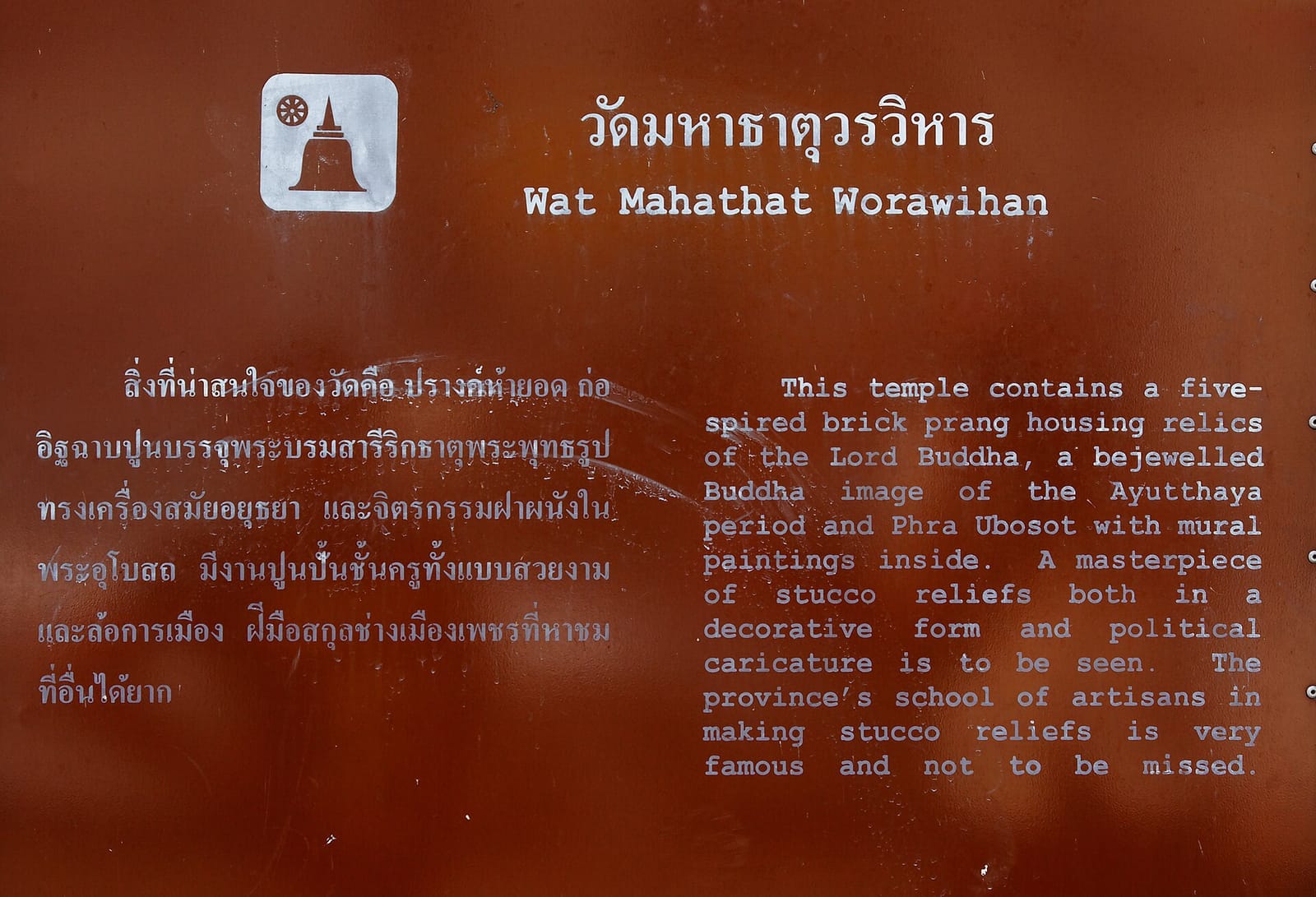
Wat Mahathat Worawihan
The town's principal temple in the heart of the old quarter, easy to spot by its tall white five-spired prang visible from a distance. The craftsmanship to look for is the stucco all around the temple — the gable of the main viharn shows Narai (Vishnu) riding a garuda, and there's lively, true-to-life stucco along the various arches. Inside the main viharn there are also wall murals of Jataka tales and an assembly of deities, and the surrounding cloister has Buddha images lined up by the hundred, pleasant to walk past. It sits right next to the old town's dessert shops and cafes.
Wat Yai Suwannaram
An old Ayutthaya-era temple that brings several crafts together in one place. The standout is the all-teak sermon hall, along with carved temple doors finished in gold leaf over black lacquer that are still very well preserved. One door panel bears a gash from a weapon, said to date from a battle with the Burmese — a piece of history you can still see. Inside there are also old murals and a beautifully carved wooden pulpit by a master craftsman. It doesn't get crowded, which suits anyone who loves fine woodwork.
Wat Sa Bua
A small temple in the old town with more stucco than its size would suggest. The ordination hall was built in the late Ayutthaya period, with a curved base shaped like the hull of a junk and a wooden gable carved with Narai riding an asura — rarer than the garuda mount you usually see. The highlight is the boundary stones around the hall, set on two-tiered stacked plinths, with stucco giants, garudas, and a man-lion (norasingh) shouldering the stones at each level. It's a compact, hands-on textbook of Phetchaburi stucco work you can study up close.
Wat Phai Lom
An old temple where only the ordination hall remains, in late-Ayutthaya style. Visitors haven't fully discovered it, but the stucco inside is striking. Behind the principal Buddha image is a room with stucco covering the entire wall, telling the story of a pilgrimage to the Buddha's footprint at Sumanakuta in Sri Lanka, complete with a chain stairway and the footprint sculpted above. The outer gable is stucco of Narai riding a Suban bird amid scrolling vine motifs. Good for anyone who loves tucked-away corners and narrative stucco work.
Etiquette before entering the old halls
Many of the old temples — Wat Ko Kaeo Suttharam especially — don't leave the hall open all the time. You should greet a monk or caretaker and ask to look around first. Dress modestly, and don't use flash when photographing the murals: flash speeds up the fading of the old mineral pigments.
See all the craftsmanship — what to look for at each temple
If you don't want to walk straight past the good stuff, here's where to stop and look at each temple. Phetchaburi's craftsmen hide their details in the corners people tend to overlook.
- The gable — check whether it's Narai riding a garuda, an asura, or a Suban bird. It differs from temple to temple and works like a craftsman's signature.
- The boundary-stone bases around the hall — Wat Sa Bua stands out here, with stucco giants, garudas, and a man-lion shouldering the stacked boundary stones.
- Doors and pulpit — Wat Yai Suwannaram has master-level gilded-lacquer woodwork; look for the gash on the door panel too.
- The interior walls — at Wat Ko Kaeo Suttharam they're painted across all four sides; work your way around to find the Western priest.
- The wall behind the principal Buddha — Wat Phai Lom hides its Sri Lanka narrative stucco in the room at the back.
What to bring
The old halls have low light and no flash is allowed, so a newer phone camera that handles dark scenes well makes a big difference. A small flashlight to pick out the stucco detail in shadowed corners helps too. And bring cash to drop in the donation box, since these temples are maintained purely on faith.
Sample itineraries: temple-hopping for the craftsmanship
All the craft temples are in and around the old town, no more than ten-odd minutes' drive apart. We've laid out two options: a half-day that hits only the standouts, and a full day that covers every craft plus a stop for Phetchaburi's famous sweets.
Three standout temples in town
Every craft covered
Carry on up Khao Wang
If you've still got the energy and want to keep the history going, Phra Nakhon Khiri (Khao Wang) is in the same town, less than ten minutes' drive from the Wat Mahathat area. You can easily add the hilltop palace to the same day.
Wondering what to eat while you walk the old town
See where to eat in Phetchaburi's old town →When to go, and how to get there
The temples in Phetchaburi are good to visit year-round, but the most comfortable stretch is late rainy season into early winter, roughly November to February, when it isn't too hot and you can walk between temples in the sun without trouble. Early mornings before ten and the late afternoon give the nicest light and fewer people than midday.
- From Bangkok — about a 2-hour drive via Rama II Road, or take a train or minivan to Phetchaburi town.
- Around town — the craft temples are clustered in the old quarter; driving or renting a motorbike is easiest, and some are within walking distance of each other.
- No car — use a ride-hailing app or one of the town's samlor (tuk-tuk) to move between temples, since the distances are short.
Plan a full Phetchaburi trip
See the Phetchaburi travel guide →