🔄 Updated 21 Jun 2026
Phimai Historical Park sits in Phimai district, about 60 km from Korat city. What makes it special is that it isn't just a pile of old stones you snap a photo of and leave. The temple still stands complete, it's well restored, and it's laid out according to Khmer cosmology in a way you can actually read the whole story off the building. Anyone who loves history can spend an hour here, and anyone who comes for photos gets great angles before they even reach the inner gallery. The list below is arranged so you can walk it in order, from the front gate arch all the way to the central tower.
A short history — why Phimai matters
Phimai was first built around the 11th–12th centuries CE (from the reign of Suryavarman I through to Jayavarman VI). Unlike most Khmer temples, it was built as a Mahayana Buddhist sanctuary rather than a Hindu shrine. In that era the town of Phimai was called Vimayapura, an important city in the northeastern part of the Khmer empire. Later, under Jayavarman VII, the town flourished, with an ancient road running straight to Angkor (Angkor Wat–Angkor Thom). And here's something many people don't know: scholars believe Phimai's layout and form were the model that later influenced Angkor Wat.
- Age — first built around the 11th–12th centuries CE (over 900 years old)
- Religion — Mahayana Buddhist, unlike the usual Hindu Khmer temples
- Size — the largest stone temple in Thailand
- The connection — its layout faces south toward Angkor, and it's seen as a model for Angkor Wat
Want more out of Nakhon Ratchasima? Book tours & activities
Booking online ahead on Klook or GetYourGuide is usually cheaper than the gate and skips the queue. Pick only the experiences you actually want — prices and availability are shown live on each site.
Carvings and architecture worth noticing
Phimai's charm lies in stone carving that's still sharp and readable. Most of the work is in the Baphuon-meets-Angkor Wat style, with lintels and pediments telling both Hindu and Buddhist stories side by side, because the temple stayed in use across several reigns. The spot to look up at is the lintel above the doorway of the central tower, carved with scenes from the Ramayana, the gods, and the life of the Buddha — cut so deep you can clearly see the depth.
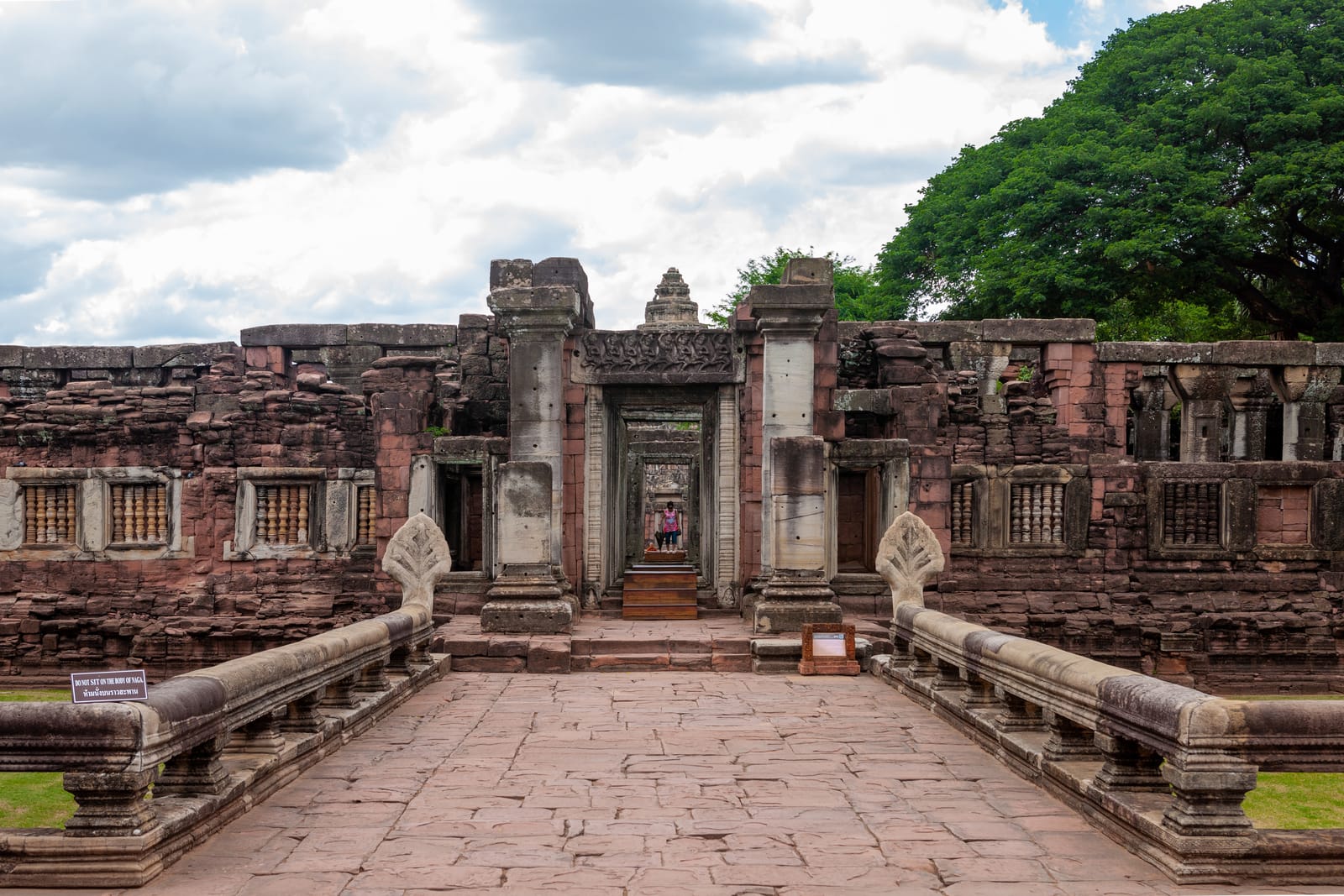
- The Naga bridge — the front entrance, with railings shaped as a seven-headed serpent king, symbolizing the link between the human world and the heavens
- The central tower (prang) — the middle tower built entirely of white sandstone, the center of the universe in the tradition of Mount Meru
- Lintels and pediments — carved with the Ramayana, Hindu gods, and the life of the Buddha, deep and sharp
- Prang Brahmadat — the laterite tower at the front, where a sculpture believed to depict Jayavarman VII was found (now in the museum)
- The red-stone prang — a small red sandstone tower on the right, a nice color contrast with the central tower for photos
Tip for reading the carvings
Bring a translation app or scan the Fine Arts Department's QR information signs — it makes reading the stories on the lintels much more fun. Low, angled light in the early morning or late afternoon makes the carved grooves stand out and captures the depth far better than midday sun.
Opening hours, entry fees, and what to know before you go
Phimai Historical Park is open daily, and the entry fee is very cheap for what you get to see. The details below are current, but during festivals or special events the hours may change, so it's worth checking the park's page before you set off.
- Opening hours — daily, 7:30 AM–6:00 PM
- Entry for Thais — 20 THB
- Entry for foreigners — 100 THB
- Free entry — students in uniform, monks, and novices
- Getting there — from Korat city take Highway 2 (Mittraphap) toward Khon Kaen for about 50 km, turn right at the Talat Khae intersection onto Highway 206 for another 10 km or so
Straight talk
The temple itself is an open stone courtyard — the sun is harsh and it gets very hot through late morning and afternoon. Go before 10 AM or after 3 PM to walk in comfort, and bring a hat, water, and sunscreen. Some sections of the ground are uneven, so sneakers help.
Photo spots you shouldn't miss
Phimai photographs well from almost every angle, but if you're short on time, capture these spots to cover both the grand scale and the carving detail.
The Naga bridge at the gate arch
Stand at the end of the bridge and shoot so the serpent king leads the eye down toward the central tower — the classic Phimai shot.
The white sandstone central tower
Step back and shoot from the gallery courtyard to get the whole tower against the sky — most beautiful in the late-afternoon light.
The lintel above the gate
Zoom in on the carved Ramayana and Buddhist scenes — angled light makes the grooves stand out in three dimensions.
The gallery and stacked gate arches
Shoot through the layered gate frames into the interior for a beautiful frame-within-a-frame effect.
Phimai National Museum
About 1 km from the temple, down by the river, is the Phimai National Museum, which recently revamped its displays (soft opening in mid-2024). It's worth budgeting time for, because many of the originals that once stood on the temple — lintels and sculptures — were moved here for preservation. The highlight is the sculpture of Jayavarman VII found in the Phimai area, along with a densely packed collection of lintels from temples across the lower Isan region.
- Opening hours — Wednesday–Sunday, 9:00 AM–4:00 PM (closed Monday–Tuesday)
- Entry for Thais — 10 THB
- Entry for foreigners — 30 THB
- Highlight — the sculpture of Jayavarman VII and the original lintels from Phimai temple
- Location — Tha Songkran Road, in Phimai town, near the temple (tel. 0-4447-1167)
Order your visit
If you come early in the week on a weekday, the museum is closed (Monday–Tuesday) but the temple is still open. Plan to come Wednesday through Sunday to see both. We'd suggest the temple in the morning, then the museum before it closes at 4 PM.
Making the most of Phimai — where to go next
Since you've come all the way to Phimai, don't rush back. There are a few standout spots nearby that are easy to reach and can be added to the same day.
- Sai Ngam Park — a weeping banyan tree over 350 years old, its branches spreading to cover a wide riverside area. Cool, shady, and easy for a stroll and photos, just a few kilometers from the temple.
- Markets and food in Phimai town — try Phimai pad mee, the local signature noodle dish, with chewy, springy noodles and a well-rounded flavor. You'll find it around the temple.
- Heading back into Korat city — on the way back you can stop for Isan food or souvenirs in town, only about an hour's drive away.
A Phimai itinerary you can actually follow
Catch the temple in good light
Lunch and a break from the sun
Wind down under the banyan
Plan the rest of your Korat trip — where to eat, stay, and explore
See the Korat travel guide →