🔄 Updated 21 Jun 2026
Phitsanulok sits halfway between the North and the Central region, so it's easy to reach by train, coach or plane. Many people just pass through on the way to Sukhothai or Phetchabun, but if you give it a proper full day there are old temples in town and a cold-season mountain to climb. Before you book your tickets, read the timing section first — the headline draw, the wild Himalayan cherry, has a very short window. Miss it and you're waiting until next year.
When is the best time to visit Phitsanulok
If you're here for the wild Himalayan cherry and cold mountain air, the best stretch is late November through February. If you just want to pay your respects at the temple and explore town, any time of year works — though the middle of the rainy season turns hot and humid and the mountain roads get slippery. Locals all say the same thing: the province is at its best in winter, because that's the only time Phu Lom Lo turns into a pink valley.
- Late Nov–Feb — winter, with genuinely cold air up on the mountain. This is when Phitsanulok looks its best and draws the biggest crowds.
- Mid-Jan–early Feb — the wild Himalayan cherry on Phu Lom Lo is in full bloom, washing the hillside pink. The peak of the year.
- Mar–May — hot and dry, with hazy mountain views. Best kept to morning temple visits in town.
- Jun–Oct — the rainy season: lush, quiet and cheap, but the road up Phu Hin Rong Kla gets slippery and the waterfalls run hard. Check the forecast before you go.
Straight talk
The wild Himalayan cherry doesn't bloom on the same dates every year — it hinges on whether the cold arrives early or late. Some years it peaks in early January, other years it drags to mid-month. Before you set off, check the Phu Hin Rong Kla National Park page to see what percentage is currently in bloom, so you don't climb all that way to find bare branches.
Phu Lom Lo wild Himalayan cherry — how to get there, when it blooms
Phu Lom Lo is the biggest spot in the country for the wild Himalayan cherry — what many people call Thailand's "sakura." It's inside Phu Hin Rong Kla National Park, on the border where Phitsanulok, Loei and Phetchabun meet, with a peak around 1,542 metres. At full bloom the whole valley turns pink, and you'll often catch frost on the grass in the pre-dawn cold too.
- Bloom window — generally mid-January to early February, but it varies year to year, so always check the bloom status first.
- Getting up Phu Lom Lo — regular cars can't make it; you take a guided ride run by the Ban Rong Kla villagers, or connect with a songthaew or local truck up the mountain. There's a queue system in high season.
- Where to stay — most people choose a homestay in Ban Rong Kla or camp inside the park. Rooms fill very fast during the bloom, so book several weeks ahead.
- Go before dawn — the light is best and the fog thickest around sunrise; later in the morning the sun gets harsh and the crowds build.
- Pack seriously warm clothing — pre-dawn temperatures up top can drop into single digits, far colder than in town.
Local tip
If your dates are flexible, skip the weekends during peak bloom — the queue for the ride up Phu Lom Lo gets long and the Ban Rong Kla homestays book out. Mid-week is easier on both the wait and your wallet, and you get photo spots you don't have to fight anyone for.
How to dress for Phra Phuttha Chinnarat
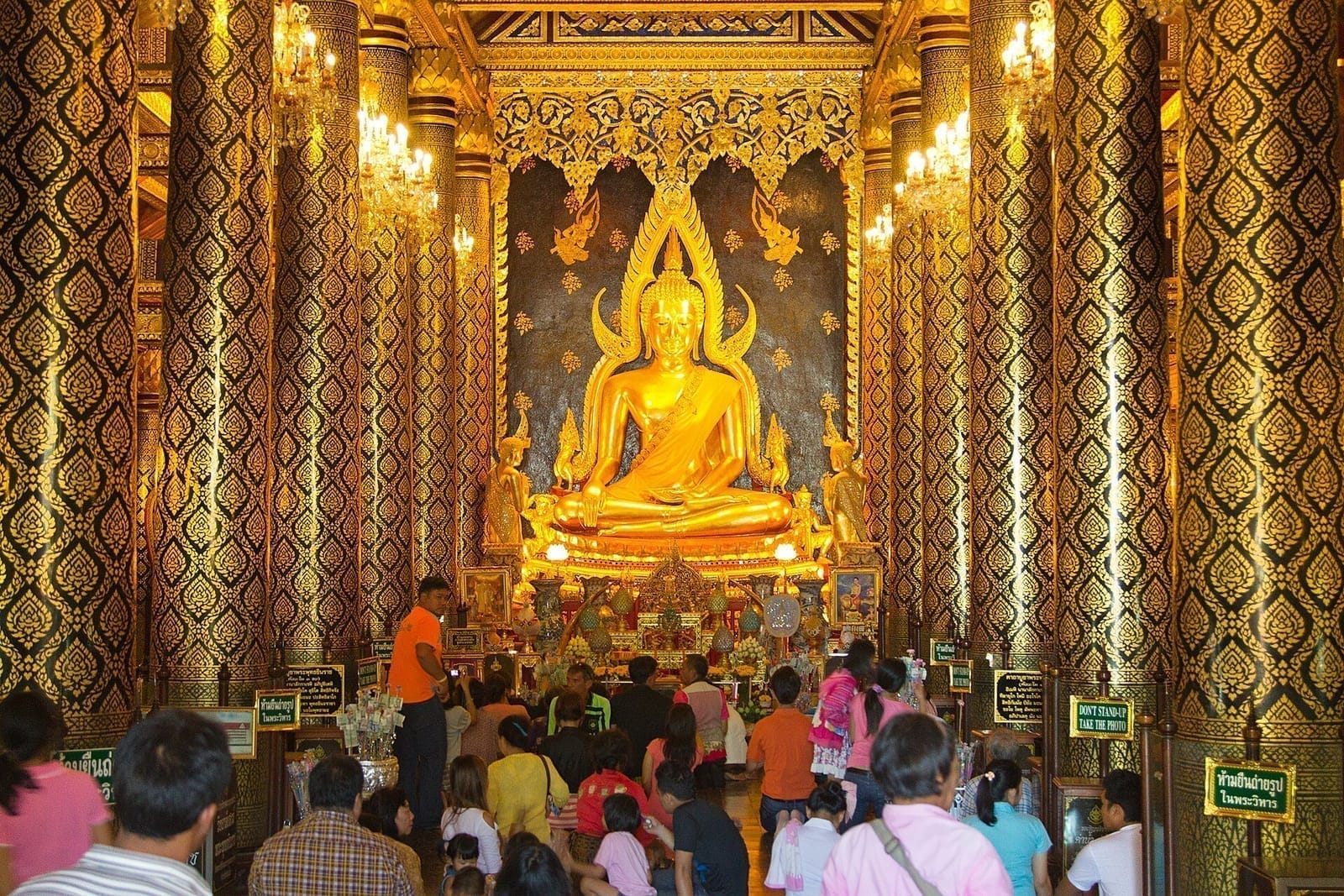
Wat Phra Si Rattana Mahathat Woramahawihan — the temple everyone calls Wat Yai — is home to Phra Phuttha Chinnarat, one of the most beautiful Buddha images in Thailand. Entry is free, and the main hall is open roughly 06:00–20:00. It's a revered temple where people come to pray all year round, so dressing neatly is worth taking seriously.
- Skip shorts and short skirts — women shouldn't wear anything too short or sleeveless. The temple lends out sarongs to cover up, but bringing your own is easier.
- Wear sleeves, cover your shoulders — a short-sleeve tee or a shirt is fine, as long as your shoulders aren't bare and it isn't too tight.
- Long trousers or a knee-length skirt — modest, and they photograph well inside the temple too.
- Easy-off shoes — you remove them before entering the main hall, so slip-ons beat lace-ups here.
- Sit when photographing the main image — inside the hall, custom says not to stand for photos in front of the Buddha; sit down to take them, out of respect.
Straight talk
Early February usually brings the annual Phra Phuttha Chinnarat homage festival — extra crowded, with parking hard to find. If you want a calm visit, come in the morning before 9, or avoid the festival week altogether, and you'll get a far better atmosphere.
Rough per-person budget
A Phitsanulok budget flexes a lot. Stick to town — visiting the temple and eating well — and it's cheap, but heading up Phu Hin Rong Kla or Phu Lom Lo adds the cost of a guided ride plus a stay on the mountain. Below is a rough estimate for a 2-day, 1-night trip per person; real prices shift with the season and holidays.
- Getting there — the Bangkok–Phitsanulok coach starts around 320–450 THB per leg / northern-line trains stop at Phitsanulok station / flying from Bangkok to Phitsanulok airport takes about 50 min, with fares starting in the low thousands.
- Accommodation — town hotels near Wat Yai run 500–1,200 THB/night; resorts or homestays around Phu Hin Rong Kla run 600–1,500 THB/night.
- Food — local spots run 50–120 THB a meal. The famous dangling-leg noodles and "floating" stir-fried morning glory aren't pricey; reckon on 300–400 THB for the whole day.
- Ride up Phu Lom Lo / park fee — the guided ride up Phu Lom Lo plus the Phu Hin Rong Kla park entry come to a few hundred THB per person. Bring cash.
- Rough total — a 2-day, 1-night trip staying in town runs about 2,000–2,800 THB per person; going up Phu Lom Lo during the bloom adds the ride and winter accommodation on top.
Bang Krathum sun-dried bananas — where to buy them
Phitsanulok's signature souvenir is the Bang Krathum sun-dried banana. Bang Krathum district is so well known for it that it's earned the nickname "the town of sun-dried bananas." The draw is the chewy, soft texture, no seeds, and a natural sweetness from drying in the sun. It also carries a GI (Geographical Indication) registration. People love receiving these because the same thing is hard to find elsewhere.
- Buy in Bang Krathum district — if you're driving through, stop at a local factory or shop for fresher stock at better prices than in town. Many let you taste before you buy.
- Pick a brand with the GI mark — the GI seal guarantees genuine Bang Krathum sun-dried bananas: fine, smooth flesh with no added colour.
- Several styles to choose from — plain, rolled, honey-baked and filled versions. Try a few before you commit to a box.
- Keeps a good while — sun-dried bananas last several weeks at room temperature, so they make a souvenir you don't have to rush to eat — though seal the bag well once opened to keep them from drying out.
Local tip
If you're not driving through Bang Krathum, there's plenty of sun-dried banana for sale in Phitsanulok town and at the souvenir shops near Wat Yai. Just check the production date and that the flesh is still soft, not stiff. Good sun-dried banana is springy and chewy, not so dry it sticks to your teeth.
What to pack so you don't regret it
- Warm jacket + layers — if you're heading up Phu Hin Rong Kla / Phu Lom Lo in winter, the pre-dawn cold is fierce. Several thin layers adjust more easily than one thick one.
- Shawl / sarong — in case you're underdressed for the temple; bringing your own beats waiting to borrow one.
- Cash — the ride up Phu Lom Lo, local shops and many homestays take cash, and the mobile signal up the mountain is unreliable.
- Easy-off shoes plus hiking shoes — slip-ons for the temple, a second pair for the damp, uneven ground on the mountain.
- Lip balm and moisturiser — the cold mountain air is dry; lips crack and skin flakes more easily than you'd think.
- Power bank — phone batteries drain fast in the cold, and charging points on Phu Lom Lo are limited.
- Dry bag — to protect your phone and camera from the dew and damp before dawn.
How to get to Phitsanulok
Phitsanulok is a major hub for the lower North, so it has the full set of options — train, coach and plane — and the town itself is easy to reach. The nature spots, though, sit a fair way out of town. If you want flexibility to head up Phu Hin Rong Kla, having your own vehicle is by far the easiest.
- Train — the northern line stops at Phitsanulok station, about 5–6 hours from Bangkok. The station is close to town, with easy onward transport to Wat Yai.
- Coach — Bangkok–Phitsanulok fares start around 320–450 THB, with several companies and many departures a day.
- Plane — flying from Bangkok to Phitsanulok airport takes about 50 min, good if you'd rather not spend hours on the road.
- Self-drive — the most flexible option, reaching Bang Krathum, Phu Hin Rong Kla and waterfalls that public transport can't. Fill the tank before the climb.
Plan your routes and getting around Phitsanulok in detail
See how to get around Phitsanulok →