🔄 Updated 21 Jun 2026
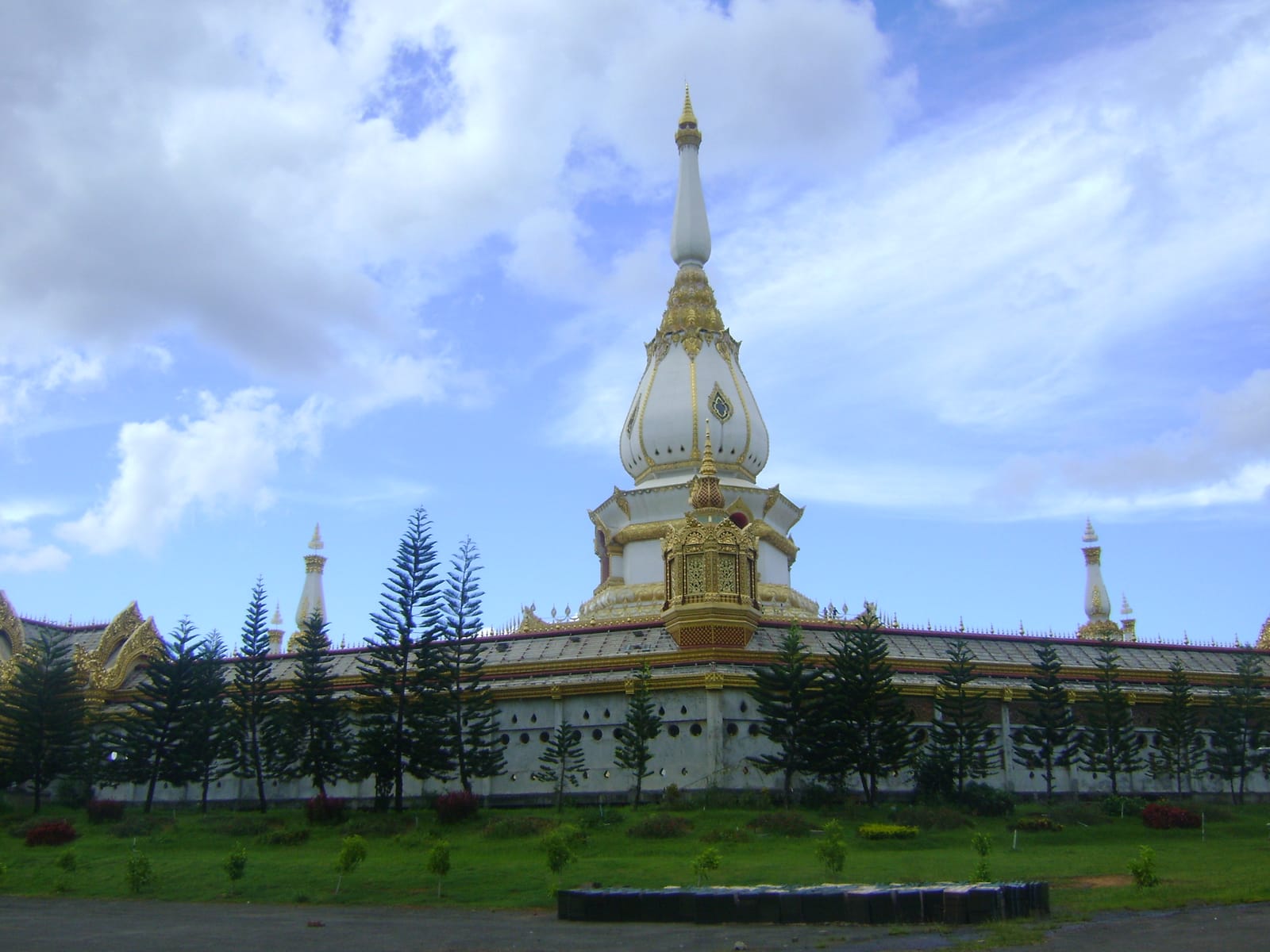
Phra Maha Chedi Chai Mongkhon sits within Wat Pha Nam Thip Thep Prasit Wararam in Pha Nam Yoi subdistrict, Nong Phok district, roughly 60–78 kilometres from Roi Et town depending on the route you take. It's a hilltop stupa you can see from far off, and plenty of people driving the Phon Thong–Nong Phok road stop in, because the white stupa trimmed in gold set against the green hills behind it really catches the eye.
The stupa was built on the faith of the disciples of Phra Ajahn Sri Mahaviro, a meditation monk who was a student of Luang Pu Mun Bhuridatto. It was designed by the Fine Arts Department, drawing on the form of Phra Pathom Chedi blended with Phra That Phanom, so it ended up with both the graceful lines of central Thailand and the solid feel of Isan in one structure.
The number 101 hidden in the stupa
Something a lot of people miss is that this stupa deliberately ties its numbers to the name of the province. Roi Et comes from the number 101, and the stupa plays with that figure in almost every dimension.
- 101 rai of land — the area set aside for building the great stupa
- 101 metres wide, 101 metres long — the stupa's base is square
- 101 metres tall to the stupa body, and 109 metres including the golden tip — 109 metres in total
- 101 statues of revered monks (Phra Supatipanno) — enshrined on the third floor
The golden tip uses around 60 kilograms of gold. That's why, when the sun is out, the top of the stupa clearly reflects a golden glow even when you're looking up from the foot of the hill.
Want more out of Roi Et? Book tours & activities
Booking online ahead on Klook or GetYourGuide is usually cheaper than the gate and skips the queue. Pick only the experiences you actually want — prices and availability are shown live on each site.
The art inside, floor by floor
The real charm of this stupa is on the inside, because you can walk up several floors and each one tells a different story. Give yourself plenty of time — at least an hour and a half to take it in at an easy pace.
Floor 1 — merit-making hall
A wide hall used for making merit, listening to dharma talks, and the temple's events. It's where you start before heading up.
Floor 2 — scenes from the Buddha's life
The walls are covered with murals telling the life of the Buddha, with detailed Thai patterns painted across the whole room.
Floor 3 — statues of Isan monks
Home to marble statues of revered Isan meditation monks, along with the 101 figures of Phra Supatipanno.
Floor 4 — temple museum
Displays the history of the temple and its meditation centre. Good for anyone curious about how it all began.
Floors 5–6 — Buddha relics
An octagonal bell-shaped chamber on the upper floor enshrines the Buddha's relics — the most sacred place of worship in the stupa.
Dress right before you go up
This is a place of worship, so dress modestly — no shorts or spaghetti-strap tops — and you'll need to take your shoes off before entering the stupa. Wear shoes that slip on and off easily, since you'll be taking them on and off several times.
The Pha Nam Yoi cliff and Phu Khiao viewpoint
Because the stupa sits on a hilltop, once you reach the upper balcony you get a long view across the forested hills of the Pha Nam Yoi range. Pha Nam Yoi itself is a rock cliff rising about two hundred metres from the plain, sitting roughly 380–500 metres above sea level, surrounded by hardwood forest that stays green year-round. The view is at its best in the early morning when the air is clear, and in the late-rainy-to-early-cool season when some days bring low-hanging mist.
- Come early — the sun isn't harsh yet, the air is clear, and you can see the hills further than you can in the afternoon
- Cool season (Nov–Jan) — pleasantly cool, with a chance of thin morning mist on some days
- Leave time to walk the temple grounds — besides the stupa, there are Buddha statues and a viewing terrace to wander and photograph
Worth knowing before you go
The sun on the hilltop can be strong and there's little shade, so bring a hat and water. If you go during the rainy season, the road up the hill can get slippery — drive slowly and watch the bends.
Getting there from Roi Et town
The main route from town is Roi Et–Phon Thong–Nong Phok, taking Highway 2044 then 2136, for a total of about 62–78 kilometres — roughly an hour to reach Nong Phok district. From there you turn up Khao Khiao for another 5 kilometres or so to reach the temple. There's free parking at the top.
- Drive yourself / rent a car — the easiest option, since public transport struggles to reach the temple up the hill. Recommended if you're travelling as a group
- Bus from town — take the Roi Et–Nong Phok bus and get off at Nong Phok district, then catch a local songthaew or hired truck up the hill. Arrange your return ride in advance
- Hire a car with driver — many hotels in town can arrange this for you, good for anyone who doesn't fancy driving the hill themselves
Opening hours are generally around 8am–6pm, and entry is free with no admission fee — though there are donation boxes if you'd like to make merit. It tends to get busier than usual on Buddhist holy days and long weekends.
Where to eat nearby
Nong Phok is a small district, and most of the restaurants are in town near the foot of the hill. It's worth filling up on food and water before heading up the stupa, since up top there are only a few small drink and snack stalls.
- Made-to-order and noodle shops in Nong Phok town — easy meals at local prices, starting around 40–60 THB a plate
- Som tam, grilled chicken and sticky rice — you'll find these along the way before the foot of the hill, the meal that suits the Isan setting best
- Coffee and snacks on the temple grounds — there are small stalls to take a break while you're walking around the stupa
Want a proper meal? Save it for town
The wider choice of food is back in Roi Et town — bold-flavoured Isan dishes and cafes alike. If you're planning a full day, visit the stupa in the morning and head back to town for a big dinner in the evening.
Plan a full trip across Roi Et province
See the Roi Et travel guide →