🔄 Updated 21 Jun 2026
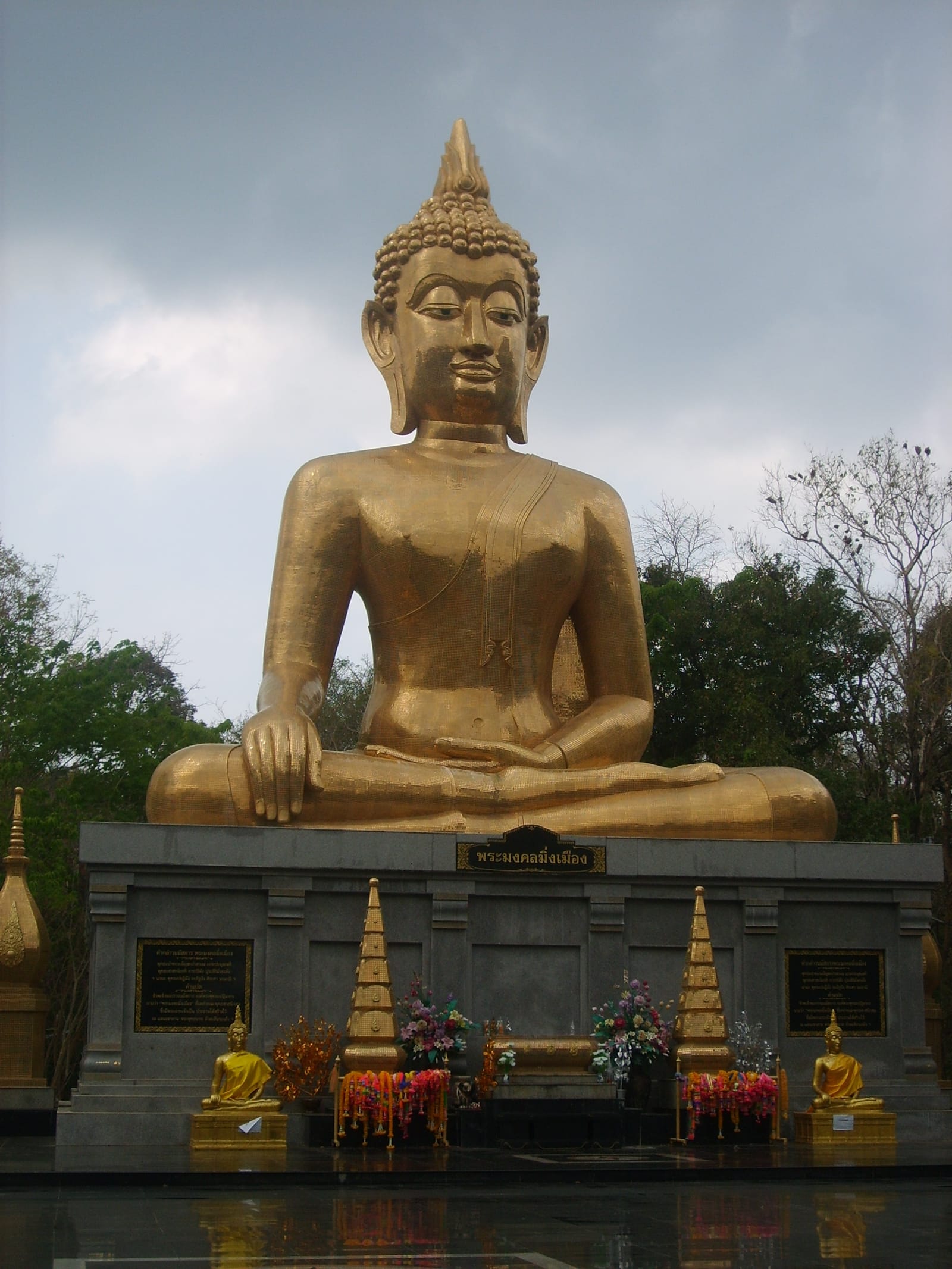
Phra Mongkhon Ming Muang Buddha Park sits on Khao Dan Phra Bat, just off Highway 212 (Amnat Charoen–Yasothon) in Bung sub-district, Mueang district, only about 3 km from Amnat Charoen town. The place many people casually call "the Big Buddha temple" is actually an open-air park, with a natural sandstone floor laced with trees and water pools in tiers. It isn't a walled temple like most, so you can walk all the way around and get a good photo from any angle.
Phra Mongkhon Ming Muang, the province's Big Buddha
The Buddha is in the Maravijaya (subduing Mara) posture, with a lap span of 11 metres and a height of 20 metres from the base to the tip of the flame finial. The whole figure is clad in golden mosaic tiles, so it stands out from a distance the moment you drive into town. The style draws on the Pala art of northern India, which reached the Isan region more than a thousand years ago, which is why its face looks different from the Thai Buddha images most of us are used to.
What you see today is a reinforced-concrete frame built over the original stucco image, designed by the craftsman Chitr Buabusaya around 1965, after the original stucco figure had begun to deteriorate with age. The image enshrines relics of the Buddha brought from India, so locals regard it as the sacred guardian image of the province, coming to pay respect both on ordinary days and on important religious days.
How locals come to pray
People here usually come to ask for blessings around work, study and good fortune — often before starting a business or sitting an important exam. There are spots on the plateau with incense, candles and flowers ready, so you don't have to bring your own. But if you'd rather be self-sufficient, a small set of flowers, incense and candles is easy to pack along.
Want more out of Amnat Charoen? Book tours & activities
Booking online ahead on Klook or GetYourGuide is usually cheaper than the gate and skips the queue. Pick only the experiences you actually want — prices and availability are shown live on each site.
The sandstone plateau and the Phra La Hai images behind
What sets this place apart from Big Buddhas elsewhere is the floor — a wide expanse of natural sandstone on the hillside. Smooth slabs of stone alternate with stands of trees and water channels, and in the late rainy season into early winter, water pools up in the rock hollows in tiers. It's a pleasant place to wander, and the air on the rise is fresher than down in town.
Behind the Big Buddha stand two ancient Buddha images carved from red sandstone, which locals call Phra La Hai (some say Phra Khi Lai). They're in the Dvaravati style, roughly 1,400–1,600 years old, and were unearthed while a reservoir was being built in the area. They're considered especially old and many people stop to pay respect here, particularly asking for good fortune, so once you've visited the main image, don't forget to walk all the way around the back.
Viewpoint over Amnat Charoen town
Because it sits up on the Khao Dan Phra Bat rise, the Phra Mongkhon Ming Muang plateau gives a wide view over Amnat Charoen town. The time locals most love to come up is in the evening before sunset, when the sun softens and the breeze cools — they sit on the stone plateau and watch the town and the sky shift colour. It's a quiet routine plenty of families come up for in the early evening.
- Morning 08:00–10:00 — the sun isn't harsh yet, good for praying and photographing the golden Buddha against the sky
- Evening 16:30–18:00 — pleasantly cool, the best time for the town view and sunset
- Late rainy season into early winter (Nov–Jan) — water pools in the rock hollows, greener than the dry season, nicer atmosphere
Getting there and what to know before you go
From Amnat Charoen town, take Highway 212 heading toward Yasothon. Drive about 3 km and you'll see the golden Buddha on the rise to your right — there are clear signs, and it's easy to turn in and park. The car park is large, taking both cars and buses. If you don't have your own vehicle, a songthaew (shared pickup) or motorbike taxi from town will get you there; it's a short trip so the fare is cheap.
- Opening hours — roughly 08:00–17:00 daily
- Entry — free (there's a donation box for site upkeep)
- Location — Khao Dan Phra Bat, off Highway 212, Bung sub-district, Mueang district, Amnat Charoen (about 3 km from town)
- Parking — large free car park, takes buses
What to wear
This is a sacred site, so dress modestly — skip spaghetti straps or very short shorts. The floor is a wide stone plateau and the midday sun is fairly harsh, so wear comfortable walking shoes and bring a hat or umbrella if you come around noon.
Where to eat nearby
Since it's so close to town, you're only a few minutes' drive back into the centre after praying, where you'll find places to eat. The Amnat Charoen specialty worth trying is khao jee (grilled sticky-rice balls coated with egg), found at morning markets, along with punchy Isan dishes like som tam, larb, koi and fish from the rivers around here. If you come in the morning, stopping at a market in town before heading up to pray works nicely.
Khao jee at the town morning market
Amnat Charoen's local breakfast — grilled sticky-rice balls coated with fragrant egg, just a few baht a skewer. Easy to grab before heading up to pray.
Main mealIsan food in town
Som tam, larb, koi and river fish at spots in town, a few minutes from the Big Buddha. An easy lunch after praying.
Plan a full Amnat Charoen trip — pray, taste local food, explore nature
See the Amnat Charoen travel guide →