🔄 Updated 21 Jun 2026
If you're planning a temple day in Nong Khai, most people think first of Wat Pho Chai with Luang Pho Phra Sai in the town centre, then skip Phra That Bang Phuan because it's well out of town. But Phra That Bang Phuan has been one of Nong Khai's guardian stupas since ancient times. What sets it apart from other temples is that it gives you three layers of things to see: the old stupa itself, the Satta Maha Sathan monuments that tell the full story of the Buddha's life, and a sacred pool where wish-makers come with real intent. You can wander around for the best part of an hour and never feel you've wasted the trip.
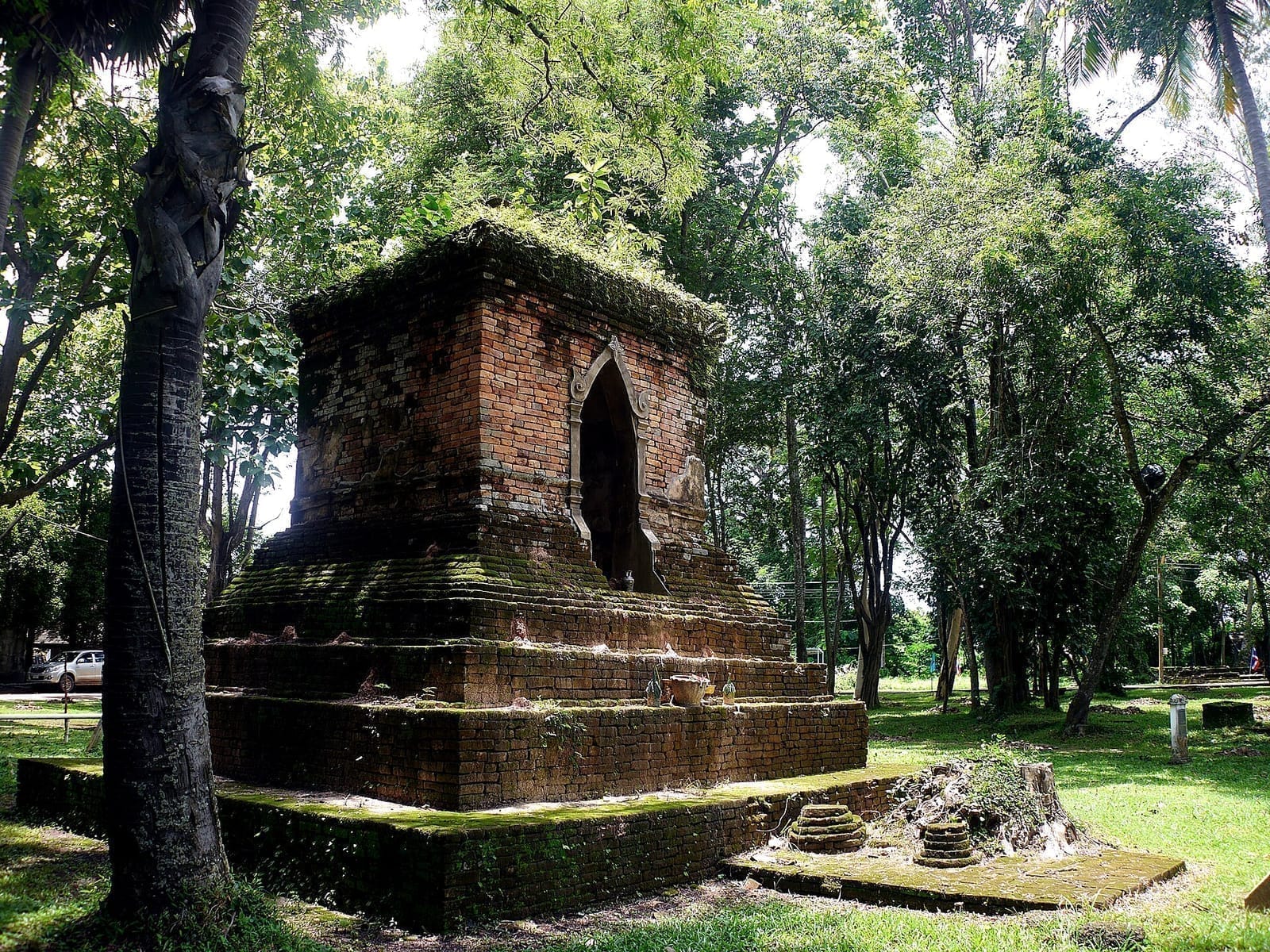
The Phra That Bang Phuan stupa, a Lan Xang-era guardian of the town
The Phra That Bang Phuan stupa is a square-based chedi built from laterite and fired brick, in the Lan Xang style found on both banks of the Mekong. It's believed to enshrine relics of the Buddha brought here and placed inside long ago. What you see today isn't entirely the original, though: in 1970 the stupa collapsed after heavy rain undermined its base, and from around 1977 the Fine Arts Department stepped in to rebuild it to its original shape, which is why it now stands as gracefully as it does.
The mood around the stupa is much quieter and shadier than the temples in town. The grounds run to a hundred-odd rai with big trees for shade, and there's none of the crowding you get at the famous downtown temples. You can pay your respects and take photos at your own pace without competing for an angle. It suits anyone after calm rather than a buzz.
On dress code and timing
This is a temple that hasn't been overrun yet. Late morning to afternoon gives you good light for clear shots of the stupa, but the courtyard around the monuments has little shade, so bring a hat and water. Dress modestly with shoulders and knees covered, since it's a sacred site.
Want more out of Nong Khai? Book tours & activities
Booking online ahead on Klook or GetYourGuide is usually cheaper than the gate and skips the queue. Pick only the experiences you actually want — prices and availability are shown live on each site.
Satta Maha Sathan, the only complete set of seven monuments in Thailand
What really makes Phra That Bang Phuan special is the cluster of small chedis known collectively as the Satta Maha Sathan, meaning the seven great places. They recreate the seven sites where the Buddha dwelt in the bliss of liberation after his enlightenment at Bodh Gaya. All seven are built here, and this is the only place in Thailand where the full set still survives. Elsewhere in the world only a handful remain. Follow the paths through the grounds and you'll find these chedis scattered around the main stupa.
- Bodhi Pallanka — the spot where the Buddha sat and attained enlightenment beneath the Bodhi tree, taken as the starting point of all seven sites
- Animisa Chedi — marks the week he spent gazing at the Bodhi tree without blinking, an act of gratitude to the tree that had sheltered him
- Rattana Chongkrom Chedi — marks the following week, when he walked back and forth in meditation
- Rattana Ghara Chedi — the jewelled chamber where he sat contemplating the Abhidhamma
- Ajapala Nigrodha Chedi — under the banyan tree where he answered a brahmin's questions and faced the temptations of Mara
- Muchalinda Chedi — marks where the naga Muchalinda spread its hood to shield him from the rain, tied to the naga pool in the temple
- Rajayatana Chedi — under the sea-almond tree where two merchant brothers offered him rice cakes, becoming his first lay followers
If you read the signs and walk them in order, it's like a refresher on the Buddha's life in the period just after his enlightenment. You don't have to be devout to enjoy it, because you simply can't see this set of monuments complete anywhere else in Thailand. Anyone who likes history and old architecture should find it especially rewarding.
The Muchalinda pool, the seven-headed naga for wish-makers
Another spot that draws a lot of people is the Muchalinda pool, or what most call the naga pool. It's an ancient pond with a statue of a seven-headed naga standing prominently in the middle. By legend its water is sacred and was once used in important royal ceremonies. Those who come to make wishes usually pay their respects here, asking for fortune, career luck, and things to go their way. Reports have circulated of well-known figures stopping by to make wishes, which has brought the Muchalinda pool wider attention in recent years.
Honest note on making wishes
The Muchalinda pool is a place people come to make wishes in earnest, and on some days there are plenty of incense sticks and offerings. If that's not your thing, you can still walk over to look at the seven-headed naga and take photos as usual. Just don't disturb anyone who's praying, and don't go down into the pool, since it's considered a sacred area.
Getting there and what to know before you go
Wat Phra That Bang Phuan is in Phra That Bang Phuan subdistrict, Mueang Nong Khai district, about 20-23 km from the town centre, roughly a 30-minute drive. The easy route is to head out of town on Highway 2 (Nong Khai-Udon Thani) for about 11 km, then turn right onto Highway 211 (Nong Khai-Tha Bo) and carry on for another 10 km or so. The temple is on the right-hand side of the road, clearly signposted, with plenty of parking.
- Opening hours — open for visitors during the day, every day, roughly 8:00 am to 5:00 pm. It's an open temple, no strict gates
- Entry fee — free, with a donation box if you'd like to give
- Getting there — easiest by your own car or a rental, since it's out of town and public transport is awkward. A motorbike works too, but it's a fairly long ride
- Time needed — about 45 minutes to an hour to see the stupa, the Satta Maha Sathan, and the Muchalinda pool
Tip for making the trip worthwhile
The temple is on the Tha Bo side as you leave town. If you're heading to riverside temples outside the city like Wat Hin Mak Peng or the Wat Pha Tak Suea skywalk, you can fit Phra That Bang Phuan in on the way out or back without doubling into town. It makes for a fuller day than coming all the way out just for this one temple.
Where to go next near Phra That Bang Phuan
Phra That Bang Phuan is on the side of town heading toward Tha Bo and Si Chiang Mai, so it pairs neatly with the temple and riverside spots outside the city. With a car you can fit them all into a single day.
Phra That La Nong (the riverside sunken stupa)
The original stupa that slipped into the Mekong, now visible from the riverbank in town, with a replica at Wat That to pay respects to. Pair it with Phra That Bang Phuan for a tour of the town's guardian stupas.
Wat Hin Mak Peng
A riverside meditation centre founded by Luang Pu Thet Thetrangsi in Si Chiang Mai district. Shady, quiet, with lovely Mekong views, and right on the route out of town toward Tha Bo.
Sala Kaew Ku
A sculpture park of more than 200 giant concrete figures in Wat That subdistrict, about 3 km from town. It's the attraction most people picture first when they think of Nong Khai, and easy to combine with the in-town temples on the same day.
A half-day plan for Phra That Bang Phuan
Temples and wish-making outside town
Back into town and along the river
See hotels and the full Nong Khai travel guide before you set off
See the Nong Khai guide →