🔄 Updated 21 Jun 2026
Phra That Phanom isn't just a famous temple in Nakhon Phanom — it's a spiritual anchor for people across the upper Isan region and for the Lao on the opposite bank. Many travel a long way specifically to pay their respects here. What sets it apart from an ordinary temple is the thousand-year story behind it, the stupa that fell and was rebuilt, and its status as a birthday stupa that draws people born on a Sunday and in the Year of the Monkey who want to visit at least once. You can walk around the stupa, take in the old stucco work, then step out and sit by the Mekong to catch the breeze — all in one spot.
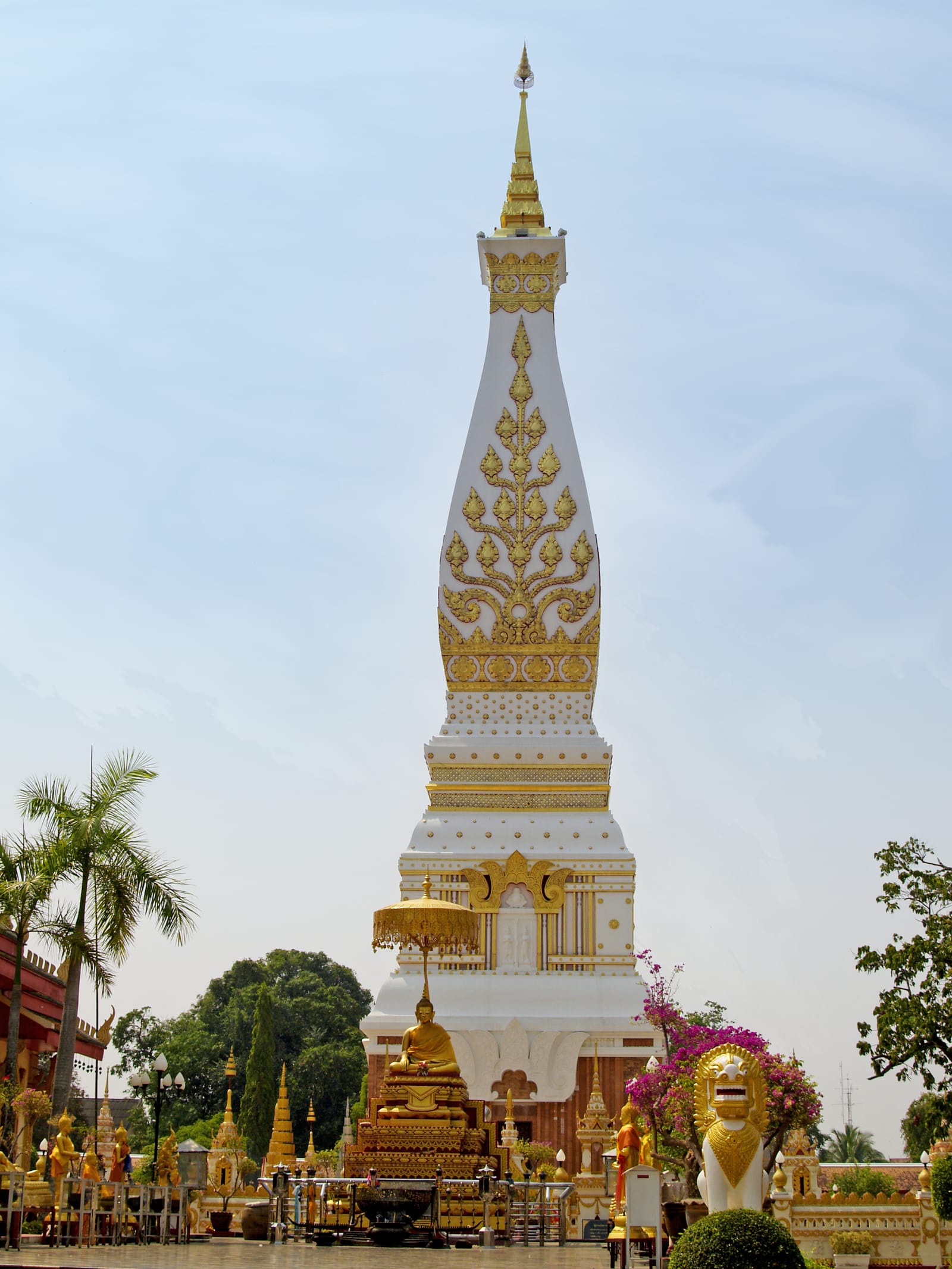
White with a golden spire, 57 metres tall by the Mekong
Phra That Phanom is a square brick stupa with a base roughly 12 metres on each side. The body stands about 53 metres tall, and with the golden tiered umbrella (chatra) at the top adding another 4 metres or so, the total height comes to around 57 metres. The body is painted clean white, contrasting with the gilded umbrella and ornamentation at the spire — which is exactly the image of a white stupa with a golden tip that people picture when they think of Nakhon Phanom. The golden chatra at the top is made from more than 100 kilograms of gold, donated by people from both banks of the Mekong.
The stupa sits on a mound known as Phu Kamphra, beside the Mekong, ringed by tiered low walls. The courtyard around it is broad and smoothly paved, so it's easy to walk in circles. Early morning before the sun gets harsh, and late afternoon near sunset, are when the stupa looks its best — golden light catches the tip of the chatra, and photos capture both the white of the body and the glint of gold at the top clearly.
On dress code and timing
This is a sacred site where people come to worship in earnest. Dress modestly with shoulders and knees covered and you'll be allowed onto every level. You'll need to remove your shoes before stepping onto the stupa courtyard, and the ground can get fairly hot by midday in strong sun — bring socks and it'll be easier to walk. Come in the morning or late afternoon to dodge the noon heat, and you'll find it more comfortable for both photos and paying respects.
Want more out of Nakhon Phanom? Book tours & activities
Booking online ahead on Klook or GetYourGuide is usually cheaper than the gate and skips the queue. Pick only the experiences you actually want — prices and availability are shown live on each site.
A thousand-year history and the day the stupa fell
According to the Urangkha Dhatu legend, Phra That Phanom was built by Maha Kassapa together with arahants and local rulers to enshrine the Buddha's chest-bone relic. Archaeological excavation suggests the original base was likely built around the 12th to 14th Buddhist century — over a thousand years ago — then added to and restored across several eras, including the Lan Xang and Rattanakosin periods. Phra That Phanom is therefore regarded as the model for several other stupas along both banks of the Mekong, and one of the most revered stupas in the Isan region.
The event people remember most is 11 August 1975, at around seven in the evening, when the entire stupa collapsed — the result of cracks that had been building up, combined with heavy rain, strong winds, and the great age of the structure. The news left people on both banks of the Mekong grief-stricken across the whole region. Afterwards, funds were raised and the stupa was rebuilt to its original form, completed with the golden chatra raised back to the spire in 1979. The stupa we see and pay our respects to today is the one rebuilt after that collapse.
A detail many people don't know
While clearing the rubble for restoration, a reliquary holding the Buddha's relics and a large quantity of ancient valuables were found inside the stupa. Some of these are now displayed in the museum within the temple grounds, which you can walk in and see. It gives you a fuller understanding of the stupa's story than just coming to pay respects and leaving.
The birthday stupa for Sunday and the Year of the Monkey
Phra That Phanom is the birthday stupa for those born on a Sunday, and the year-of-birth stupa for those born in the Year of the Monkey. People in these two groups consider visiting Phra That Phanom at least once to be a way of boosting their own good fortune. Anyone not born on that day or in that year can pay their respects just the same — this is a stupa cherished by the whole community, where anyone is welcome to come and ask for blessings, not just those born on a Sunday or in the Year of the Monkey.
Nakhon Phanom also happens to be a province with a full set of birthday stupas for all seven days of the week, plus a stupa for those born on a Wednesday night — eight stupas in a single province. Many people into spiritual merit-making plan a trip to pay respects at their own birthday stupa in Nakhon Phanom, with Phra That Phanom as the main one, then stop by the others matching their family members' birthdays along the way.
How to pay your respects at Phra That Phanom in full
Locals have a way of doing this that's been passed down over time — it isn't complicated, and first-timers can follow along easily. Start by buying flowers, incense, and candles at the shops in front of the temple, then go through this order.
- Walk three times around the stupa — walk clockwise around the stupa courtyard three times, keeping your mind on the Buddha, the Dhamma, and the Sangha as you go.
- Make your wish — find a quiet spot in front of the stupa, light your incense and candles in offering, and set your mind on what you've come to wish for. Most people ask for health, success in their work, and smoothness in life.
- Offer flowers and flower trays — place your flower tray at the spots set up around the stupa as an offering to it.
- Join the robe-draping — if there's a ceremony to drape a cloth over the stupa that day, it's an offering that people make a special point of joining, considered a great act of merit.
- Visit the temple museum — finish by walking through the antiquities found inside the stupa, which will deepen your understanding of its story.
An honest word about asking for blessings
There's no strict ritual to paying respects here — all that's asked is that you do it with a calm mind and respect for the place, so there's no need to worry about getting the steps wrong. During long holidays and the annual worship festival it gets very crowded, so if you want a calm atmosphere and an unhurried visit, try coming on a weekday or early in the morning before the crowds build up.
The annual Phra That Phanom worship festival
Once a year there's a big event, the Phra That Phanom worship festival, held around February — running from the 8th day of the waxing moon of the third lunar month through to the 1st day of the waning moon, nine days and nine nights in all. For 2026, the province is holding it from 26 January to 3 February. During the festival, people from across Isan and from the Lao side travel in to pay respects in huge numbers, with processions, markets, and religious activities throughout. If you want to see the full devotion of people on both banks of the Mekong, come during this time — but be prepared for big crowds and accommodation that fills up fast.
Getting there and what to know before you go
Wat Phra That Phanom Woramahawihan is on Chayangkun Road, in That Phanom subdistrict, That Phanom district, about 50 kilometres south of Nakhon Phanom city. Drive along the highway that runs beside the Mekong for around an hour and you're there — the road is good the whole way. If you're coming from Mukdahan to the south it's closer, about 50 kilometres heading north as well. The stupa sits in the middle of the district and its spire is visible from a distance, so it's easy to find.
- Opening hours — open daily, roughly 05:00–21:00. It opens very early so people can make merit, offer alms, and pay their respects before work.
- Entry fee — no entry fee; there are donation boxes for those who wish to give. Flowers, incense, and candles can be bought at the shops in front of the temple.
- Getting there — the easiest option is your own car or a rental. There are songthaews and vans from Nakhon Phanom city to That Phanom, but allow extra time for waiting.
- Time needed — paying respects, walking around, and seeing the museum takes about 1 to 1.5 hours.
A tip to make the trip worthwhile
Phra That Phanom sits roughly halfway between Nakhon Phanom and Mukdahan, so if you're driving along the Mekong, you can stop to pay your respects on the way without doubling back. Arrive mid-morning to pay your respects, have lunch by the river in the district, then carry on to your next destination — it works out better than coming just for the stupa as an out-and-back trip.
Where to eat and what to see near Phra That Phanom
Around That Phanom district there are riverside restaurants and markets to stop at after paying your respects, so there's no need to rush back to the city. You can sit and eat with a view of the Lao side at an easy pace.
Chom Khong Riverview, That Phanom
A riverside restaurant on the Mekong, not far from the stupa. Sit down to Isan food and river fish with a view of the Lao bank, at reasonable prices. Open around 9:00–20:30 — good for a lunch stop after paying your respects.
Dao Thong Vietnamese Food
A Vietnamese restaurant in That Phanom district, serving naem nueang, rice dishes, and Nakhon Phanom-style gifts to take home. Open around 07:00–20:30 — popular for a meal and for takeaway.
Thai–Lao Market, That Phanom
A market with goods brought over from the Lao side — food, household items, and inexpensive souvenirs. A pleasant browse with a border-town feel, in the district and easy to reach.
Planning a half-day visit to Phra That Phanom
Pay your respects and eat by the Mekong
Carry on to the market and head back to the city
Check out hotels and the full Nakhon Phanom travel guide before you set off
See the Nakhon Phanom guide →