🔄 Updated 21 Jun 2026
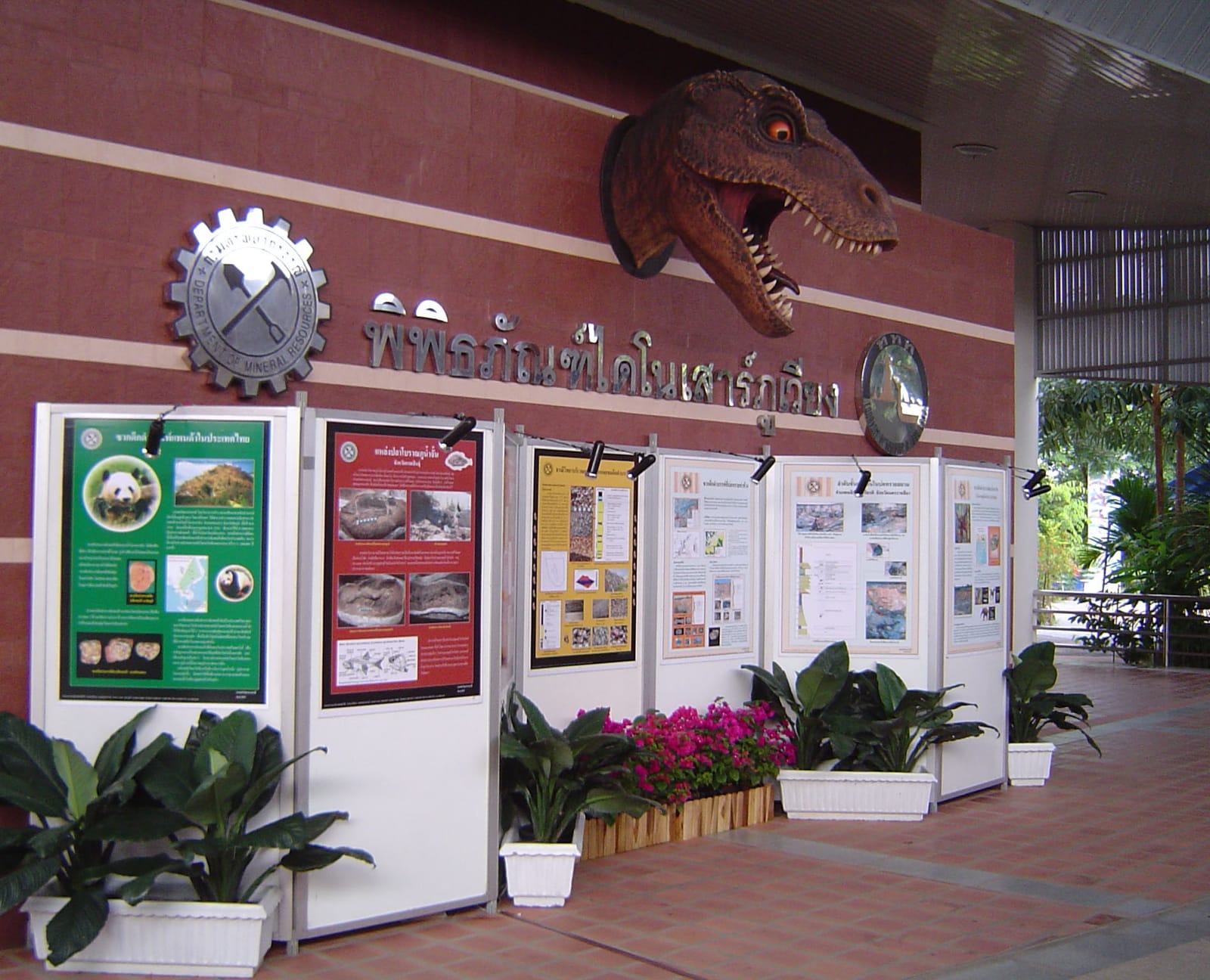
Thailand's dinosaur story genuinely started at Phu Wiang. In 1976 a large bone was found at Phu Pratu Ti Ma, and it was later confirmed to be the first dinosaur bone ever excavated in Thailand. From that point Phu Wiang became a major dig area, eventually turning up a new species named Phuwiangosaurus sirindhornae in honour of Her Royal Highness Princess Maha Chakri Sirindhorn. The museum opened in 2004 as Thailand's first geology museum, and it's still a favourite for families who want to bring the kids to learn about the prehistoric world.
The highlight: real fossils and skeletons you can get close to
What sets Phu Wiang apart from your average dinosaur museum is that the real thing is here. It displays fossils dug straight out of the surrounding ground, including Thailand's first dinosaur bone right in front of you — not just resin replicas. On top of that there are life-size skeleton casts of dinosaurs found in this area, set up so you can walk all the way around them up close, plus a lab where researchers separate bone from rock behind a glass wall. If you come on a day when someone's actually working, you'll see the real process of studying a fossil.
About bringing kids — straight talk
Most kids prefer the Dinosaur Valley zone with its life-size models over the fossil cabinets. If you've got little ones, walk the academic zones quickly and spend more time at the model zone and the outdoor area — it'll be a lot more fun for them.
Want more out of Khon Kaen? Book tours & activities
Booking online ahead on Klook or GetYourGuide is usually cheaper than the gate and skips the queue. Pick only the experiences you actually want — prices and availability are shown live on each site.
What to see: the 5 zones inside the museum
The building is split into 5 zones arranged along the timeline of Earth, so following the route they've laid out keeps the story flowing — from the birth of the universe all the way to the post-dinosaur era. Budget around 1–1.5 hours to walk through the indoor exhibits at a comfortable pace.
Zone 1: Birth of the Universe & Evolution
Covers the formation of Earth, the geological eras, and the extinction of the dinosaurs through video and models. A good primer before you get into the Phu Wiang story.
Zone 2: Phu Wiang Fossils
The heart of the museum. Displays fossils excavated from the actual area, including Thailand's first dinosaur bone.
Zone 3: The Laboratory
A glass-walled lab where you can watch researchers separate bone from rock. A spot kids love to stand and watch.
Zone 4: Dinosaur Valley
A recreated prehistoric forest with life-size dinosaur models of species found in this area. Great for photos and the kids' favourite.
Zone 5: Post-Dinosaur Era & Mineral Resources
Tertiary-period fossils and the geological resources of Isan, wrapping up the route.
The real dig sites on the mountain — you can walk out to them
If you want to see dinosaur bones where they were actually found, you'll need to head up to Phu Wiang National Park, which is in a different spot from the museum itself. On the mountain there are several dig sites developed for visitors — Site 1, Site 2, Site 3 and Site 9, for example. Each one has a shelter built over it with glass so you can look down at dinosaur bones still embedded in the sandstone in their original positions. Walking trails connect the sites, so you can do a loop on foot.
- Site 1 (Phu Pratu Ti Ma) — where the sauropod bones were found that led to the naming of Phuwiangosaurus sirindhornae. The most meaningful site of them all.
- Sites 2 and 3 — fragments of sauropod bone in the sandstone, a continuation from Site 1 along the prepared trail.
- Site 9 — another dig point with a shelter and glass so you can view the bones in their original position.
- Walking trails — there are paths linking the sites and you can see them all on foot, but it's a natural trail on the mountain, so wear comfortable walking shoes.
Plan before heading up the mountain
The museum sits at the foot of the mountain, while the dig sites are up in the national park — two separate places. If you mean to see both in one day, leave half a day to a full day, and check with the park about site access first, because some sections are occasionally closed for excavation work or maintenance. You can ask the museum at 081-846-2760.
Tickets, opening hours and what you need to know
- Opening hours — Tuesday–Sunday, 09:30–16:30. Closed Mondays (arrive before 15:30 to give yourself time to see everything).
- Ticket (Thai nationals) — adults 20 THB, children 10 THB.
- Ticket (foreign visitors) — adults 60 THB, children 30 THB.
- Location — Nai Mueang, Wiang Kao district, Khon Kaen 40150.
- Contact — 081-846-2760 (office), 081-845-8628 (activities/guided tours).
- Time needed — around 1–1.5 hours in the museum; allow half a day if you include the hillside dig sites.
The entry fee is very cheap for what you get to see — a learning-focused attraction that's great value for families. There's also an outdoor area and dinosaur photo spots on site where kids can run around.
Getting there from Khon Kaen city
Phu Wiang is fairly far from the city, about 80 km away, roughly 1 hour 40 minutes by car. The main route is out of the city on Highway 12 (Khon Kaen–Chum Phae), passing through Ban Fang and Nong Ruea districts, to the Phu Wiang turn-off at around 48 km, then onto Highway 2038 for about another 22 km to Phu Wiang district, and another 10 km or so to the museum in Wiang Kao district.
- Private car / rental — the easiest option, since the site is far from the city and there's no public transport going directly there. Just open Google Maps and search for Phu Wiang Dinosaur Museum.
- Chartered car / taxi — if you're not driving yourself, you can charter a car from the city for the round trip; negotiating a day rate is better value given the distance.
- Pair it with other stops — Phu Wiang is far out, so it's worth pairing with other Isan attractions along the same route, or staying a night around Chum Phae / Phu Wiang if you also want to visit the dig sites in the park.
An early start is best
Because it's a long drive and the museum closes at 16:30, leaving the city in the morning makes for the most relaxed day — you'll have time for both the museum and the dig sites. Leave in the afternoon and you may only manage the museum itself. And don't forget it's closed Mondays.
Plan a full Khon Kaen trip
See the Khon Kaen travel guide →