🔄 Updated 21 Jun 2026
If you thought Kalasin was all about dinosaurs, Ban Phon is the other side worth a stop. This isn't just a fabric shop — it's a community where Phu Thai women still sit at the loom and weave as part of everyday life. Each piece of praewa takes a month to weave, some take a year, because every line of the pattern is picked up by hand, not by machine. Once you see with your own eyes what goes into a single piece, the prices that once felt steep start to make a lot more sense.
What is praewa, and why call it the Queen of Silks?
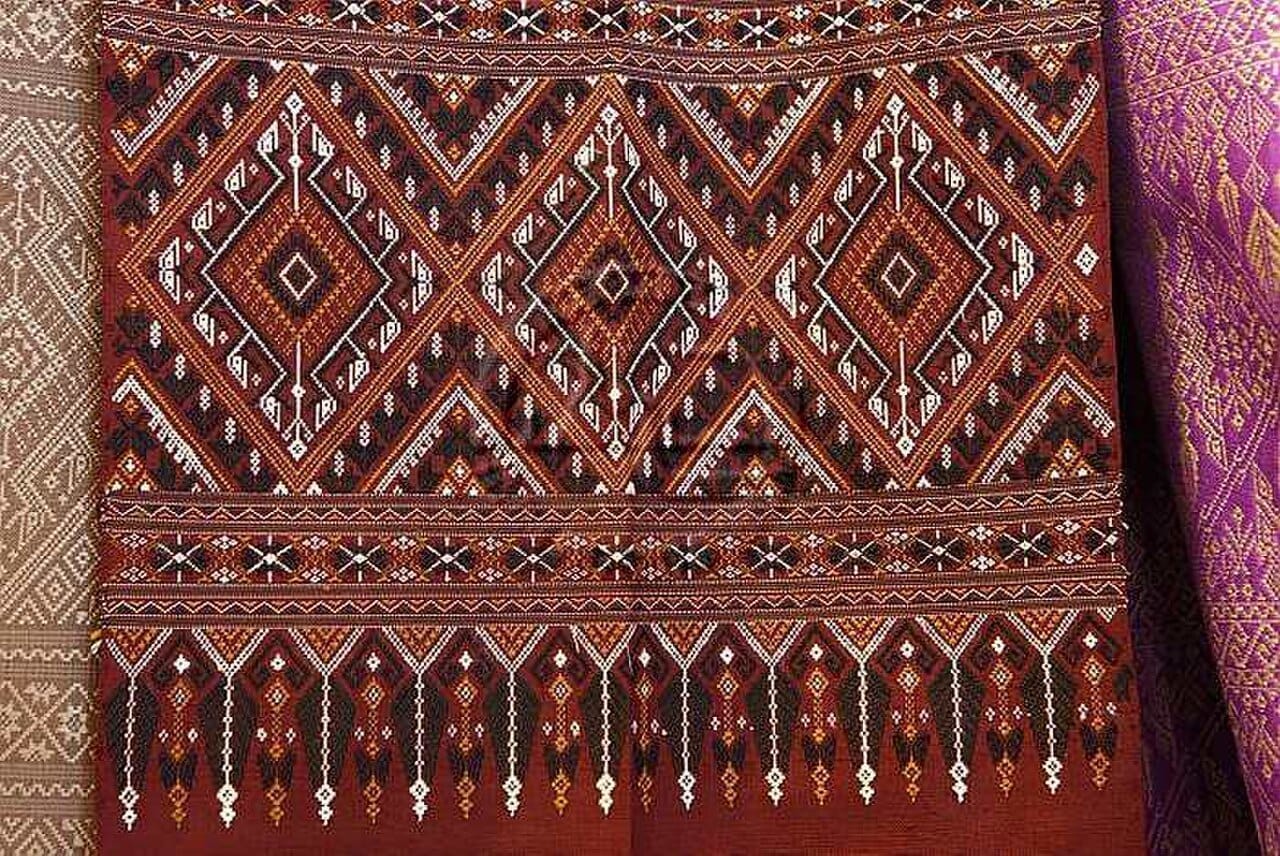
The word praewa comes from phrae (silk) + wa (a unit of length). It originally referred to a shawl about one wa long that Phu Thai women draped over one shoulder at merit-making ceremonies and important occasions. The patterns come entirely from picking up the threads by hand, which makes the designs dense, fine, and dimensional in a way machine-woven cloth struggles to copy. That's why people in the Thai textile world crowned it the Queen of Silks.
The turning point for Ban Phon came in 1977, when Her Majesty Queen Sirikit the Queen Mother visited local people in Kham Muang district and saw the Phu Thai praewa cloth. She took it under the SUPPORT Foundation, encouraging weavers to make full lengths of fabric instead of just shawls. What had been household work became a livelihood that supports the whole community to this day.
- Main pattern — the large central motif, the star of the cloth, such as the naga pattern or community-specific floral designs.
- Divider pattern — smaller patterns set between rows of the main motif, giving the cloth a sense of rhythm.
- Border pattern — the bands along both edges of the cloth that frame and complete the piece.
Want more out of Kalasin? Book tours & activities
Booking online ahead on Klook or GetYourGuide is usually cheaper than the gate and skips the queue. Pick only the experiences you actually want — prices and availability are shown live on each site.
The weaving steps you get to see for yourself
The charm of coming to the source is getting to sit and watch real weavers, not just read a sign. The weaver can explain what each step does and why it's so slow. Praewa breaks down into three main techniques by difficulty: luang (the simplest), chok, and ko (the hardest and most expensive).
Raising silkworms & reeling silk
It starts with raising silkworms on mulberry leaves. Once they spin their cocoons, the cocoons are boiled and the silk is reeled out into long threads. Some communities still reel by hand; others buy thread to weave with. Good silk thread is shiny and strong.
Dyeing
The silk threads are dyed in the colors they'll be used in — both chemical dyes and natural ones from lac, tree bark, and indigo. A single piece of praewa uses anywhere from 2 to 9 colors; the more colors, the more complex the pattern.
Pattern picking (kep khit)
The heart of praewa. The weaver uses her little finger and a pick-up stick to lift the silk threads one at a time into the pattern she wants. This is the most time-consuming step — the finer the pattern, the slower it goes.
Chok / ko color insertion
A technique of threading multicolored silk into the cloth point by point, so a single row can carry several colors. The ko pattern uses this technique the most, which is why it's the most expensive cloth.
Working the loom into cloth
Once a row of the pattern is picked, the weaver presses the treadles, passes the shuttle, and beats the reed to pack the threads tight. She repeats this row by row until the piece is full. That's why a single wa of cloth takes a month.
Know what to look for
Try flipping the cloth over and looking at the back. If it's genuine handwoven praewa, you'll clearly see the knots and the pattern threads on the reverse — not the smooth back of printed or machine-woven fabric. This is the easy trick buyers use to spot the real thing.
Buying praewa at Ban Phon — how to choose, what it costs
Praewa prices swing very widely, from small pieces in the hundreds of THB to full lengths in the tens of thousands or even hundreds of thousands, depending on the technique, the number of colors, and the fineness of the pattern. Pieces entered in competitions and award winners have been priced as high as 45,900 THB each, while some special handwoven pieces that took years to make climb into the millions. But don't worry — there are small starter pieces here you can buy as souvenirs without straining your wallet.
Scarves / small shawls
The popular starter piece — practical to use and easier on the wallet than a full length. Great for a first gift.
Tube skirts / dress lengths
Full lengths for tailoring a shirt or tube skirt, with rich, beautiful patterns. This is what serious buyers come for.
Home décor
Table runners, placemats, keychains, and praewa fabric bags — small, affordable pieces that are easy to buy several of.
- Check the technique — luang patterns are the cheapest, chok a step up, and ko the most expensive because of its many colors and difficulty.
- Count the colors — the more colors in a single piece, the longer the pattern took to pick and the higher the price.
- Ask about the origin — at Ban Phon you can ask the seller straight out who wove it and how many months it took, information shops in town usually can't give you.
- Ask for certification — Kalasin praewa is a GI product, and some shops have a certification mark for genuine cloth. Ask before buying an expensive piece.
How to get there, opening hours, and what to do nearby
Ban Phon is in Ban Phon subdistrict, Kham Muang district, about 70–80 km from Kalasin town — roughly an hour or so driving north, on good roads the whole way. The village has a Phu Thai cultural center, a SUPPORT Foundation crafts center, and homes that open up for you to watch the weaving. Just ask the locals which house is weaving that day.
- Getting there — the easiest way is to drive or rent a car from Kalasin town. Public transport is hard to reach here, so a private car is recommended.
- Opening hours — most shops and weaving houses are open during the day in office hours. Come morning to early afternoon and you'll catch the weavers at the loom.
- Call ahead — the Phu Thai Cultural Center, Praewa Silk, Ban Phon, tel 043-856-157 or 089-841-2440. Call first to be sure of the opening days.
- Keep exploring — from Kham Muang you can drive on to Lam Pao Dam, the Sirindhorn Museum, or Phu Kum Khao, making a one-day trip that blends culture with nature.
Insider tip
If you want to see the full weaving process in detail, try contacting ahead to say you'd like a demonstration. Some homes are happy to walk you through it from start to finish, usually without charging an entry fee. Buying a piece of cloth is the best way to say thank you.
Plan a Kalasin trip combining Ban Phon, Lam Pao Dam, and the dinosaur museum all in one go.
See the Kalasin travel guide →