🔄 Updated 21 Jun 2026
Pua sits about 60 km north of Nan town, roughly an hour and a half by car along Highway 1080. You'll pass through Tha Wang Pha on the way, which has a few good stops of its own. Pua's appeal isn't a big headline landmark — it's the slow rhythm of the Tai Lue villages, rice fields that change colour with the season, and temples that are still woven into everyday village life.
The Tai Lue are an ethnic group who migrated from Sipsongpanna (Xishuangbanna) several hundred years ago and settled around Pua and Tha Wang Pha. They left their mark on the language, the flowing-water (lai nam lai) woven textiles, the food, and a low-eaved, multi-tiered temple roof style you rarely see anywhere else.
Tai Lue temples and viewpoints worth stopping for
Wat Sri Mongkol (Wat Kong)
One note first: this temple is in Tha Wang Pha, not Pua proper, but it sits right on the road into Pua, so it usually gets counted as the first stop of the trip. The highlight is the deck behind the temple looking out over a wide spread of green rice fields, with the layered ridges of Doi Phu Kha behind. There's a bamboo bridge and the Hug Na Nan cafe where you can walk down and take photos out in the paddy.
Wat Phuket
Set on a rise, with a terrace behind the temple that juts out over a broad valley of rice fields and a full view of the Doi Phu Kha range. It's the spot early risers come to catch the sunrise. The front of the viharn is decorated with bright coloured glass, and there's a fish pond and a small market below to wander.
Wat Nong Bua
An old Tai Lue temple people mostly come for the murals. The viharn is the low, squat Tai Lue style, and inside there are Jataka-tale paintings by local craftsmen with details that are still sharp. It's a temple to walk through quietly and take your time with.
Wat Ton Laeng
An old Lanna–Tai Lue temple. The standout is the viharn's low-sloping wooden roof in three stacked tiers, topped with a three-headed naga — a hard-to-find example of Tai Lue architecture. In the early morning the light filtering into the viharn is gorgeous.
Wat Rong Ngae
An old temple that has won conservation awards. What people love to photograph are the doors and the wooden vent panels carved with fine floral fretwork — local craftsmanship that's been well preserved. Worth a stop if you have extra time.
Temple tips
Wat Phuket has its best view in the early morning before 8am, while the sun is still soft and there's a thin mist over the fields. Go late and you'll be shooting into the sun with crowds around. Put Wat Phuket first on your day's list to make the most of it.
Want more out of Nan? Book tours & activities
Booking online ahead on Klook or GetYourGuide is usually cheaper than the gate and skips the queue. Pick only the experiences you actually want — prices and availability are shown live on each site.
Terraced rice fields and Tai Lue life
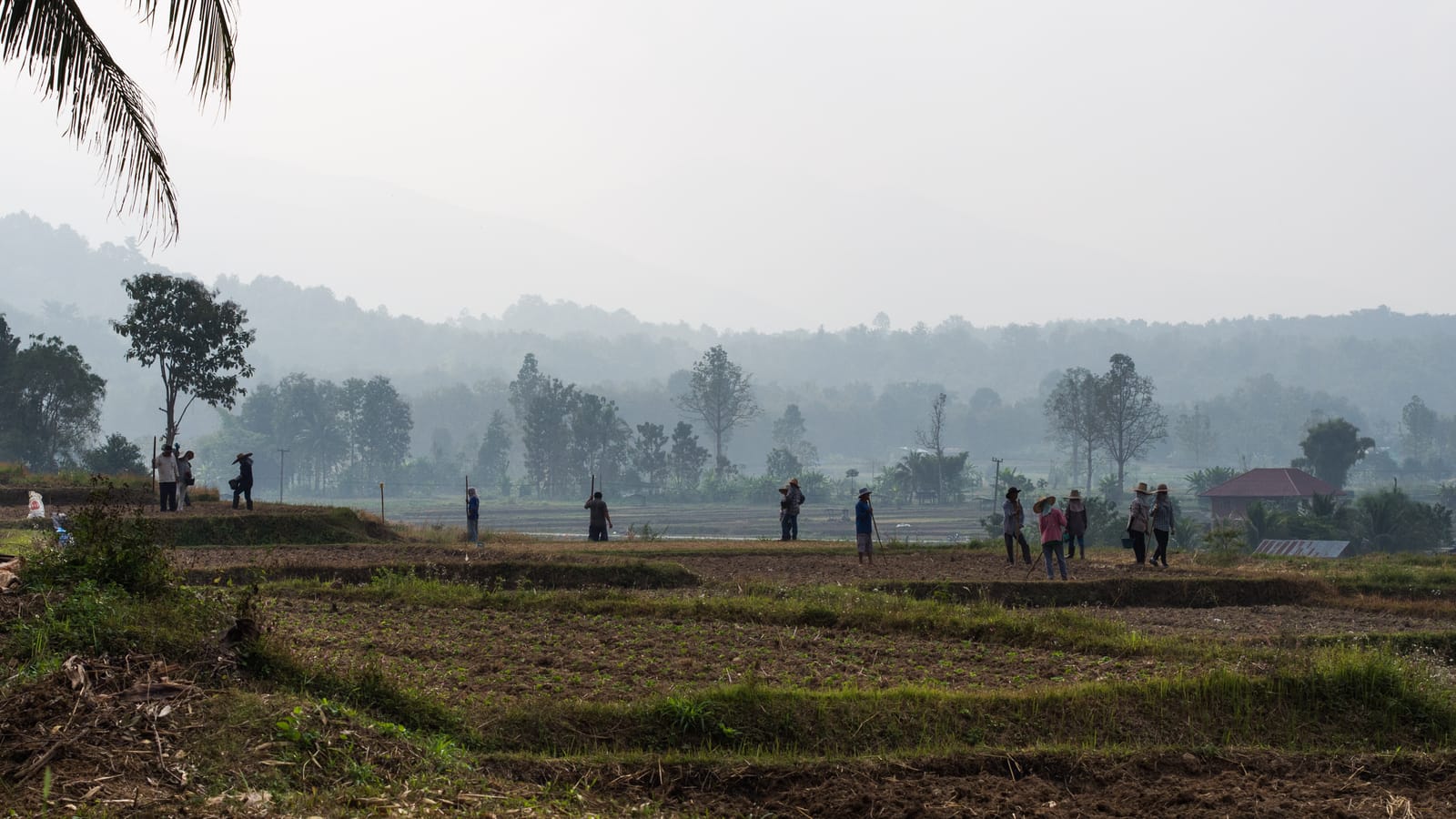
The rice fields in Pua aren't the giant terraces of Bali or Vietnam — they're paddies that step gently down low hills, easing through the levels in their own pretty way. The clearest views are around Wat Phuket and Wat Sri Mongkol. The colour of the fields changes month to month, so it's worth timing your trip to match the look you want.
- Lush green — roughly July to September, when the rice is growing and the whole valley is deep green. This is also when the morning mist is heaviest.
- Golden fields — late October to November, when the rice ripens to gold just before harvest. This is the most popular window for photographers.
- After harvest — December to January, when the fields are bare stubble and the air is cool and comfortable — but the scene won't be the green or gold of the first two windows.
Walking through the Tai Lue villages around Sila Laeng and Tha Wang Pha, you'll see raised wooden houses, looms under the houses, and shops selling the genuine handwoven flowing-water textiles. Tai Lue weaving makes a souvenir you can buy with a clear conscience, because you can see exactly where it came from.
About the textiles
If you want genuine handwoven cloth at a fair price, try the shops inside the villages rather than the tourist stalls. Many houses will show you the actual weaving process, and the price is negotiable based on the work that went into it.
Rice-view cafes that make the early start worth it
Pha Coffee (Pha Four Four)
A wooden-house cafe where you sit looking out over the rice fields and the mountains — one of Pua's most popular spots. Coffee runs about 60–90 THB; come early for the best view before it fills up.
Baan Tai Lue Coffee
A homey little place in Sila Laeng subdistrict, set in the middle of the fields with mountains behind and a Tai Lue feel to the decor. Good for settling in for a long morning.
Cocoa Valley
A cocoa cafe using cocoa grown in the area, with cocoa drinks and desserts and views over the garden and fields. A good mid-morning break.
Hug Na Nan (behind Wat Sri Mongkol)
A coffee spot out in the paddy, reached by the bamboo bridge from Wat Sri Mongkol. Sip your coffee and shoot the rice fields in the same spot.
The nice thing about Pua's cafes is that most open early to catch the crowd coming down from Wat Phuket. Plan the order well and you can have the temple sunrise and a rice-view coffee in the same morning. Just be aware that many are small spots, so on long weekends they get busy and the good view seats fill up fast.
An unhurried 2-day, 1-night Pua trip
From Nan town up to Pua
Sunrise at Wat Phuket, then on to Phu Kha
Getting around
Pua is easiest with your own car or a rental from Nan town. Public transport is sparse and inflexible. If you're not driving, hiring a car with a driver for the day is far smoother — especially if you plan to continue up to Doi Phu Kha.
Plan a full Nan trip covering both the old town and Pua
See the Nan travel guide →