🔄 Updated 21 Jun 2026
The Sa Morakot ancient site sits within the cluster of Si Mahosot old town in Si Mahosot district, Prachinburi province, about 20 km southeast of Prachinburi town. The Fine Arts Department has registered the site and excavated here on and off for decades. The real draw isn't Angkor-style grandeur — it's the age and the layers of history stacked on the same ground, both Dvaravati and ancient Khmer. History buffs get genuinely absorbed here, while anyone just out for a day trip still gets a calm atmosphere under the big shade trees.
Si Mahosot — a city 1,500 years old
Before heading in to see Sa Morakot, it helps to picture the bigger setting: all of this lies within "Si Mahosot," a large Dvaravati-period ancient city. The town plan is oval to rounded-rectangle in shape, covering roughly 742 rai, ringed by a moat and earthen city walls. Inside the walls are mounds, ponds, wells, and the remains of hundreds of religious structures. Archaeologists have found that the city's development dates back to before the 6th century CE — over 1,500 years ago — contemporary with the Funan culture.
What makes the city so interesting is that it wasn't tied to a single religion. The area holds traces of both Dvaravati Buddhism and Brahmin–Hindu shrines, with sandstone deity images carved as Narayana, Vishnu, and Ganesha — a sign that this was once a crossroads of trade and many faiths.
Want more out of Prachinburi? Book tours & activities
Booking online ahead on Klook or GetYourGuide is usually cheaper than the gate and skips the queue. Pick only the experiences you actually want — prices and availability are shown live on each site.
Sa Morakot — an ancient pond in the woods
Sa Morakot itself is a large ancient pond cut down into the natural laterite layer, measuring roughly 115 by 214 meters and about 3.5 meters deep. Archaeologists believe digging the pond served two purposes at once: it was a water reservoir for the city, and a quarry where laterite was cut to build the various religious structures around town. These days the surface is often dotted with patches of lotus, and the shaded banks ringed by big trees make it an easy, pleasant walk around the edge.
Why it's called Sa Morakot
The name "Sa Morakot" (Emerald Pond) comes from the water's color, which looks clear green at certain times of year. It has nothing to do with the Emerald Pool in Krabi, which is a hot spring in a completely different place. When you search for info, add "Prachinburi" or "Si Mahosot" so you don't end up looking at Krabi by mistake.
The twin Buddha footprint — the highlight here
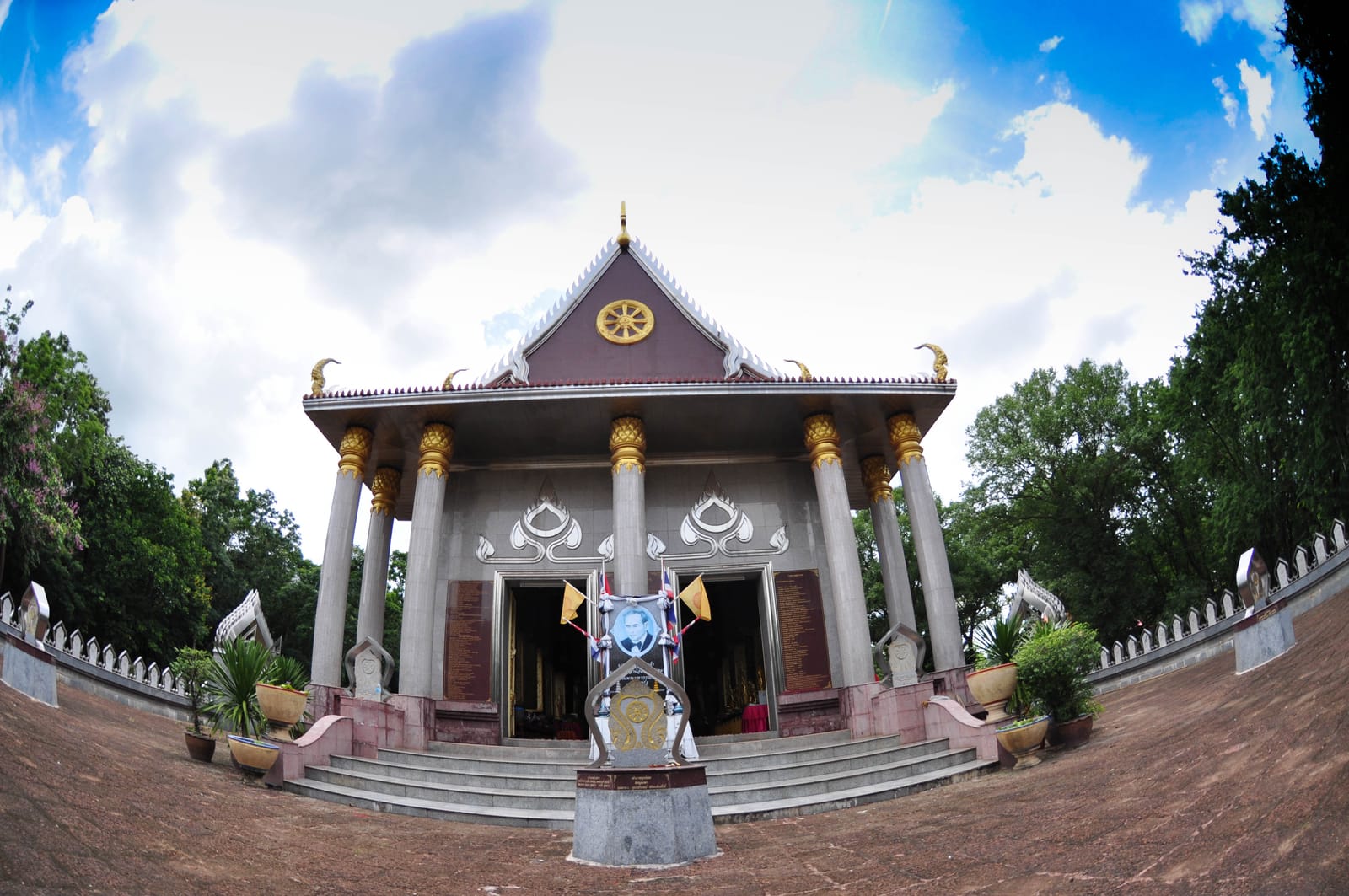
What most people come specifically to see is the twin Buddha footprint near the edge of the pond. It's carved down into the natural laterite as a pair of footprints, made to look like real feet — the toes are of uneven length and not perfectly aligned. The center of each sole is carved with a Dharmachakra (wheel of law), the prints are encircled by a ring, and between the two feet a cross-shaped channel is cut with a round hollow in the middle.
Scholars estimate the twin footprint dates to around the 9th century CE, made as a paribhoga chedi in the Sinhalese tradition to mark that Buddhism once spread to this land. It's considered the oldest Buddha footprint ever found in Thailand. The print was uncovered during a survey around 1986. People who reach this spot tend to stand and look a while — because it's the real thing, over a thousand years old, right in front of you.
Etiquette when visiting
The twin Buddha footprint is a place of worship, and locals and pilgrims come to pay their respects regularly. Take off your shoes before stepping onto the footprint platform, dress modestly, and don't step on the print or set anything on it. If you take photos, do so respectfully.
Sacred well + surrounding ruins
Near the footprint platform there's an ancient well, bored down into the natural rock layer, with a mouth about 120 centimeters wide and around 10 meters deep. This well holds national importance: in 2019 it was chosen as one of Prachinburi province's sacred water sources for use in the Royal Coronation ceremony.
On top of that, excavations in the area have revealed two eras layered together — the Dvaravati period (which the twin footprint belongs to) and the ancient Khmer Baphuon period. Finds include carved stone pillars, Buddha images in the meditation posture, Buddha images sheltered by the Naga, earthenware vessels, and various architectural fragments, some of which are now displayed at the Prachinburi National Museum. Walking among the scattered laterite remains, you can see this really was a large religious complex.
- Twin Buddha footprint — the main highlight, carved into laterite with a Dharmachakra at the center of each sole, the oldest in Thailand
- Sa Morakot pond — a large ancient pond cut into laterite, shady and dotted with lotus
- Sacred well — its water was used in the 2019 Royal Coronation ceremony
- Laterite religious ruins — traces of Dvaravati and Khmer Baphuon scattered around the grounds
- Exhibition building — displays of artifacts and a model of the ancient city
How to make the most of it — half a day is just right
History lover's Si Mahosot route
Si Maha Phot Bodhi Tree
An ancient bodhi tree believed to be grown from a sapling brought from Bodh Gaya, not far away — a great pairing for a history-focused trip
In townChao Phraya Abhaibhubejhr Hospital
An old Baroque-style building and herb garden in Prachinburi town — an easy afternoon add-on
Getting there, opening hours, and good to know
- Location — Si Mahosot district, Prachinburi province, about 20 km southeast of Prachinburi town
- From Bangkok — roughly a 2–3 hour drive via the motorway/Highway 304, then Highway 319 into the Si Mahosot area
- Getting around — a private car is easiest, since the sites are spread out and public transport is hard to reach them with
- Opening hours — generally open during the day (around 08:30–16:30); it's worth checking with the local office first, and Buddhist holy days can draw extra crowds of worshippers
- Entry fee — usually free, but it's good to bring some cash for a merit donation as you see fit
- What to bring — comfortable walking shoes, sun protection, and drinking water, since there's a fair bit of walking out in the open
When it gets crowded
The Makha Purami Si Prachin festival around Makha Bucha Day (February) brings a big merit-making event around the twin Buddha footprint — crowded and lively. If you want a quiet visit with relaxed photos, avoid that period. But if you'd like to see the local tradition, that's exactly the time to come.
Plan a full day in Prachinburi
See the Prachinburi travel guide →