🔄 Updated 21 Jun 2026
Samui packs a lot of different trips into one island. Beach people get long stretches of sand along the east coast; if you're into temples or photo spots, there are shrines and viewpoints; and anyone who wants to get out on the water can take a boat to Ang Thong. This guide runs zone by zone — starting with the popular beaches, moving through the temples and natural spots, and finishing with the boat trip out to the islands, plus a short sample plan you can adapt yourself.
Chaweng and Lamai — the two main east-coast beaches
Chaweng is the longest and liveliest beach on the island — fine white sand, clear water, and a continuous run of restaurants, bars, and places to stay along the back of it. It suits anyone who wants the beach plus some nightlife. Lamai sits just to the south, quieter and more laid-back, better if you'd rather sunbathe somewhere calm.
- Chaweng — the longest, busiest beach, packed with restaurants and live music at night, with a wide range of stays from guesthouses to beachfront resorts
- Lamai — quieter, soft sand, good for sunbathing and swimming, with the Hin Ta Hin Yai rocks at the southern end
- Both beaches are free — no entry fee, though some beachfront bars set a minimum spend if you want to use their loungers
Before you get in the water
During Samui's monsoon season (roughly Oct–Dec) the sea can get rough and cloudy, and some days there are warning flags up. Always check the forecast and look for the beach flags before going in. The east coast — Chaweng and Lamai — tends to catch more of the swell during this period than the other sides of the island.
Want more out of Koh Samui? Book tours & activities
Booking online ahead on Klook or GetYourGuide is usually cheaper than the gate and skips the queue. Pick only the experiences you actually want — prices and availability are shown live on each site.
Big Buddha (Wat Phra Yai), the north-coast landmark
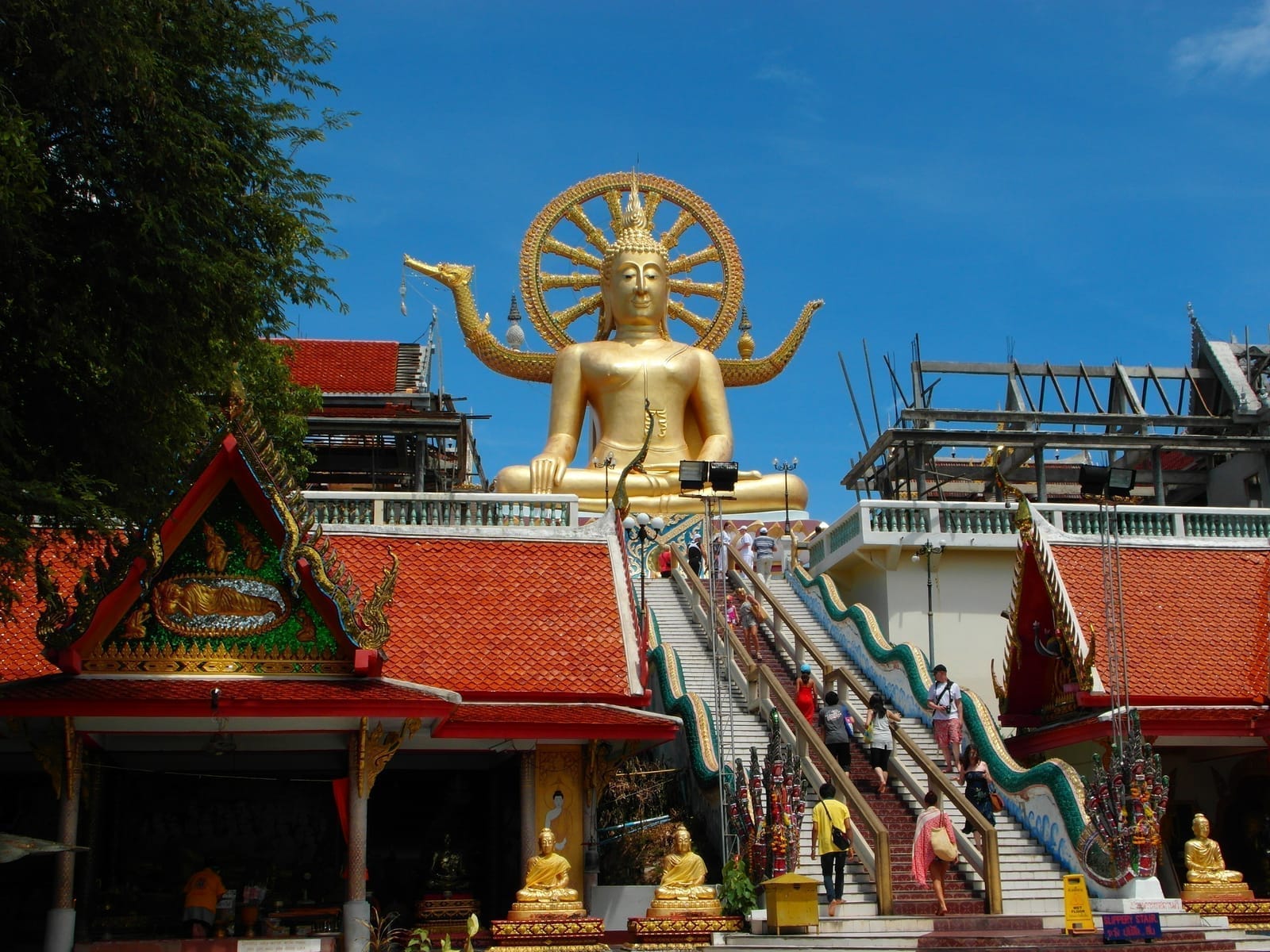
The Big Buddha temple sits on a small island off the north coast near Bophut, with a large golden seated Buddha around 12 metres tall that you can spot from a distance when your plane comes in to land or as you arrive by boat. Climb the naga staircase to pay your respects at the top and you'll get sea views all around as well.
- Opening hours — roughly 06:00–18:00 daily, free entry (there's a donation box if you'd like to give)
- Dress code — cover your shoulders and knees, and take your shoes off before going up into the building, the same as any Thai temple
- Nearby — pair it with Wat Plai Laem, which is a short drive away, in the same trip
When to go
Go in the morning or toward late afternoon — the sun is gentler and it's less crowded than midday. Bring a shoulder wrap in case you've turned up in a sleeveless top, so you don't have to borrow one on the spot.
Hin Ta Hin Yai, the oddly shaped rocks at the end of Lamai
Hin Ta Hin Yai is a cluster of seaside granite rocks at the southern end of Lamai beach, weathered by nature into shapes that resemble male and female genitals — which is exactly why so many people stop to take photos. There's a local legend tying them to a grandfather and grandmother whose boat wrecked on the way to ask for a girl's hand in marriage. It's also one of the island's prettier sunset spots.
- Free entry — walk down from the car park past the souvenir stalls straight to the rocks
- Watch your footing — the rocks get wet and mossy, so shoes with grippy soles help, and don't climb out where the waves reach
- Combine it — it's right by Lamai beach, so you can roll it into the same part of your day
Bophut and the Fisherman's Village
Bophut is an old neighbourhood on the island's north coast, and its highlight is the Fisherman's Village — a narrow seaside street lined with old wooden buildings, restaurants, cafés, bars, and shops. It's a pleasant stroll any day of the week, and it gets especially busy on Friday nights when it turns into a walking street.
- Friday walking street — opens Friday evenings, roughly 17:00–23:00, with food, souvenirs, clothes, and live music (the road closes to traffic on Fridays — it's walking only)
- Weekdays — the shops are still open and it's an easy stroll, with fewer people than Friday
- Dinner by the sea — there are seafood restaurants and sea-view cafés where you can settle in for the sunset
Nature spots — Na Muang Waterfall and Lad Koh viewpoint
If you want a break from the beach and some nature in the island's interior, Na Muang Waterfall sits in the middle of Samui. It has two tiers — the first is an easy drive up to, the second takes a bit of a walk into the forest — and entry is free. Lad Koh viewpoint is on the coastal road between Chaweng and Lamai, an easy place to pull over and photograph the bay.
- Na Muang Waterfall — open roughly 09:00–18:00, free entry · tier 2 means a forest walk, and the path is slippery in the rain, so wear trainers
- Lad Koh viewpoint — free entry, with a pavilion and a path down to the clifftop, looking over the east-coast bay
- A note on elephants — around Na Muang you'll be offered elephant trekking, and some operators raise concerns about animal welfare, so skip it if it doesn't sit right with you
Ang Thong Marine Park — the boat trip out to the islands
If you have a full day to spare, Ang Thong National Marine Park is Samui's big day out on the water. It's an archipelago of more than 40 limestone islands, with an emerald sea inside the mountains (a saltwater lake in the middle of the main island), clifftop viewpoints, white-sand beaches, and snorkelling spots. It's a roughly 1–2 hour boat ride out from Samui, depending on the type of boat.
- Park entry fee — around 300 THB for adults, 150 THB for children (most tours include this already, but check before you book)
- Big boat — from around 1,000–1,400 THB/person, comfortable to ride and takes longer to get there, better if you get seasick easily
- Speedboat — from around 1,800–2,500 THB/person, faster and gives you more time on the islands, but a bumpier ride
- Activities — hiking up to viewpoints, kayaking, and snorkelling, depending on the package
Before you book a boat trip
Ang Thong closes for part of the monsoon season (usually around Nov–Dec), and trips can be cancelled if the sea gets rough · tour prices swing with the season and group size. Always check the forecast, the operator's reputation, and the life jackets before you get on the boat. If you get seasick easily, take something about half an hour before you set off.
Try planning your island loop like this
If you're not sure where to start, here's a rough outline you can lay out and then adjust around your accommodation and the weather.
North zone + beach
Inland + south
Out to sea at Ang Thong
Want a well-located place to base yourself for the island loop?
See 10 Samui hotels worth booking →