🔄 Updated 21 Jun 2026
Start with the big picture. There are two main ways to reach Samui: flying direct into the island's airport, or car/bus + ferry via the mainland at Surat Thani. Which one suits you depends on your budget and how much time you have. Once you're on the island you still need to figure out how you'll get around, because Samui has no city-style public bus system, and most fares on the island are negotiated rather than set by a fixed meter. We'll walk through it one piece at a time.
Option 1 — Fly into Samui Airport (USM)
The fastest and most comfortable option. Samui Airport is a privately run airport operated by Bangkok Airways — it's an attractive open-air, resort-style terminal in the north of the island around Bophut and Bang Rak, near the Big Buddha and Chaweng Beach. The flight from Bangkok (Suvarnabhumi) takes a little over an hour.
- Airlines: Most flights are Bangkok Airways, which runs several Bangkok–Samui services a day. More recently Thai Airways and a few other carriers have added some flights, and there are a handful of direct international routes too, such as Singapore, Malaysia and Hong Kong.
- Ticket prices: Clearly pricier than other islands, because there aren't many airlines and the airport is privately owned. A one-way Bangkok–Samui fare swings roughly 1,800–6,000 THB depending on when you book and the season. Booking well ahead helps a lot.
- Airport to your hotel: There are airport shuttles and minivans running to the main zones — Chaweng is about 10–15 minutes away, Lamai a bit further. Fares are charged by zone, so ask the price before you get in.
About Grab and the airport
Grab works on Samui, but it cannot pick up passengers inside the airport grounds. To save money on arrival, book a transfer in advance with your hotel, or use the airport's own transport counter. Don't stand around the airport tapping Grab and wondering why no car shows up.
Option 2 — Bus/car + ferry via Donsak/Surat Thani
A lot cheaper than flying direct, and a good fit for travellers on a tight budget, people pairing Samui with other southern provinces, or anyone wanting to bring a car or motorbike onto the island. The basic idea: get down to Surat Thani first (by plane, bus or train), then transfer to the pier and take the ferry across to the island. The main mainland pier is Donsak Pier in Donsak District, Surat Thani Province.
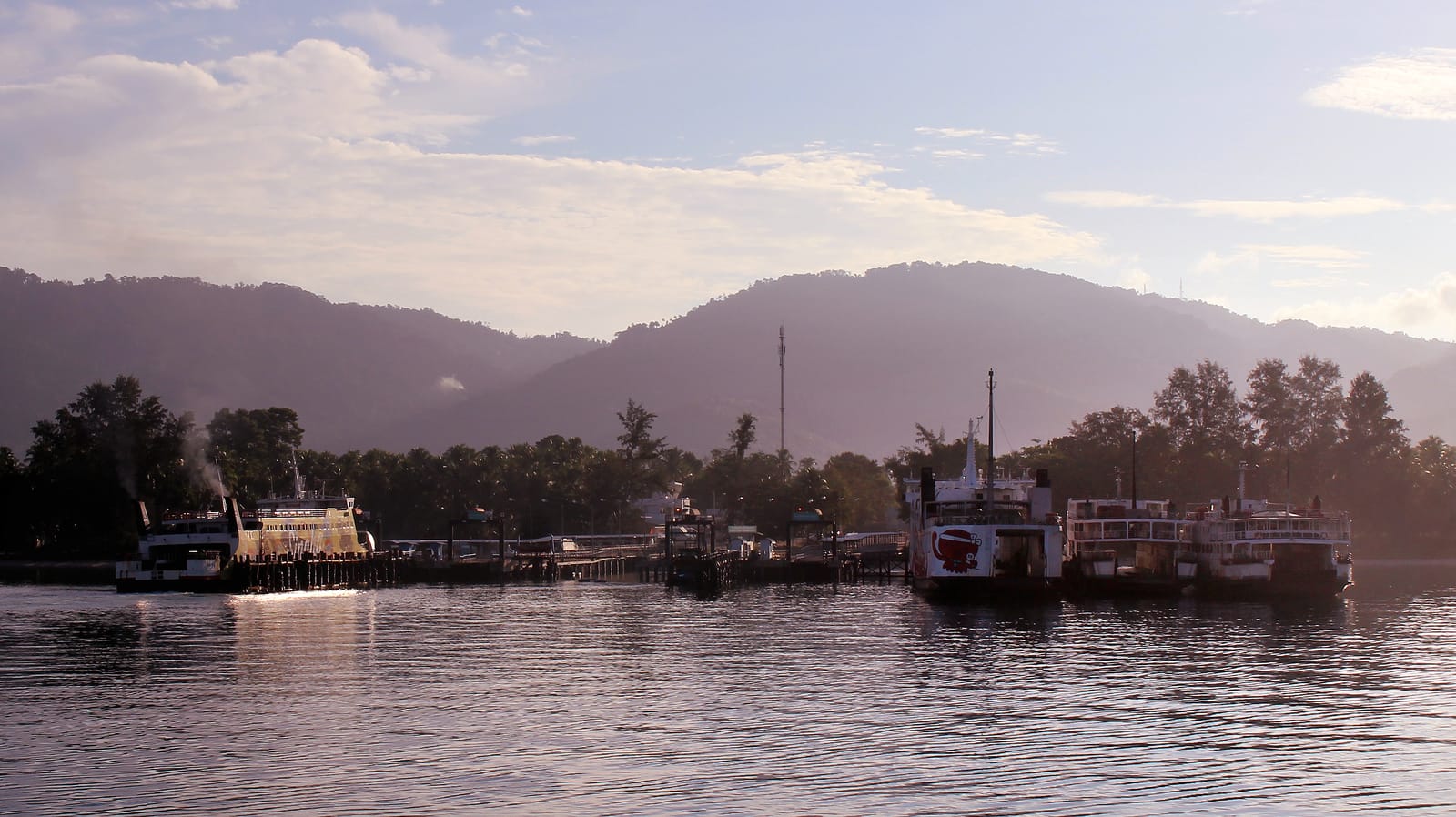
Several operators run ferries across to Samui, split into two broad types — big car ferries that can carry vehicles (slower, but cheaper and able to take cars) and fast speedboat/catamaran services that take passengers only. Here are the main operators.
Raja Ferry
A big car ferry that carries cars and motorbikes, running Donsak–Lipa Noi Pier (on Samui's west side). Departures roughly every 90 minutes, around 05:00–19:00, taking about 1.5 hours. If you want to bring a vehicle onto the island, this is the main operator.
Seatran Ferry
A popular ferry running Donsak–Nathon Pier (on Samui's west side), with frequent departures from morning to evening. Combined bus+ferry tickets are sold as packages, which is handy for foot passengers. Some boats carry vehicles, some are passenger-only, so check when you book.
Lomprayah
A fast catamaran for foot passengers only, departing the Surat Thani side into Nathon/Maenam. Its strength is connecting onward to Koh Phangan and Koh Tao on the same boat. Faster, but pricier and easier to get seasick on when the swell is up.
Honest note on prices and seasons
The figures above are mid-range averages — ferry fares and combined bus+ferry tickets shift with the season and the operator you book. Check the real price again for your travel date. The easiest option for foot passengers is to buy a combined 'van/bus + ferry' ticket from Surat Thani, which arranges all the onward connections so you don't have to find your own way to the pier. If you're bringing a vehicle onto the island, aim mainly for Raja Ferry to Lipa Noi.
Fly or ferry — how to pick what's worth it
There's no single right answer — it depends on what your trip values most.
Fly direct to Samui
If you're on a short 3–4 day trip and the budget allows, flying is the best value for your time. You skip losing half a day on transfers — land, and you're at your hotel within a few dozen minutes.
Car/bus + ferry
If you have time to spare, want to put the savings toward your hotel, are pairing the trip with southern towns, or want to bring a car or motorbike onto the island, this route is much better value — even if it's tiring and eats up most of a day.
Once you're on the island, how to get around
Samui has no city-style public buses, so getting around the island means relying on songthaews, taxis, Grab, or renting a car or motorbike and driving yourself. The thing that confuses newcomers most is that fares rarely run on a fixed meter — most are negotiated or set by the app. Know the going rate beforehand so you don't get overcharged.
Songthaews — cheapest, but ask the price before you board
Songthaews on Samui are converted pickup trucks with a covered back. Each colour runs a main route around the island (for example Chaweng–Nathon–Lamai). They're the cheapest option and have a nice local feel.
- Price: Around 50–100 THB per person by distance for typical island routes. Chartering the whole truck or going off the main route costs more.
- Daytime, they run set routes: Flag one down at the roadside, tell the driver where you're getting off, and ring the buzzer or tell the driver to stop.
- At night they become charters: Late at night, with fewer people about, songthaews often switch to quoting a charter price, which is pricier. Agree the fare before you board, every time.
Songthaew tip
Always ask the price before boarding, and if you can, ask clearly whether it's a 'per person' or 'whole-truck charter' rate, so there's no misunderstanding when you get off. During the day on main routes the rate is usually a standard per-person fare, but once you go off-route or it's late, it turns into a negotiation straight away.
Taxis and Grab — convenient, but pricier than you'd think
Samui taxis are notorious for high prices, because drivers often won't run the meter and quote a flat charter rate instead, which is usually several times the metered price. Grab is more transparent by comparison, since you see the fare before you book, but it's still pricier than on the mainland.
- Taxis: They have meters, but drivers prefer to quote a flat rate. Trips within the main tourist zones often get quoted at around 300–600 THB per ride. Agree the price clearly before you set off, every time.
- Grab (GrabCar): You see the fare before booking, which is more transparent than haggling yourself, but during peak times or in far-out zones cars get scarce and prices spike.
- Grab motorbike: Available on the island — cheap and fast for solo riders over short distances, but not suitable if you have big luggage.
- Airport restriction: Grab can't pick up within the airport grounds, so on arrival you'll need an airport transfer or a pre-booked car.
Motorbike rental — the most freedom, but watch the genuinely steep roads
If you can ride and you're used to upcountry roads, renting a motorbike is the freest and best-value way to loop the island yourself. Rental shops are spread across every tourist zone — but there are some warnings worth reading in full before you decide.
- Price: A 110–125cc scooter runs roughly 150–350 THB/day; bigger models like a Honda Click 150–160cc or a big bike cost more, from several hundred up into the thousands. Weekly rentals usually get a discount.
- Documents: You should carry an International Driving Permit (IDP) that covers motorbikes — checkpoints on the island can ask to see it, and without one you may be fined and your insurance won't cover you if something happens.
- Helmets: Wear one every time — it's both the law and basic safety. Most shops provide one.
- Inspect before taking the bike: Photograph or film every scratch around the bike before you take it, to avoid being charged for damage you didn't cause when you return it — and avoid shops that want to hold your passport as a deposit (leaving a cash deposit is better).
Watch the steep roads and rain — this is real, not scare talk
The main ring road is flat and easy to ride, but the climbs up to viewpoints, the access roads to waterfalls, and some stretches in the south are very steep and slippery, especially when it's raining or the road is wet. Every year there are plenty of accidents involving tourists riding motorbikes on the island. If you're not genuinely comfortable on a motorbike, don't rent one yet — songthaews, a chartered taxi, or Grab are safer. And don't force your way up a steep climb if you're not confident.
Car rental and hiring a car with driver
A good fit for families, bigger groups, people with a lot of luggage, or anyone who doesn't want to ride a motorbike on steep roads. The ring road is easy to drive and traffic is lighter than in big cities, with easy parking at the sights.
- Self-drive rental: A small car starts from roughly 700–1,200 THB/day and up depending on the model and season. Check that the insurance covers you, and photograph the car's condition before taking it, just like with a motorbike.
- Car with driver: Negotiate by the day or by the trip. It's good value split across several people, with no headaches over parking or steep roads — ideal for a day spent looping several temples, waterfalls and viewpoints.
- Driving licence: If you're self-driving, you should carry an International Driving Permit too.
The ring road — understand the layout before planning your days
The heart of Samui is Route 4169, the main road that loops around the island in a ring, roughly 50 kilometres in total. Almost every landmark sits along this loop, so if you understand the layout you can plan your days without wearing yourself out.
- North-east (Bophut–Bang Rak–Chaweng): The lively zone — the airport, the Big Buddha, Fisherman's Village in Bophut, Chaweng Beach, and the most shops and restaurants. Most newcomers stay here.
- South (Lamai–Hua Thanon): Lamai Beach, the Hin Ta–Hin Yai rocks, Wat Khunaram, and Na Muang Waterfall, all on one continuous stretch you can cover in a single day.
- West (Nathon–Lipa Noi–Taling Ngam): The ferry piers in and out of the island are on this side. Quieter, with lovely sunset spots, but far from the main tourist zones.
- North (Maenam): The quietest area. Some piers to Koh Phangan are around here — a good fit for people who genuinely want to rest.
Plan by zone, don't hop across the island
The tip that saves both time and transport costs is to plan your trip one zone at a time. On a day in the south, knock out the rocks, temple and waterfall all in one day — don't run to Chaweng in the morning, Taling Ngam in the afternoon, and back again in the evening, because the distances plus some steep stretches just waste time and tire you out for nothing. If you stay in a zone near the airport (Chaweng/Bophut/Bang Rak), your first and last days involve the least travel.
Sample 3-day transport plan (no motorbike needed)
If you still can't picture how to handle transport, here's an example of laying out your travel without riding a motorbike yourself. Adjust it to your flights and the weather.
Arrive and cover the zone near the airport
Hire a car to loop the south in one go
An easy day before heading home
Picking a well-located hotel as a base for looping the island will cut your transport costs and travel time a lot.
See the Top 10 Samui Hotels →