🔄 Updated 21 Jun 2026
The nice thing about diving in Samui is that you choose your own level. You can just slip on a mask and walk in from the beach to look at coral, sign up for your very first scuba course at one of the local dive shops, or — if you're already certified — take a boat out to famous deep sites like Sail Rock and Koh Tao. This article runs from easiest to hardest: we start with the walk-in snorkel spots, move to the deep sites you need a boat for, then finish with the seasons, prices, and safety points worth knowing before you get in the water.
Walk-in snorkeling — easy, no boat needed
Samui's east coast has a few small rocky coves with coral close to shore that you can walk straight into — no tour booking required. They're great for beginners and families who want to try a gentle mask-and-fins session first. The water is shallow and the waves are calmer than on the open beaches, but the bottom is rock and coral, so wear water shoes to avoid cuts and be careful not to step on the coral.
- Coral Cove — a small rocky bay between Chaweng and Lamai, widely rated as Samui's best walk-in snorkel spot. The coral sits close to shore, it suits beginners, and there's no entry fee.
- Silver Beach (Thong Takian / Crystal Bay) — a small bay with clear water and white sand, framed by rocks on both sides that hold fish and coral. The water is fairly shallow and calm, good for families and first-timers.
- Chaweng Noi — the southern end of Chaweng, quieter than the main beach, with rocks along the edge of the bay where you can spot fish.
Before you walk in on your own
When you snorkel on your own without a guide, always go in pairs — never alone. Check the current and waves first. At low tide the coral sits very shallow, so watch you don't scrape your stomach. Wear water shoes against the sharp rocks, use reef-safe sunscreen, and never touch or stand on the coral — it grows incredibly slowly.
Want more out of Koh Samui? Book tours & activities
Booking online ahead on Klook or GetYourGuide is usually cheaper than the gate and skips the queue. Pick only the experiences you actually want — prices and availability are shown live on each site.
Snorkel boat trips — Koh Tan & Ang Thong
If you want richer coral than what you find off the beach, you'll need to take a boat out a bit. Koh Tan, off Samui's south coast, is known for its coral gardens — people call it Coral Island — and it's a short boat ride from the south side. The Ang Thong Marine Park, meanwhile, is a full-day trip that combines snorkeling, kayaking, and a climb to a viewpoint. The best snorkel spots in Ang Thong are around Koh Wua Ta Lap, Koh Mae Koh, Koh Wao, and Koh Sam Sao.
- Koh Tan + Koh Mudsum — a half- or full-day trip snorkeling over coral, departing from Samui's south coast. Tours start at roughly 800–1,500 THB per person, depending on the boat and what's included.
- Ang Thong Marine Park (full day) — includes snorkeling, kayaking, viewpoints, and the hidden lagoon. Big boats start around 1,000–1,400 THB and speedboats around 1,800–2,500 THB per person (usually with lunch; some tours don't include the park entry fee, around 300 THB for adults — check before you book).
- Gear — most tours throw in a mask, snorkel, and life jacket, but if you have your own mask that fits well, it'll be more comfortable than a rental.
On the season for boat trips
Ang Thong closes for part of the monsoon (often around Nov–Dec), and trips can be cancelled if the swell is up. Tour prices swing with the season and group size. Pick a reputable operator, check that there are enough life jackets, and keep in mind a trip may be pushed to another day if the weather turns.
Scuba diving from Samui — the top sites
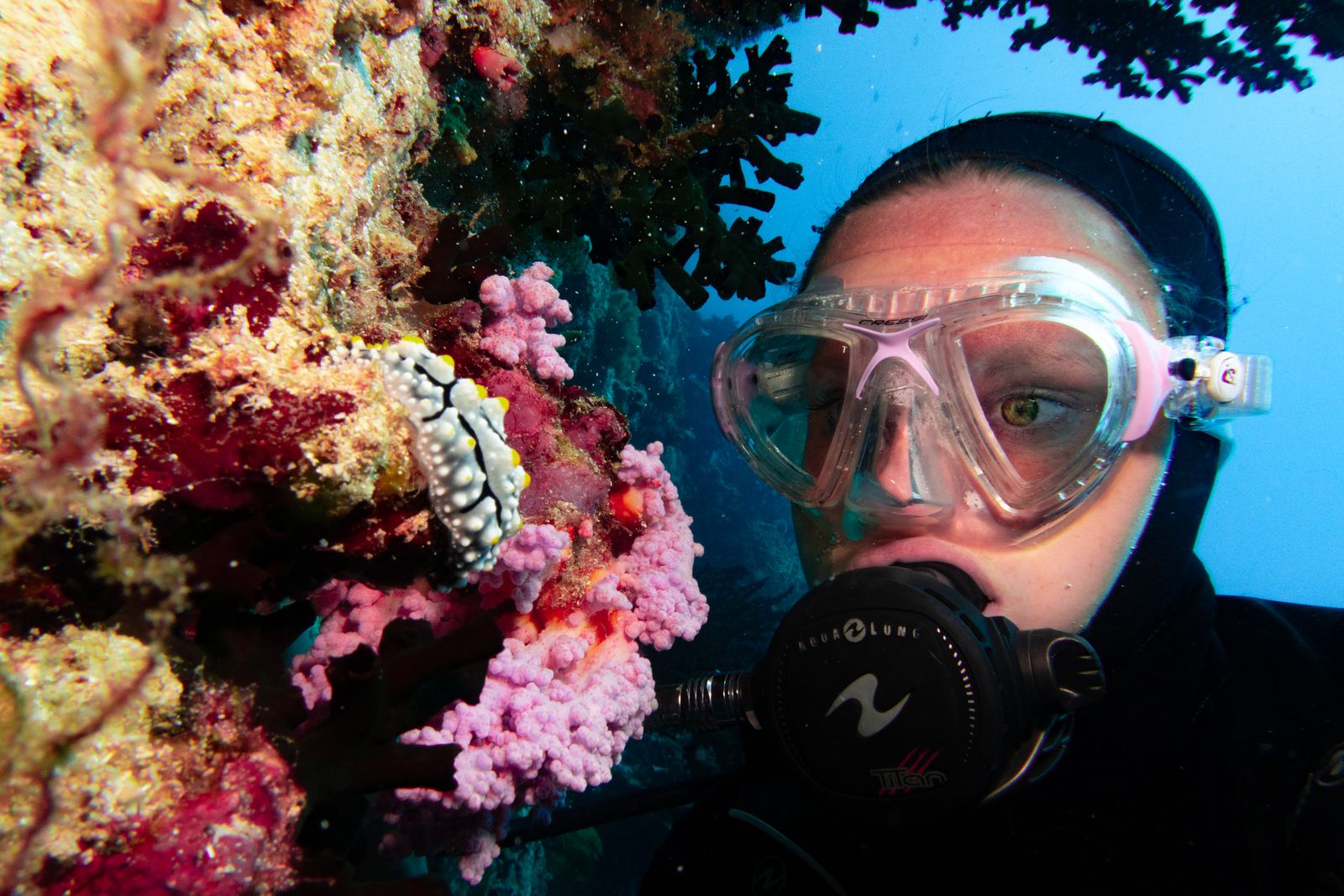
For certified divers, or anyone wanting to try scuba for the first time, the Samui dive shops run boat trips out to the deep sites in the Gulf of Thailand. The most famous is Sail Rock (Hin Bai), a granite pinnacle in the open sea between Samui and Pha-ngan. Most of the rest are trips that cross over to Koh Tao, the diving capital of the Gulf.
Sail Rock (Hin Bai)
A granite pinnacle in the open sea between Samui and Pha-ngan, famous for its vertical chimney — a rock swim-through you can rise through from about 18 metres up to the surface. There's a resident school of chevron barracuda, and from March to May you've got a shot at seeing a whale shark. About 50 minutes by speedboat from Chaweng.
Koh Tao — multiple sites
The diving capital of the Gulf: lots of sites, clear water, good for both courses and fun dives. Trips from Samui are usually a 2-dive full day, with all kinds of fish, hard coral, and turtles at some spots.
Chumphon Pinnacle
A submerged pinnacle near Koh Tao, known for big fish, schooling fish, and whale sharks in some seasons. It's a little deeper than the other sites, so it suits Advanced divers or those with some experience.
Dive sites around Koh Tao (Twins / Shark Island / White Rock)
Shallow-to-mid sites around Koh Tao that suit Open Water and Discover Scuba courses. The currents are gentle, with plenty of hard coral and pretty fish — these are the spots shops usually take beginners on their first dive.
Note: scuba trips from Samui involve a long boat ride and an early start, so budget the whole day for travel. On some days the shop may swap sites depending on the swell and current — not every trip lands exactly at the spot you were hoping for.
New to scuba? How to get started
If you've never scuba dived before, there are two main options: a one-day try-dive with no exam (Discover Scuba Diving) or a proper certification course (Open Water). Dive shops on Samui and Koh Tao run both. Prices depend on the shop and the season — the figures below are rough estimates to compare against, so confirm with the shop.
- Discover Scuba Diving (one-day try-dive) — no certification needed. You learn the basics in shallow water, then do one real dive, usually at Koh Tao. Prices start at roughly 2,500–3,000 THB including gear.
- Open Water course (certification) — takes about 3–4 days and earns you a PADI/SSI card you can dive with worldwide. Prices run roughly 11,000–19,000 THB depending on the shop and location (Koh Tao tends to be cheaper because there's so much competition).
- Already certified, want to fun dive — book a 2-dive day. Prices depend on the site and distance; Sail Rock and Koh Tao from Samui usually cost more than diving around Koh Tao directly, because of the longer boat ride.
How to pick a dive shop you can trust
Choose a shop that's an official PADI or SSI centre. Read real reviews about safety and group size (one guide shouldn't be looking after too many divers). Ask about insurance and how the gear is checked, and don't pick on price alone — underwater is no place to cut corners.
When is the water clearest? Pick the right window
The Gulf of Thailand is a semi-enclosed gulf, so the sea is fairly calm and you can dive nearly all year. But water clarity and the chance of seeing big animals vary by season. The clearest water and calmest sea is roughly February to May, with March–April as the peak — underwater visibility can reach around 25–30 metres, and it's the best window for spotting whale sharks at Sail Rock.
- Feb–May — clearest water, calm sea, with March–April the peak. Best chance of a whale shark at Sail Rock, good for both snorkeling and diving.
- Jun–Sep — still good diving, hot weather, busier during the European high season, with good visibility on many days.
- Oct–Dec — Samui's monsoon: strong swell, lots of rain, water can get murky, and boat trips to Ang Thong may close or cancel often. If you come now, keep your plans flexible and check the weather day by day.
An honest word on seasons
Don't take the calendar as gospel — the sea's seasons shift from year to year, and some years the monsoon comes early or lingers longer. Before you book a dive trip, check the weather and swell forecast 2–3 days ahead, and leave a spare day in case you need to reschedule.
Safety and what to know before you get in
The sea is beautiful, but you can't be careless. Whether you're snorkeling off the beach or boating out to deep sites, safety comes first. Here's the short list worth knowing.
- Check the weather and beach flags — when a warning flag is up, don't push it and go in, especially during the monsoon when waves and currents are strong.
- Snorkel in pairs — never go in alone. Wear a life jacket if you're not a strong swimmer, and watch for currents pulling you away from shore.
- Don't fly right after a deep dive — leave at least 18–24 hours between scuba diving and a flight. Plan your dive days so they don't clash with your departure.
- Seasickness — boat trips go far out, so if you get seasick easily, take a tablet about half an hour before departure, sit in the middle of the boat, and look at the horizon.
- Don't touch, don't take — don't handle marine life, and don't collect coral or shells. Reef-safe sunscreen helps protect the reef too.
Try a Samui diving plan like this
If you're not sure where to start, here's a rough plan by level — adjust it to your hotel and the weather.
Ease in with beach snorkeling
Boat snorkel trip, or your first scuba dive
Certified divers take on Sail Rock & Koh Tao
Want a well-located hotel near the beach as a base for your dive days?
See 10 great Samui hotels to book →