🔄 Updated 21 Jun 2026
If you've got a long three-day weekend and want both the buzz of a floating market and the calm of an old town in one trip, the Samut Songkhram–Phetchaburi route fits the bill nicely. The two provinces line up along the same road — driving from Amphawa down to Phetchaburi takes only about 40–50 minutes — so there's no looping around or doubling back.
The heart of this plan is simple: spend the first two days in Samut Songkhram hitting the railway market, the floating market, and a firefly boat ride, then cross into Phetchaburi on day three to walk the old town, visit the temples, and grab custard cake to take home. To make it line up perfectly, aim to leave on a Friday — Amphawa Floating Market only runs Friday to Sunday, and those are the nights you can ride out to watch the fireflies.
Route and getting around
From Bangkok, take Rama II Road (Highway 35) down to Maeklong town, roughly 70 kilometres, which is a little over an hour. After that, everything in Samut Songkhram is close together — most stops are only a few minutes' drive apart. Once day two wraps up, you carry on from Amphawa on Highway 4 (Phetkasem) into Phetchaburi town, about 45 kilometres, under an hour.
- Driving yourself — easily the most convenient option for this trip, since a few spots like Khao Luang Cave and Bang Kung Camp are hard to reach by public transport.
- No car — you can take a Bangkok–Maeklong van from the Southern Bus Terminal (Sai Tai Mai), then get around town by songthaew or motorbike taxi. For the leg over to Phetchaburi, there are regular Maeklong–Phetchaburi vans.
- The Maeklong railway line — if you're after the experience, try the Wongwian Yai–Mahachai train, cross the river by ferry, then catch the Ban Laem–Maeklong service. Only a few trains run each day, so check the times before you go.
Line your days up with the markets
Amphawa Floating Market only opens Friday to Sunday, roughly 11:00–20:00. The Maeklong Railway Market runs every day, but weekends are far busier. If you plan the trip for Friday to Sunday, you'll catch the floating market, the railway market, and the firefly boat all in one go.
Book the activities in your Samut Songkhram trip ahead
Booking online ahead on Klook or GetYourGuide is usually cheaper than the gate and skips the queue. Pick only the experiences you actually want — prices and availability are shown live on each site.
Day 1 — Maeklong, the railway market, and riverside temples
Day one is about ticking off the highlights in Maeklong town. Start with the railway market — the image most people picture when they think of this province — then visit a couple of old riverside temples before settling into your accommodation around Amphawa.
From the umbrella-pulldown market to the Maeklong riverside
About the railway market
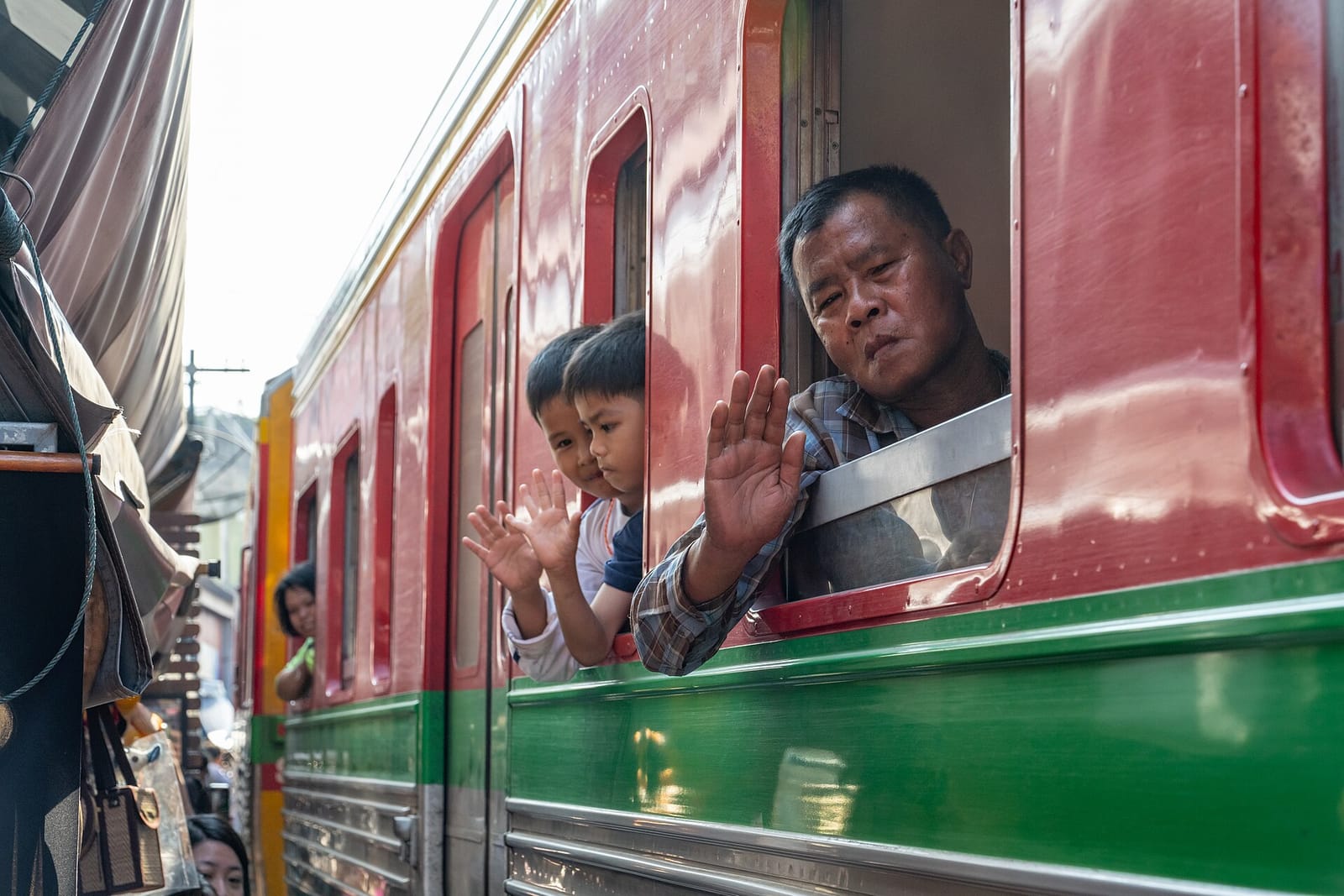
What makes Talad Rom Hub special is the split second the train rolls in and the vendors pull back their awnings and goods all at once. For a good photo, get into position about 15 minutes before the train arrives, pick an angle that doesn't block the tracks, and keep an eye on your belongings when it gets crowded. The train times can change, so ask a vendor on the spot rather than trusting an old timetable.
Day 2 — Amphawa, the Rama II Memorial Park, and Bang Kung Camp
Day two stays around Amphawa the whole time. Ease into it by walking the Thai houses at the Rama II Memorial Park, which sits right next to the floating market, then move on to Bang Kung Camp to see the temple wrapped entirely in tree roots, before coming back to spend another night around Amphawa.
Rama II's Thai houses and the bodhi-wrapped temple
About Bang Kung Camp
The bodhi-wrapped temple is the top photo spot — the roots of four large trees (bodhi, banyan, krai, and krang) creep over the building until you can barely see the walls. Morning or late-afternoon light gives better photos than the harsh sun at midday. Inside sits Luang Pho Nin Mani, an old stucco Buddha image that people in the area hold dear.
Day 3 — Crossing over to old-town Phetchaburi
On the last morning, check out and drive south to Phetchaburi — about 45 kilometres on Highway 4, reaching town in under an hour. Phetchaburi is an old town with a palace on a hill, ancient temples, a cave where light filters down onto a Buddha image, and sweets that have been passed down through several generations. Today is built to cover the temples and the food before you head home.
Khao Wang, ancient temples, and custard cake
About Khao Wang
Khao Wang has two ways up — climb the fairly steep stone staircase, or take the electric cable car, which is far easier, especially on a sunny day. At the top there's the palace, the Phra That Chom Phet stupa, and temples you can walk between. Monkeys are all over the place, so don't carry food bags out in the open, and keep an eye on your glasses and hat.
Food in both towns you shouldn't miss
You'll eat well in both provinces on this trip. Samut Songkhram shines for its seafood and canalside sweets, while Phetchaburi is a genuine town of sweets. Here's what to try before you head home.
Maeklong mackerel
Short-bodied, bent-faced mackerel — rich, sweet meat, steamed in traditional bamboo baskets. A signature dish worth trying on your first day in Maeklong.
Amphawa canalside sweets
Coconut sticky rice, old-style Thai desserts, and riverside coffee. Graze your way along in the evening for the full floating-market atmosphere.
Phetchaburi custard cake
Custard cake with a caramelised top and the scent of pandan; old-name shops like Mae Kim Lai and Mae Kim Lang have been making it for decades. A great souvenir to bring home.
Phetchaburi khao chae
Rice in flower-scented chilled water, eaten with fried and sweet-savoury side dishes — the town's classic dish for beating the heat, easy to find in the hot season.
Before you go
- Pick Friday to Sunday if you want both Amphawa Floating Market and the firefly boat — the market only opens on these three days.
- Book ahead — canalside homestays in Amphawa fill up fast on weekend nights, so reserve at least a week in advance.
- Carry cash — stalls at the floating market, the railway market, and many old sweet shops still mainly take cash.
- Bring comfortable walking shoes — both Khao Wang and Khao Luang Cave involve climbing up and down, and some surfaces are slippery.
- Watch out for monkeys — both Khao Wang and Khao Luang Cave have plenty of them, so keep food and valuables well out of reach.
Want a good canalside place in Amphawa before crossing into Phetchaburi?
See the Top 10 places to stay in Samut Songkhram →