🔄 Updated 21 Jun 2026
The charm of Samut Songkhram is that it's a riverside town where everyday life still goes on — a floating market where locals genuinely paddle out to sell, a railway line that threads straight through a fresh market, and mangroves where the fireflies still live. But all of this is tied to the time of day, the day of the week, and the season far more than most people expect. Plan your trip for the wrong day and you can end up at a dead-quiet floating market or a Don Hoi Lot so flooded you can't walk out on it. This guide rounds up everything you need to know before you go.
Which days is Amphawa open? Check before you book
The most common slip-up is assuming Amphawa floating market is open every day. In reality, Amphawa floating market only opens on Friday, Saturday and Sunday, plus public holidays. Stalls start setting up in the afternoon and the market really comes alive from around 3 pm until evening. Show up Monday to Thursday and central Amphawa is very quiet — most of the canalside shops are shut, leaving just a few cafés and food stalls.
- Amphawa floating market days — Friday, Saturday, Sunday and public holidays (closed Monday–Thursday)
- Busiest window — mid-afternoon into the evening, when the vendor boats and canalside shops all open together around dusk
- If you go on a weekday — focus on Don Hoi Lot, Wat Bang Kung, the King Rama II Memorial Park and the riverside cafés instead, because the floating market will be dead
- Tha Kha floating market — the province's other market, open only on dates ending in 2 and 7 plus Saturdays and Sundays. It's a traditional morning market with fewer people than Amphawa
The timing that works best
Arrive Friday or Saturday evening, walk the floating market in the afternoon and evening, then take a firefly boat after dark and stay one night. The next morning, head to Don Hoi Lot at low tide. It's the most efficient way to use your time.
Amphawa fireflies — rainy season only
The fireflies are Amphawa's signature after dark, but they're not around all year. They're at their thickest in the rainy season, roughly May to October, when the humidity is high and the lamphu trees along the canal give them somewhere to gather. In the dry season (January–April) you might still catch a few, but far fewer — on some nights you'll barely see any.
- Best season — May to October, the rainy months, when the fireflies are plentiful and bright
- Pick a dark night — a waning-moon or moonless night shows the firefly glow far more clearly than a full moon
- Firefly boat tours — they run about an hour and head out after sunset, from around 7 pm onwards
- Avoid nights with heavy rain — in a downpour the fireflies hide; an overcast, lightly drizzling night actually gives a better show
The price question to nail down
A private long-tail boat for firefly watching is usually charged per boat (it seats several people), while a shared boat is per head. Prices shift with the season and where you board. Ask the price and how many people per boat clearly at the pier before you get on — don't take an offer from someone touting in the middle of the market without comparing rates.
Don Hoi Lot — go at low tide
Don Hoi Lot is a sandbar at the mouth of the Mae Klong River that only surfaces when the tide goes out. Come at high tide and all you'll see is a wide expanse of muddy sea — there's no walking out onto the bar at all. So the whole point of visiting comes down to checking the tide table before you set off.
- Best season — around March to May, when the tide stays out longer and the bar surfaces wide enough to stroll on comfortably
- Check the tide table — look up the "Pak Nam Mae Klong" station at the Hydrographic Department (hydro.navy.mi.th) or any general tide-table site, and plan around the lowest low tide
- Low tide is often in the morning — many days the lowest tide falls from late morning to midday, but it shifts every day, so check it for the actual date you're going
- Boat out to the bar — there are boats from the pier out to the sandbar offshore, charged per boat, ideal if you want to see the cockle-gathering up close
Why you have to check day by day
Tide times shift a little every single day. Low tide is late morning today, maybe early afternoon tomorrow. Only use the table for the "day you're actually going" — don't rely on times from old reviews or from someone who went on a different day.
Maeklong railway market — line up the train times
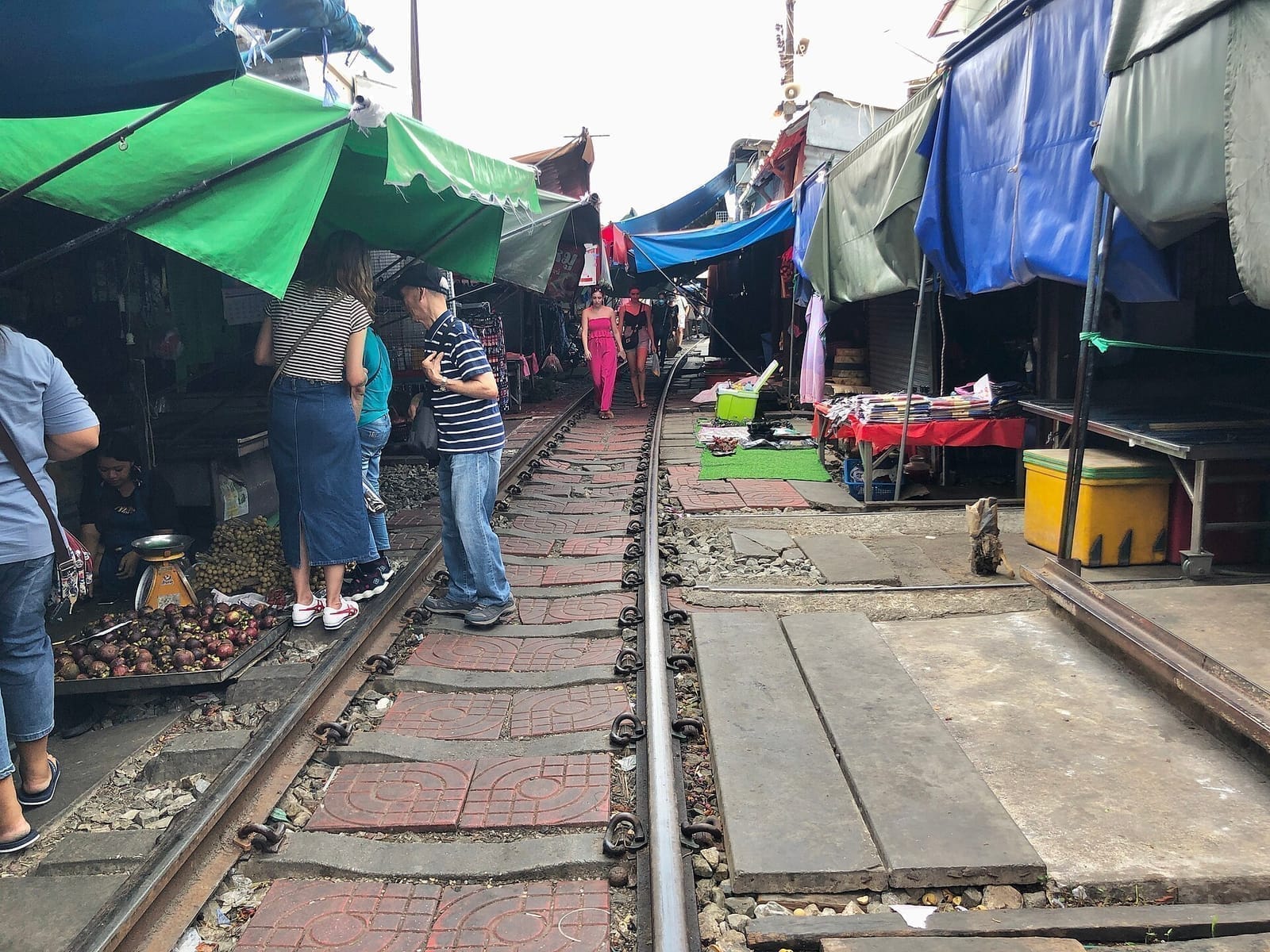
The Maeklong railway market (Talat Rom Hup) is a fresh market with stalls set up straddling the railway tracks. As a train approaches, the vendors fold down their awnings and pull their stalls back so it can squeeze through, then set everything back up exactly as before. The thing to plan around is that you have to time your visit to when trains run in and out of Mae Klong station to actually catch this. Otherwise it's just an ordinary fresh market.
- Trains arriving at Mae Klong station (approximate) — around 08:30 / 11:10 / 14:30 / 17:40
- Trains departing Mae Klong station (approximate) — around 06:20 / 09:00 / 11:30 / 15:30
- Get there 15–20 minutes early — so you can find a good spot and watch the vendors fold the awnings before the train arrives
- Always check the latest schedule — times can change, so check with the State Railway (railway.co.th) before you go, especially on long weekends
A safe spot for photos
Stand tight against the stalls on the side — don't walk down the middle of the tracks as a train nears. Listen for the warning signal and do as the vendors tell you. The people here are used to tourists and will warn you themselves if you're standing in the wrong place.
Getting to Samut Songkhram
Samut Songkhram is about 70 kilometres from Bangkok — a bit over an hour by car — but you can also get there without one in several ways, from fast, on-time minivans to the Maha Chai–Mae Klong railway, which is an experience in itself.
New Southern Bus Terminal (Taling Chan)–Mae Klong minivan
The most convenient and fastest option if you don't have a car. They leave roughly every 30 minutes and take about an hour and a half, dropping you at the Mae Klong market or Pom Kaeo in the centre of town. From there you can take a songthaew or motorbike on to Amphawa.
Victory Monument–Mae Klong minivan
Another pickup point Bangkok folks know well. It takes about 1 hour 20 minutes and drops you at the Mae Klong market — handy if you're around Phaya Thai or Ratchathewi.
Maha Chai–Mae Klong railway
This is the very line that runs through the Rom Hup market. Take the train from Wongwian Yai to Maha Chai, cross the river by ferry to Ban Laem, then catch another train on into Mae Klong. It's a journey that's a trip in itself — slow, but full of atmosphere.
Driving yourself
The most flexible if you want to hit several spots — Don Hoi Lot, Wat Bang Kung and the out-of-town cafés that public transport can't reach. There's parking at the markets and temples, but on weekend evenings the roads around Amphawa get packed.
No car but want to see it all
Take a minivan to Mae Klong, then use songthaews, motorbike taxis, or rent a bicycle or motorbike in town to get between spots. Distances within the province are short — Amphawa is only about 6 kilometres from central Mae Klong.
Sample 2-day, 1-night trip
If you're coming on a weekend and want to cover all the highlights — the floating market, the fireflies and Don Hoi Lot — this is the rhythm that works. Adjust the Don Hoi Lot timing to the tide table for the actual day you go.
Mae Klong town + Amphawa floating market + fireflies
Don Hoi Lot + Wat Bang Kung + King Rama II Park
Rough budget per person
Samut Songkhram can be done on a tight budget or in easy comfort. The figures below are a rough per-person budget for a 2-day, 1-night trip, not counting souvenirs and personal shopping.
- Round-trip travel — minivan around ฿140–180, or split fuel and tolls between the group if you drive
- One night's stay — canalside homestays start around ฿600–1,200 per room; hotels and resorts go up to ฿1,500++
- Firefly boat — a few hundred baht per boat for a private one, split among the group, or around ฿60–100/person for a shared boat
- King Rama II Park admission — around ฿40 for adults (฿60 for foreigners)
- Food across the trip — around ฿300–500/day on canalside street food covers several meals
- Budget total — a 2-day, 1-night trip can start around ฿1,200–1,800 per person if you go as a group and stay in a homestay
How to save a bit more
Going as a group of 4–6 is the best value, because the private firefly boat and the fuel split down to far less per person. Many canalside homestays also charge by the room rather than per head.
Checklist before you set off
- ✅ Day of your visit — does it fall Friday–Sunday, if you want to walk Amphawa floating market?
- ✅ Season — rainy season (May–Oct) if you're set on seeing the fireflies
- ✅ Tide table — check the Pak Nam Mae Klong low tide for that day if you're going to Don Hoi Lot
- ✅ Train schedule — note the times trains run in and out of Mae Klong if you want to see the Rom Hup market
- ✅ Accommodation — book ahead on weekends; canalside homestays fill up fast
- ✅ Cash — many canalside shops and boats take cash first and foremost
See canalside Amphawa and Mae Klong town stays with real reviews
See the Top 10 Samut Songkhram stays →