🔄 Updated 21 Jun 2026
Sangkhlaburi is about 215–220 km from Kanchanaburi town and roughly 350–360 km from Bangkok — a destination you have to set out for, not somewhere you pass through. The pull here is the quiet, the morning mist over the lake, and a Mon way of life you still see in everyday routines rather than just as a photo backdrop.
Mon Bridge — the Uttamanusorn Bridge
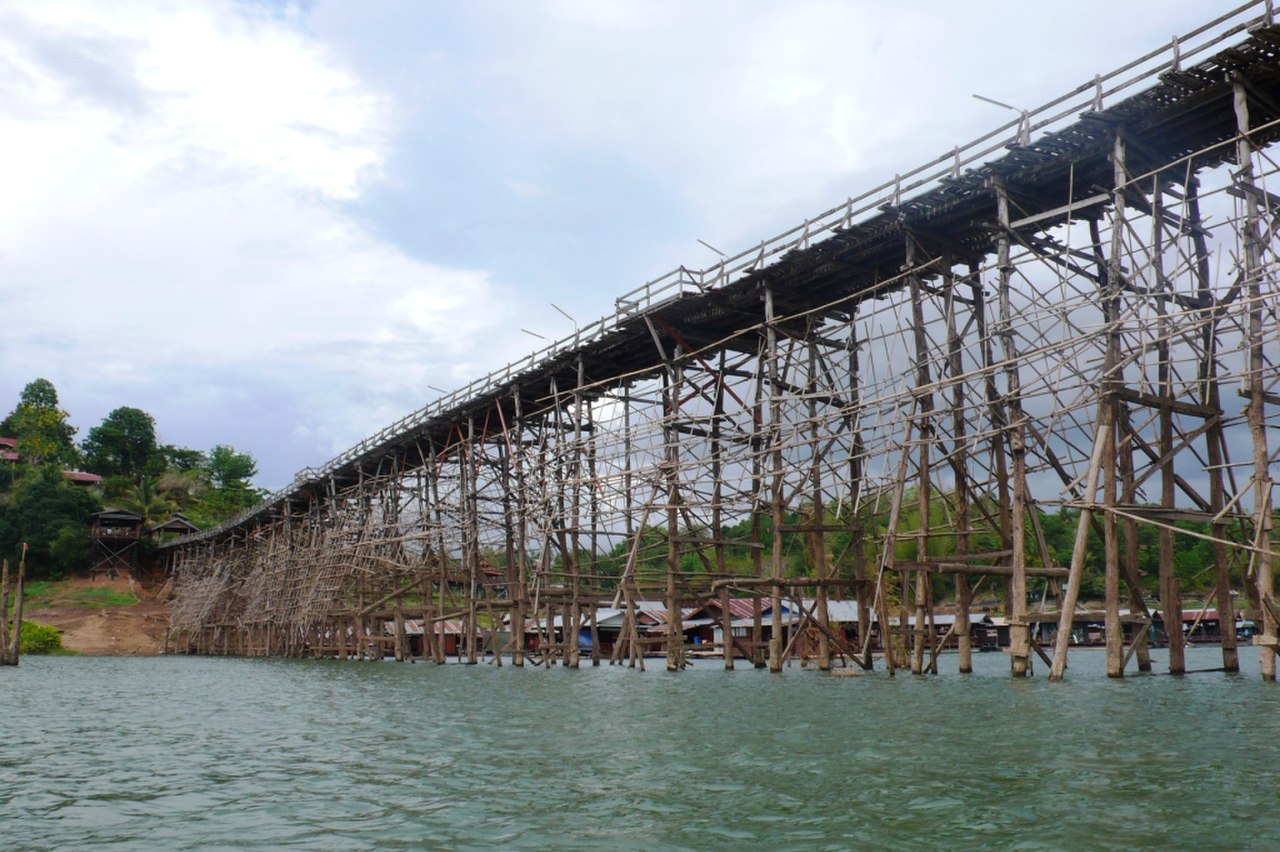
The Mon Bridge — officially the Uttamanusorn Bridge — is the longest handmade wooden bridge in Thailand. It spans the Songkalia River, linking the Thai side of Sangkhlaburi town with the Mon village of Wangka on the far bank. It was built around 1986–1987 through the faith and labour of the Mon community, on the initiative of Luang Por Uttama, the late abbot of Wat Wang Wiwekaram whom the Mon people deeply revered. The bridge was named in his memory.
Walking across is free — there's no entry fee. The whole structure is timber, and you'll hear the planks creak in rhythm under your feet. The middle of the bridge is the favourite photo spot, with the lake and mountains as the backdrop. Part of the bridge collapsed in a flood back in July 2013, but it has since been repaired and is fully back in use.
Best time to go
Walk the bridge in the early morning, around 6am, to catch the mist drifting over the water and soft light, with fewer people around. Late afternoon before sunset is lovely too, but busier. Midday is harsh and hot — not a fun time to be out on the bridge.
Want more out of Kanchanaburi? Book tours & activities
Booking online ahead on Klook or GetYourGuide is usually cheaper than the gate and skips the queue. Pick only the experiences you actually want — prices and availability are shown live on each site.
Morning alms-giving and Mon life at Wangka
The highlight many people come for is the morning alms-giving on the Wangka village side. Around 6am the monks walk their alms route, while locals and visitors sit waiting along the wooden walkway to offer food. It's a simple, genuine scene. There are stalls selling pre-packed rice and dry goods for almsgiving right by the village entrance.
Cross the bridge to the Wangka side and you'll find a small morning market selling Mon food, plus Mon outfits to rent for photos. Many Mon women still wear thanaka paste on their faces and traditional sarongs. Wander the village and you'll see wooden houses, temples, and a way of life clearly different from town.
- Respect the locals — if you want to photograph people, especially during alms-giving, ask first or shoot discreetly without disrupting the ritual.
- Dress modestly — Wangka is a Buddhist community; cover shoulders and knees if you plan to enter a temple.
- Rent a Mon outfit — there are rental shops on the Wangka side, starting in the low hundreds of THB; you can wear it to walk the bridge and take photos.
Wat Wang Wiwekaram and Luang Por Uttama
Wat Wang Wiwekaram is the spiritual centre of Sangkhlaburi's Mon community, founded by Luang Por Uttama, a Mon monk who migrated from the Myanmar side. The temple blends Thai with Mon–Burmese style, and inside it enshrines the preserved body of Luang Por Uttama for people to pay their respects. The atmosphere is calm — a good stop after an early-morning walk across the bridge.
Not far away is the Buddhakhaya pagoda, a golden, square-tiered stupa modelled on the Bodh Gaya pagoda in India, holding relics of the Buddha inside. It's a landmark you can see from a distance and a key photo spot in town, surrounded by shops selling souvenirs and Mon snacks.
Dressing for the temple
Both Wat Wang Wiwekaram and the Buddhakhaya pagoda require you to remove your shoes and dress modestly. Bring a shawl or scarf — it's handy if you're wearing a sleeveless top.
Sunken temple — the old submerged temple by boat
Before the Vajiralongkorn Dam (Khao Laem Dam) was built, the original temple and village stood on land that is now part of the lake. The old Wat Wang Wiwekaram and the old Wat Somdet were left submerged. During the dry season, roughly March to August, the water level drops and the tops of the ordination hall and the bell tower rise above the surface — a striking sight many people come specifically to see.
To get there, hire a boat from one of the piers in town. As a rough guide, a single-temple visit runs about 300 THB per boat and takes around 1 hour, while a three-temple boat tour is around 500 THB per boat and takes 2–3 hours (the cost can be split among everyone aboard). When the water is at its highest you'll see less of the temples, so ask the boatman beforehand how much is visible at that time.
More to see around Sangkhlaburi
Three Pagodas Pass
The Thai–Myanmar border crossing, about 20-some km from town, marked by three small white pagodas. The crossing is open roughly 8am–8pm, with a market selling Burmese goods.
Sangkhla town viewpoints
Several spots around town look out over the lake, the Mon Bridge, and the mountains — good for photos in the morning and evening.
Kroeng Krawia Waterfall
Right beside Highway 323, about an hour before you reach Sangkhla town. A good place to stop for a swim or photos along the way.
How to get to Sangkhlaburi
Sangkhlaburi has no train and no airport — there's a single road in. From Kanchanaburi the route is Highway 323 through Sai Yok and Thong Pha Phum, then up into the hills to Sangkhlaburi. The final stretch is a winding climb, so if you get carsick, bring something for it.
- Minivan/bus from Kanchanaburi — leaves from Kanchanaburi bus terminal, takes around 4–5 hours, with fares of roughly 100–200 THB per trip.
- Bus from Bangkok — services run from Mo Chit 2 bus terminal via Kanchanaburi, taking around 6–7 hours in total.
- Self-drive — the most convenient way to get around town; take Highway 323 from Kanchanaburi, about 215–220 km, and allow extra time for the climb into the hills.
- Getting around town — there are motorbikes for rent and songthaews in town, and the sights aren't far apart.
When to go
The best window is November to February — cool, comfortable weather, little rain, and pretty mist in the mornings. The rainy season (June to October) is lush and green, but the hill road gets slippery and fog can be thick, so drive carefully.
Want to stay near the Mon Bridge so you can be out walking before the mist lifts?
See Kanchanaburi hotels →