🔄 Updated 21 Jun 2026
When most people think Sukhothai, they picture the historical park — Buddha statues rising from crumbling chedis. And yes, that's genuinely unmissable. But the city has more going for it than that: the quieter ruins of Si Satchanalai to the north, waterfalls inside Khao Luang national park, and a new-town district with proper coffee shops and street food. We've split the guide into three tracks — pick what fits the time you have.
Culture Track — The UNESCO Old City
The heart of Sukhothai is its historical park — a UNESCO World Heritage site since 1991, inscribed together with Si Satchanalai and Kamphaeng Phet. Inside the inner walls alone there are around 26 monuments; outside, nearly 200 more. The most popular way to see them is by rented bicycle: a steady breeze makes it comfortable, and you can reach spots that are a stretch on foot.
Wat Mahathat
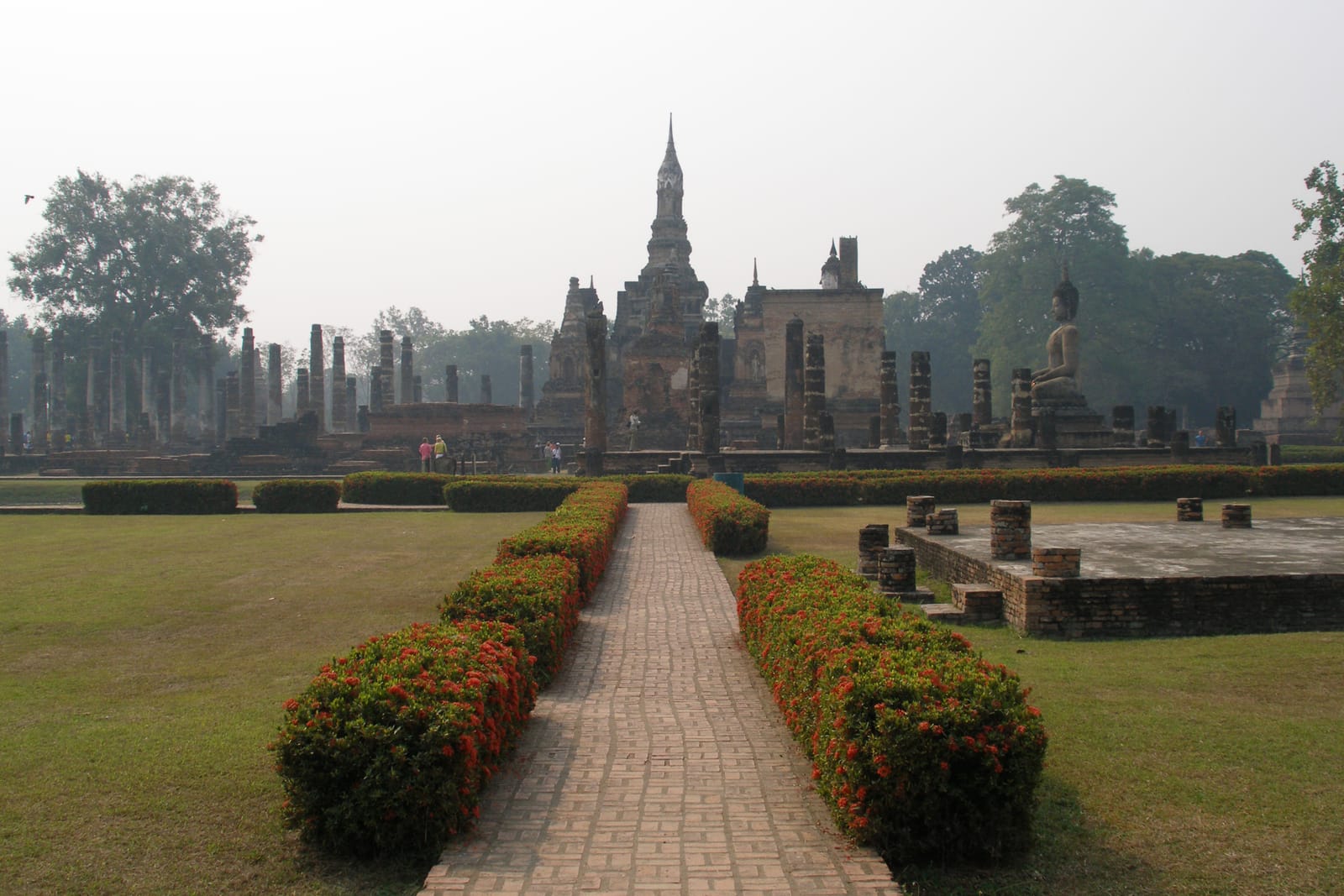
The largest and most important temple at the centre of the old city — once the spiritual heart of the Sukhothai kingdom. Its defining feature is the lotus-bud chedi (Phum Khao Bin style) ringed by smaller stupas and a large seated Buddha. Late-afternoon light turns the ruins golden, making this the shot everyone associates with Sukhothai.
Wat Si Chum (Phra Acana)
Northwest of the inner walls, this temple houses Phra Acana — a massive seated Buddha with a lap width of about 11 m that fills the entire square mondop. You view it through a narrow doorway slit, and the framing makes the Buddha look like it's pushing out towards you. That effect gave rise to the legend that this Buddha could speak.
Wat Sa Si
A Ceylonese-style chedi on a small island in Traphang Trakuan pond, perfectly reflected in the water — especially striking at dawn and dusk. It's one of the most romantic compositions in the inner zone and an easy bike ride from Wat Mahathat.
Wat Sri Sawai
Three Khmer-style prangs that started as a Hindu shrine before being converted to a Buddhist temple — architecturally distinct from everything else in the park. It's inside the inner zone, so you can loop it into the same bike route as Wat Mahathat.
Ramkhamhaeng National Museum
Directly opposite the park entrance, this museum houses Sukhothai-era artefacts and sculpture. The highlight is the story of Ramkhamhaeng Inscription No. 1 — one of the earliest known examples of Thai script. Stopping in before or after the park puts everything in context.
Si Satchanalai Historical Park
A second ancient city about 60 km north of Sukhothai, much quieter and less visited than the main park. The standout is Wat Chang Lom, with its chedi ringed by moulded elephant buttresses. Good choice if you want to wander ruins in peace.
How entry fees work across zones
The park is split into three zones (Inner, North, and West/Aranyik) with separate admission — there's no longer a combined pass. Thais pay 20 THB per zone; foreigners pay 200 THB for the Inner Zone and 120 THB each for the North and West zones. Students in uniform, monks, and visitors 60+ enter free. Bicycle and electric tram hire are charged separately.
Want more out of Sukhothai? Book tours & activities
Booking online ahead on Klook or GetYourGuide is usually cheaper than the gate and skips the queue. Pick only the experiences you actually want — prices and availability are shown live on each site.
Nature Track — Khao Luang & Waterfalls
After a full round of temples, Sukhothai's other draw is Ramkhamhaeng National Park — commonly called Khao Luang — in Khiri Mat district. The park covers over 340 sq km of forested ridges where barking deer and banteng still roam.
Khao Luang Summit
The main trekking route up to the summit is popular with campers. From late rainy season through winter (July–February) there's a real chance of catching cloud sea and a clear sunrise. The ascent is steep enough to need some prep — go in reasonable shape.
Sai Rung Waterfall
The largest waterfall in Khao Luang, with four tiers. The upper falls are the most dramatic. Between roughly 11:00 and 16:00, sunlight hits the spray and produces a rainbow — which is exactly what the name means.
Lam Kliao Waterfall
The appeal here is the walk itself: a shaded trail following a stream past cascades stepping down over rocks, with no serious elevation. Good option if you want nature without the full summit effort.
Before heading to Khao Luang
National parks in Thailand periodically close sections for forest regeneration or during certain seasons. Check the DNP (Department of National Parks) page or call the park office before you go — especially if you're planning to camp overnight. It saves a wasted trip.
City Track — Markets, Cafés & Chill Spots
Sukhothai has two main zones: the old city (around the park) and the new town about 12 km away, where most hotels, restaurants, and markets are. If a full day of cycling isn't in the plan, the new town has plenty of places to rest, eat, and slow down.
- Morning alms-giving at Wat Traphang Thong — Monks walk their alms route around 07:00, circling a small island in the middle of the old city's pond. It's a calm, genuinely local scene; a fresh market nearby makes a good follow-up.
- Thung Thalae Luang — A large flood-retention basin with a heart-shaped island at its centre, where Phra Phuttharatanasiri Sukhothai is enshrined. Nice for a late-afternoon bike ride or just sitting in the breeze.
- Sangkhalok Pottery Village — Around the Koh and old-city area, kilns and studios still produce the celadon-glazed and painted Sangkhalok ceramics Sukhothai has long been known for. Good for picking up a meaningful souvenir.
- New-town cafés and Sukhothai noodles — The new-town district has decent coffee shops and several well-regarded spots serving Sukhothai-style noodles. Good for refuelling before or after the park.
Making the Most of One Day
With a single day, focus on the inner zone and Wat Si Chum first, then add Khao Luang or Si Satchanalai if time allows. Here's a rough schedule you can adjust based on energy.
Old City — before the heat builds
Wat Si Chum & the Museum
Chase the golden hour
Want a full Sukhothai trip itinerary?
See the Sukhothai Travel Guide →