🔄 Updated 21 Jun 2026
Sukhothai was the capital of Thailand's first kingdom over 700 years ago. Its temples are spread across a central zone, a northern zone, and a western zone inside and around the old city walls. Si Satchanalai is a separate park about 55 km north — it requires a different ticket and realistically a different day if you want to do both properly. The temples here were chosen because each one has a clear, memorable centrepiece that stands on its own without needing a guidebook to decode.
Wat Saphan Hin — Standing Buddha with a View Over the City
Wat Saphan Hin sits in the western zone of Sukhothai Historical Park on a low hill about 200 metres above the surrounding plain. The name means "stone bridge" — it comes from the slate-paved path that leads up the slope. The climb takes about 10–15 minutes and is manageable for most people.
The highlight at the top is the Phra Attharot, a 12.5-metre standing Buddha in the Abhaya mudra (right hand raised, palm facing outward), set in front of the remains of a viharn whose laterite columns still face east. Morning light hits the face directly, which makes it the better time to go up. Local legend says King Ram Khamhaeng rode his white elephant Ruchakiri up to pay respect here on Buddhist holy days.
Best Time to Visit
Go up to Wat Saphan Hin in the morning or late afternoon — the midday sun on the open hilltop is harsh and there's almost no shade. Bring water. Some sections of the stone path can be slippery, so wear shoes with grip.
Want more out of Sukhothai? Book tours & activities
Booking online ahead on Klook or GetYourGuide is usually cheaper than the gate and skips the queue. Pick only the experiences you actually want — prices and availability are shown live on each site.
Wat Chetuphon — Four Postures of the Buddha in One Mondop
Wat Chetuphon is a large temple in the southern zone of Sukhothai Park, roughly 2 km outside the city walls heading south. The main draw is the mondop at the centre of the complex, which once held four large stucco Buddhas facing in the four cardinal directions, each in a different posture: walking (east), reclining (south), standing (west), and seated (north).
Grouping all four postures under one roof is a Sukhothai-period concept tied to episodes in the Buddha's life. Two of the four have deteriorated significantly, but the standing figure to the west and the walking figure to the east are still readable — even though their heads are gone. The mondop walls are built from large slate slabs set in a distinctive pattern of open bays, a local craftsmanship technique you don't see often.
- Four-posture mondop — the centrepiece of the temple; walk around all four sides to see each figure
- Slate-slab walls — large stone panels set as open vents, a regional technique unique to this area
- Off the main circuit — fewer visitors than the central zone, good if you want to walk around quietly
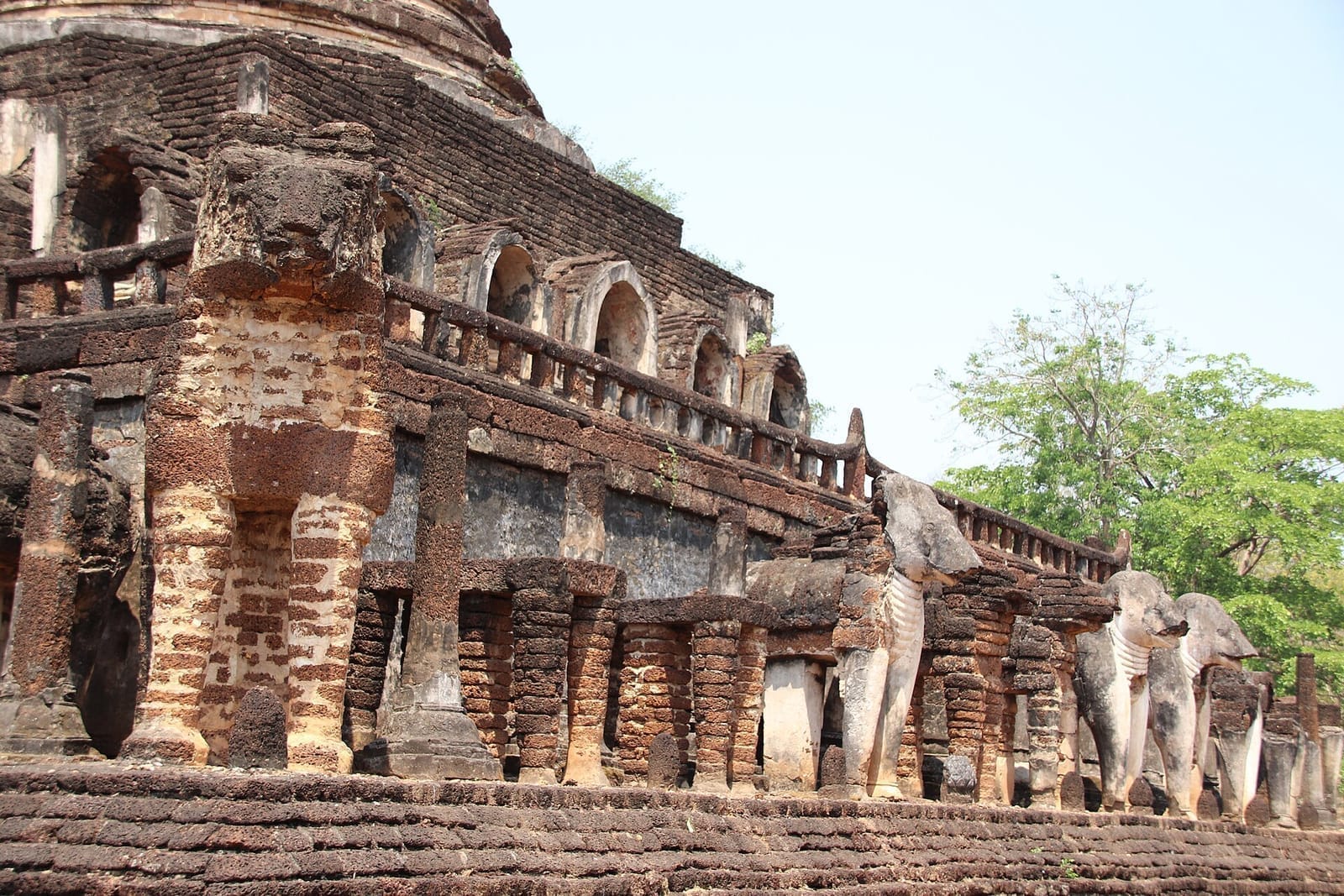
Wat Chang Lom (Si Satchanalai) — Chedi Ringed by 39 Elephants
Over at Si Satchanalai Park, Wat Chang Lom stands near the centre of the old walled city close to the Yom River. The chedi is a Sinhalese-style bell-shaped stupa set on a two-tiered square base. Around the lower tier, full-bodied stucco elephants face outward on all four sides — 39 in total, with the four corner elephants larger than the rest.
What sets this one apart is that the elephants stand completely free from the wall — full bodies, close to life-size or larger — rather than half-figures projecting from the masonry as you see at similar temples elsewhere in the region. Local residents consider this the finest example of its kind. The temple is believed to date to the reign of King Ram Khamhaeng.
Don't Mix Up the Two Wat Chang Loms
There is a Wat Chang Lom in both Sukhothai Park and Si Satchanalai Park. The one we're talking about here is the Si Satchanalai version — that's the one with intact, fully sculpted elephants. If you're making the trip specifically for the elephant chedi, drive to Si Satchanalai.
Wat Chet Thaeo (Si Satchanalai) — A Row of Stupas in Different Styles
Wat Chet Thaeo is also in Si Satchanalai, just a short walk southeast of Wat Chang Lom. The name "Chet Thaeo" means seven rows — referring to the satellite chedis arranged in rows around the main stupa. There are about 30 of them in total, each in a different form: lotus-bud, Sinhalese bell-shaped, and prang-style towers. Walking through them feels like an open-air museum of Sukhothai stupa design.
Historians believe the temple served as a royal mausoleum for the rulers of Si Satchanalai, built roughly between 1340 and 1350 CE during the reign of Phaya Li Thai. Several chedis still have niches and traces of stucco decoration. Photographers favour the site because the row of stupas catches early morning and late afternoon light in a way that creates long, layered shadows.
Main Lotus-Bud Chedi
The central stupa in classic Sukhothai lotus-bud form — the main photo subject of the complex
Satellite Stupa Row
Dozens of smaller chedis in varying styles; walk between them for the best angle in morning or evening light
Opening Hours, Entry Fees & Getting There
Both parks are open daily roughly 08:00–17:00 (the Sukhothai central zone stays open into the evening on illuminated-monument nights). Tickets are sold by zone, and Thai nationals pay considerably less than foreign visitors. There is a small surcharge for bringing a bicycle into each zone. Bring cash — some booths do not accept cards.
- Sukhothai Historical Park — separate tickets per zone (central / west / north); Thais approx. 20–30 THB, foreigners approx. 100–200 THB per zone; bicycle surcharge approx. 10 THB
- Wat Saphan Hin + Wat Chetuphon — western and southern zones of Sukhothai; bicycle hire near the park gate runs approx. 30–50 THB/day; both are reachable by bike
- Si Satchanalai Historical Park — a separate park about 55 km north of central Sukhothai; drive or hire a motorbike; foreigners approx. 100 THB, Thais approx. 20 THB
- Wat Chang Lom + Wat Chet Thaeo — both inside Si Satchanalai; walkable from each other, easy to combine in one trip
How to Make the Most of Your Time
With one day, focus on Sukhothai's central zone first, then head to Wat Saphan Hin in the late afternoon. With two days, save the second day for the drive to Si Satchanalai — you'll have time to explore Wat Chang Lom and Wat Chet Thaeo without rushing.
Plan your full Sukhothai trip — temples, food, and everything in between
See the Sukhothai Travel Guide →