📝 Written 1 Jul 2026 · ✅ Fact-checked 3 Jul 2026 · prices and schedules can change — check with the operator before booking
Kanchanaburi is about 2–3 hours from Bangkok, and you can cover history, nature, and riverside chill all in one trip. In town there's the River Kwai Bridge and the war museum; on the outskirts, waterfall parks, caves, and the River Kwai itself with its floating raft houses; and further out, Sangkhlaburi with its Mon Bridge and submerged temple.
The activities we've picked below are the ones reviewers talk about most. We've summed up who each one suits, what the highlights are, and what you should know before booking — drawing on real reviews from both the people who loved it and the ones who flagged concerns.
River Kwai Bridge Tour + Death Railway Train Ride (via Tham Krasae curve)

The River Kwai Bridge and the Death Railway are among Kanchanaburi's most historically significant sites. This stretch of track was part of the Thailand-Burma Railway built by the Japanese army during World War II, using Allied prisoners of war and huge numbers of Asian laborers, tens of thousands of whom died during construction under brutal conditions. Most tours walk you across the arched steel bridge over the river, then board a train from River Kwai Bridge Station or Kanchanaburi Station, running along the original Death Railway route. Many itineraries also stop at the museum and the Allied war cemetery, so you understand the story before boarding.
The highlight of the train ride is the Tham Krasae curve, where the tracks sit on a wooden trestle along a high cliff above the Khwae Noi River. The train slows down here, giving full views of the river, mountains, and green forest. According to real reviews from people who've been, many say this stretch is unforgettable, and riding a train on a route with this much history makes you feel more connected to the past than reading about it in a book ever could. A good guide will tell the story behind the site respectfully, turning the trip into more than just photos — a moment of remembrance for those who died.
Before booking, know that the bridge area gets crowded around midday, especially when a train is pulling in, so walking and taking photos on the bridge can mean waiting your turn. Kanchanaburi is hot and sunny, so bring a hat, water, and sunscreen. The train itself is a simple local service — hard seats or fan-cooled cars, no air-conditioning, and it runs slowly, sometimes behind schedule. If you're expecting a luxury tourist train, adjust your expectations, but many people consider that rustic, unpolished feel to be exactly the charm of this route.
- A genuine WWII historical site — both the bridge itself and the Death Railway route
- The Tham Krasae curve, where the train runs along a cliffside above the river, is a view many reviewers say they'll never forget
- A good guide tells the story behind the site respectfully, giving you a deeper understanding of the history than seeing it on your own
- Train tickets are affordable, and there are several tour options that include hotel transfers
- The bridge area gets crowded around midday, especially when a train pulls in, meaning you may have to wait to take photos
- Hot, sunny weather — bring a hat, water, and sunscreen
- The train is a simple local service with no air-conditioning, runs slowly, and sometimes falls behind schedule
Erawan Falls 7-Tier Day Tour, Kanchanaburi (Erawan Falls day tour)
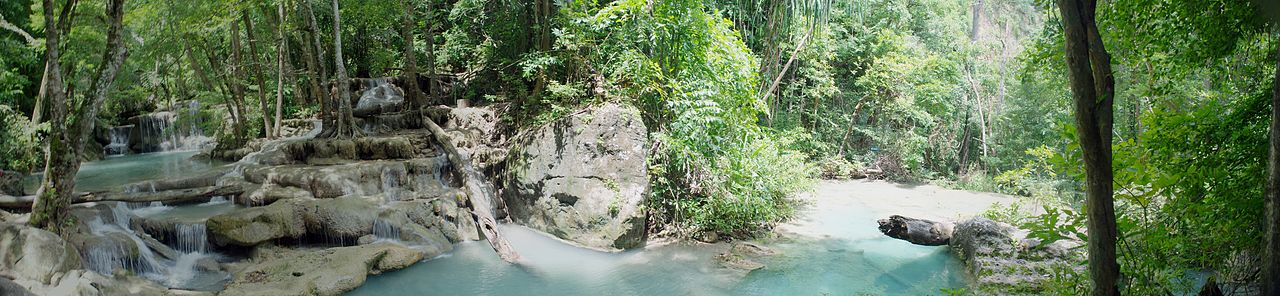
Erawan Falls is Kanchanaburi's most talked-about inland nature highlight, located in Erawan National Park, Si Sawat District, about an hour and a half from town. Most full-day tours include van transfers from your hotel in town along with a guide, taking you up to hike the falls, which cascade down in 7 tiers over about 1,500 meters. Each tier has its own name and shape. The most photographed spot is usually one of the middle tiers, where the water pools into a wide, clear emerald-green basin formed by underwater limestone. Many tiers are swimmable. Tours usually include lunch and leave time to cool off in the water before hiking back down. Some itineraries add on Tham Phra That Cave or the River Kwai Bridge, so you get both nature and history in a single trip.
According to real reviews on Tripadvisor, Erawan Falls scores around 4.5 out of 5 from over 2,300 reviews. Most say the water is clearer and more beautiful than expected, and the higher tiers get quieter and calmer the further you hike. Many say cooling off in the cold water along the way is the most memorable part of the trip. Guided tours get praised for their care and the information shared along the way, so you don't have to worry about navigating or timing things yourself — a good fit for people who don't want to drive and want to fit everything into one day.
Some honest things to know before booking: the park entrance fee is charged separately from the tour price — around 300 baht for foreign visitors, much less for Thai nationals — and it's usually paid in cash on-site. Plastic water bottles brought in must be deposited at the checkpoint and reclaimed when you bring the bottle back down, to prevent litter in the park. The trail up to tiers 6-7 is fairly steep and slippery, with some sections requiring scrambling over rocks and grabbing roots, so wear shoes with good grip. If you have knee problems, hiking to tier 4-5 is a reasonable stopping point. Fish in the pools like to nibble at your legs and feet, which startles a lot of people. Weekends and long holidays get very crowded, especially at the lower tiers, and the topmost tier is often closed to hikers heading up in the early afternoon — staff start clearing people out from around 3:30pm — so head out early to make it to tier 7 in time.
- Clear emerald-green water, more beautiful than expected — swimmable at many tiers, as many reviews confirm
- The higher you hike, the fewer people and the quieter the views
- Guided tours include transfers and lunch, so there's no need to drive or plan your own schedule
- Some itineraries add on the River Kwai Bridge, combining nature and history in a single day
- Extra park entrance fee paid in cash on-site (foreigners pay more than Thai nationals), plus a plastic-bottle deposit
- The trail up to tiers 6-7 is steep and slippery, fish nibble at your legs, and the lower tiers get very crowded on weekends
- The topmost tier closes to hikers in the early afternoon; staff start clearing people out from 3:30pm, so arriving late may mean missing tier 7
Kanchanaburi Elephant Conservation Sanctuary — Full-Day Elephant Care Program (ElephantsWorld-style, no riding)

Kanchanaburi is one of the provinces with several "work for the elephants" style sanctuaries along the Mae Klong River. A commonly mentioned example is ElephantsWorld, founded in 2008 to take in old, sick, disabled, and rescued elephants formerly used for logging, shows, or street begging. The sanctuary's principle is that people care for the elephants, not the other way around, so there's no riding and no shows. The full-day program has you chop sugarcane and bananas to prepare food, hand-feed the elephants, make soft food balls for elephants with bad teeth, help scrub and bathe elephants in the River Kwai, and join in mud baths that elephants love, all under the watch of mahouts and staff throughout.
According to real reviews on Tripadvisor, the sanctuary scores around 4.8 out of 5, and many reviews rank it among the top activities in Kanchanaburi. What reviewers agree on is getting real, close time with the elephants. Staff clearly love the elephants and can explain each one's backstory well; lunch is generous and the riverside setting is shady and pleasant. Many say it was the most memorable day of their whole Thailand trip, because they felt the money they paid genuinely went toward caring for the elephants, not just toward a photo op.
Despite the high rating, there are things worth knowing honestly. Some reviews feel the photo and feeding sessions are somewhat staged, like a performance, with elephants directed to stand or lie down at certain spots, and Tripadvisor itself doesn't allow bookings for elephant activities involving direct contact because they don't meet the platform's animal welfare standards. Bathing and mud-bathing that involve people touching the elephants is also still debated among some conservation groups. If you want to avoid all physical contact with elephants, you might choose a hands-off sanctuary instead. It's worth reading the policy of whichever sanctuary you're considering, and comparing several options in Kanchanaburi before booking.
- No elephant riding and no shows — the focus is on feeding, preparing food, and bathing rescued elephants
- Scores around 4.8/5 on Tripadvisor, and many reviews rank it among the top activities in Kanchanaburi
- Staff and mahouts explain each elephant's backstory well, with close care throughout the day
- Includes lunch and in-town transfers, in a shady setting along the River Kwai
- A full-day activity located out of town, so factor in travel time both ways, and book several days ahead
- Involves mud and bathing, so your clothes will definitely get wet and muddy — bring a change of clothes
- Some reviews feel the photo and feeding sessions are staged like a performance, and Tripadvisor doesn't allow bookings because it doesn't meet the platform's animal welfare criteria; the per-person price is also fairly high
River Rafting + Raft-House Stay on the River Kwai, Kanchanaburi (River Kwai raft-house float & river experience)

A Kanchanaburi signature you'll struggle to find anywhere else is sleeping in a raft house floating on the River Kwai — rooms built on wooden rafts moored along the banks in Sai Yok District, on the Khwae Noi River, whose water stays clear and cool year-round. Many rafts sit in valleys that cars can't reach, so you take a longtail boat or get towed in by boat. The main draw is jumping straight into the water from your own room's doorstep, then floating along with the current in a life jacket before swimming back to the raft. Days are quiet, with only the sound of the river; nights are full of stars, with no city light to interfere.
A well-reviewed raft operator, River Kwai Jungle Rafts, has been running since the early days of raft-house stays in this area, and scores around 4.1 out of 5 from over 1,400 reviews on Tripadvisor. Reviewers consistently mention the beautiful setting, memorable enough that many say they still remember the stay long after. Meals are tasty, staff from the local Mon village are friendly, and there are bonus activities like walking through the Mon village and watching traditional performances in the evening. Basic riverside raft stays in the area come in a range of price points too, from simple rafts for budget travelers to nicer, better-decorated raft houses, with both overnight stays and round-trip half-day rafting packages available.
Some honest things to know before booking: many rafts deliberately keep things rustic. Some have no electricity in the rooms, or only for part of the day, relying on lanterns or flashlights, and some only have cold water, no hot water. Because you're in the forest by the river, there are mosquitoes and insects — even with a mosquito net provided, bring your own repellent. Another thing reviews often warn about is that some rafts are karaoke/party rafts that play loud music late into the night — if you want quiet, make sure to specify a quiet zone when booking. Finally, river activities depend on the weather — during the rainy season the water can get murky and flow too fast to float safely, so ask the operator about river conditions before your trip.
- Sleep on a raft floating in the middle of the River Kwai, wake up to jump in the water from your doorstep and float along — an experience that's hard to find elsewhere
- Quiet, peaceful setting; the night sky is full of stars with no city light, and many reviews say they still remember it well
- A well-known operator like River Kwai Jungle Rafts serves tasty meals, with friendly staff from the local Mon village
- Bonus activities like walking through a Mon village and watching a traditional evening performance, as many reviews recommend
- Many rafts have very basic amenities; some lack electricity in the rooms or only have it part of the time, only cold water, and no wifi
- Being in the forest by the river means mosquitoes and insects — bring your own repellent even with a net provided
- Some karaoke/party rafts play loud music late into the night, and river activities depend on weather — during the rainy season the water can be too murky and fast to float in safely
Hellfire Pass + Museum Tour, Kanchanaburi

Hellfire Pass is one of Kanchanaburi's key WWII historical sites, located in Sai Yok District, about 70 kilometers from town. This is the section of the Death Railway where Allied prisoners of war and Asian laborers were forced to cut through solid rock by hand in 1943. Working at night under torchlight and lamps, the scene of the rock cutting looked like fire from hell, which is where the name Hellfire Pass comes from. Tours booked through platforms usually include hotel transfers from town, guides narrating in Thai or English, and time to walk through the museum and the memorial trail. Many itineraries pair Hellfire Pass with the River Kwai Bridge, the Allied war cemetery, and the Death Railway in a single trip.
The Hellfire Pass Interpretive Centre is run by the Australian government and displays detailed stories, photographs, and testimonies from former prisoners of war, with free admission. What real reviews on Tripadvisor consistently mention (scoring around 4.6 out of 5 from hundreds of reviews) is the audio guide, available to borrow at the counter, which plays narration and interviews with former POWs at points along the trail. Many say it's a moving, informative experience — walking while listening gives a deeper understanding of the weight of what happened there than reading a plaque ever could.
In terms of preparation, the trail down from the museum to the Konyu Cutting is downhill, easy on the way in, but the way back is a fairly steep climb in hot, humid air. Many reviews warn to pace yourself, bring water, and wear shoes that grip well on slippery ground. If you can't manage the full walk, you can view just the main cutting and turn back. Also, this is a memorial site that calls for appropriate behavior, not a spot for casual fun photos, and some tours that pack in several stops in one day give relatively little time at Hellfire Pass — if you want to take it in fully, choose an itinerary that clearly allocates time here, or a tour focused specifically on history.
- The audio guide includes narration and interviews with former POWs, giving a deep understanding of the history, as many reviews praise
- The museum, run by the Australian government, is detailed and free to enter
- The memorial trail lets you actually walk and see the Konyu Cutting, hand-carved by prisoners of war
- Tours usually include transfers and pair well with the Death Railway and River Kwai Bridge in one trip
- Located far out in Sai Yok District, about 70 km from town, meaning a long round-trip drive
- A somber memorial site, not a fun tourist stop — behave appropriately
- The uphill walk back is steep and hot, and some tours that pack in several stops give too little time at Hellfire Pass
Mallika R.E.124 Kanchanaburi Entry Ticket (a living museum of 1905-era Siam)

Mallika City R.E.124 is a recreated village depicting Siamese life during the reign of King Rama V, located in Sai Yok District along Route 323, about 30 kilometers from the River Kwai Bridge. The ticket you book grants entry to the grounds, built up with wooden houses, raft houses, shops, and a riverside market designed to look like it did over a century ago. The main draw is renting a traditional Thai costume to wear while walking around and taking photos all day, filling the town with people in period dress, walking around shopping for old-fashioned snacks and food using coins exchanged for the town's own currency. There are also traditional Thai dance performances and craft activities shown at scheduled times.
Real reviews on Tripadvisor give it around 4.1 out of 5 from about 95 reviews. People who enjoyed it often say the scenery is beautiful and great for photos, a good fit for families and anyone who likes dressing in Thai costume — staff at many spots are cheerful and help pose you for photos. Visitors who went in the late afternoon, around 4pm, say the weather was pleasant and crowds thinner, giving them room to explore fully. However, many reviews also note that the town feels more like a constructed set than genuine old architecture — anyone expecting real historical ruins may find it isn't quite what they're looking for.
Some honest things to know before going: the entry ticket price is just the starting cost. Costume rental is charged extra depending on the style, from tens to several hundred baht, and inside the town you need to exchange money for the local coin currency before you can buy food or souvenirs, so total costs run higher than expected when you buy the ticket. The grounds are also an open-air area with no air-conditioning, and around midday to early afternoon the sun is intense and it gets very hot, so avoid that window or bring an umbrella and water. The town is also located outside Kanchanaburi town, about a 40-minute drive, so if you don't have your own transport, plan your trip in advance.
- Beautifully built recreation of Siamese-era houses, great for photos — a good fit for families and anyone who likes dressing in Thai costume
- You get to spend the day walking around in traditional Thai costume in an old-town atmosphere
- Traditional dance performances, crafts, and old-fashioned food to see and try at scheduled times
- Late afternoon visits are less crowded, giving you room to explore and take photos, per many reviews
- Costume rental and the in-village coin currency are charged separately from the entry ticket, so total costs run higher than expected
- Many reviews feel it's more of a constructed set than genuine historical architecture — those expecting real historical sites may be disappointed
- The grounds are outdoor with no air-conditioning, getting very hot around midday, and it's located outside town, about a 40-minute drive away
River Kwai Kayaking / Rafting, Kanchanaburi (River Kwai kayak & rafting adventure)

The River Kwai runs right through the middle of Kanchanaburi, so the water activities people mention most come in two styles. The first is a relaxed downstream kayak float — operators usually drop you off upriver and let you paddle back into town with the current, over a distance ranging from about 8 kilometers up to a full 15-kilometer route. Along the way you'll see forest, raft houses, temples, and the River Kwai Bridge on both banks. The water here is mostly calm and slow-flowing, making it a good fit for first-timers or families. The second style is white-water rafting on stretches with real rapids, such as parts of the Khwae Noi River or areas around Songkalia near Sangkhlaburi, which require a proper guide team and real safety gear.
According to real reviews on Tripadvisor of a small local kayak operator in Kanchanaburi (RiverKwaiCanoe Travel), it scores a full 5 out of 5, though the number of reviews is still small (around 7). What reviewers consistently mention is that the kayak is stable and easy to paddle since the current does the work; the guide and owner are kind, preparing drinking water and dry bags, taking photos, and looking after kids. The atmosphere is peaceful, with birds and jumping fish to spot. Many say the 15-kilometer route is the most beautiful stretch if you have the stamina, and at around 500–700 baht per person including hotel transfers, it's considered good value.
Some honest things to know before booking: water conditions change with the season. If you go rafting during the rainy season (roughly June–October), the water runs much stronger and faster — more exciting but riskier too. During the dry season, some rapids run too shallow to be fun. This activity also requires a fair amount of effort, especially on longer routes or when paddling against the wind, so your arms and back can tire. Safety depends heavily on the operator, so choose one that provides life jackets for everyone, has an experienced guide team, and checks river conditions before setting out — don't push through rafting in dangerously high water. Finally, many put-in points are located outside town, so allow time for transfers, and confirm clearly whether the price includes transport and equipment.
- The kayak is stable and easy to paddle since the current does the work — good for beginners and families, per many reviews
- The guide and owner are kind, providing drinking water and dry bags, taking photos, and looking after kids
- Peaceful views on both banks, with forest, raft houses, temples, and the River Kwai Bridge, plus birds and fish to spot
- At around 500–700 baht per person including hotel transfers, it's considered good value
- Water conditions change with the season — during the rainy season the rapids run stronger and riskier, while in the dry season some rapids are too shallow to be fun
- Requires a fair amount of paddling effort — longer routes or paddling against the wind will tire your arms and back
- Safety depends on the operator, so choose one with full life jackets and an experienced guide team; put-in points are usually outside town, so allow time for transfers
Wat Tham Suea, Kanchanaburi (giant hilltop Buddha statue + the Kesa Kaew Maha Prasat pagoda)

Wat Tham Suea sits atop a hill in Tha Muang District, about 20 kilometers from Kanchanaburi town. The most photographed spot here is the large gold Buddha statue in the blessing pose, enshrined prominently on the hillside and visible from the entrance. Further up the hill stands the Kesa Kaew Maha Prasat pagoda, a tall, multi-tiered octagonal structure that opens onto an all-around viewing terrace once you climb up. The real draw here is the view: below spreads a vast expanse of green rice fields with the winding Mae Klong River cutting through, a sight rarely found at temples elsewhere.
There are two ways up: climbing about 157 steps, or taking the electric cable car that pulls you up the hill for a fee of a few tens of baht per ride. Many who visit in the morning or evening say the weather is more pleasant, the light better, and it's less crowded than around midday. The temple has free admission with no entry ticket, making it a popular stop on Kanchanaburi tours, often combined in the same itinerary as the River Kwai Bridge, the Death Railway, or the neighboring Wat Tham Khao Noi.
Things worth preparing for, as reviewers consistently note, are the sun and heat. The hilltop has almost no shade, and the ground and tiles get hot enough during the day to make walking barefoot difficult when you remove your shoes to enter the temple grounds — bring water and a hat. The stairs are fairly steep for people with bad knees, and the cable car occasionally closes for maintenance, forcing a walk up. Another common point of confusion is that people mix this up with the Wat Tham Suea in Krabi province, which is a completely different place. And because it's often treated as a brief stop on combined tours, some feel they don't get enough time to explore fully if they want to see everything.
- A large gold Buddha statue and a 9-tier pagoda atop the hill, impressive even from a distance
- Panoramic views of rice fields and the Mae Klong River from the hilltop, which many reviews say make the climb worthwhile
- Free admission with no entry ticket, and a cable car available as an alternative to the stairs
- Not far from town, and can be combined with the River Kwai Bridge or the Death Railway in a single trip
- Requires climbing 157 fairly steep steps, or paying for the cable car, which occasionally closes for maintenance
- The hilltop has intense sun and no shade; the ground gets hot enough to make barefoot walking uncomfortable, so dress modestly
- Often just a brief stop on combined tours, so some feel they don't get enough time there
Sai Yok Noi Waterfall + Cave + Death Railway Wooden Trestle Tour, Kanchanaburi

This tour group visits Sai Yok Noi Waterfall (sometimes called Khao Pang Waterfall) in Sai Yok National Park. Its distinguishing feature is that it cascades right beside the Death Railway — a short walk from the waterfall station gets you straight to the falls. Entry is free, with paved walkways and bridges for comfortable viewing, and in some seasons the water is strong enough to swim in. In the same area there's also a limestone cave to explore, along with a cave temple in the forest above the waterfall. Most tours pair Sai Yok Noi Waterfall into Kanchanaburi's historical route, alongside Hellfire Pass, the Tham Krasae Bridge where the train runs along the cliffside, and the River Kwai Bridge, with van transfers and a guide narrating throughout the day.
Real reviews on Tripadvisor score the waterfall around 4.0 out of 5 (roughly 475 reviews), and on Google it sits around 4.4 out of 5. What reviewers consistently praise is how easy it is to access, requiring no long walk, free entry, and the rare combination of seeing a waterfall alongside old railway tracks. Many say riding the Death Railway along the Tham Krasae cliffside is the most memorable part of the trip, while Hellfire Pass, often included in the same program, gets praise for its exhibits and trail, offering both knowledge and a sense of quiet reflection. A good fit for people who want to combine nature and history in a single day.
Some honest things to know before booking: Sai Yok Noi Waterfall depends heavily on the season. During the dry season, roughly February to April, the water thins out to little more than a trickle on some days. Many reviews say visiting in the wrong season can make the waterfall feel smaller than expected and not worth it if you're going purely for the falls. Weekends and long holidays draw large crowds of Thai visitors, and by afternoon it can get crowded enough that finding an empty spot for photos is hard. Also, tours combining several stops in a day tend to rush, so some stops get shorter visits than you might want, and Kanchanaburi gets very hot in the hot season, so bring water, a hat, and shoes that grip well since the rocks near the falls are slippery. The national park fee is usually charged separately, paid in cash on-site.
- Easy to access with no long walk, free entry, a good stop while touring the historical route
- Seeing the waterfall alongside the Death Railway is a rare sight, as many reviews praise
- Often combined with Hellfire Pass and the Tham Krasae Bridge in one program, covering nature and history in a full day
- A limestone cave and cave temple in the same area to explore
- The waterfall depends heavily on the season — during the dry season (Feb–Apr) the water thins to a trickle on some days
- Very crowded on weekends, hard to find an empty spot for photos in the afternoon, and very hot in the hot season
- Tours combining several stops in a day tend to rush, giving some stops shorter visits than you might want
Sangkhlaburi Tour — Mon Bridge + Wat Wang Wiwekaram + the Submerged Temple (overnight trip from Kanchanaburi town)

Sangkhlaburi sits at the northernmost tip of Kanchanaburi, right on the Myanmar border — a trip that takes you out of the city atmosphere into a Mon community beside the reservoir above the Vajiralongkorn Dam. The first highlight is the Mon Bridge (Uttamanusorn Bridge), Thailand's longest wooden bridge at about 400 meters, spanning the waterway connecting the district center with the Mon village. The most talked-about time to visit is early morning, when mist hangs over the water and Mon villagers come out to give alms on the bridge — a scene of daily life rarely seen elsewhere. From there, visit Wat Wang Wiwekaram, founded by Luang Pu Uttama, to see the golden replica of the Buddhagaya pagoda, and finish with a boat ride to view the submerged temple, the ruins of the original ordination hall that have sat underwater since the dam was built in 1984.
Most organized trips are overnight packages of 2 days 1 night, including transfers from Kanchanaburi town, lakeside lodging, a guide, and meals. Some operators add a stop at the Three Pagodas Pass on the border, or a waterfall along the way. Real reviews on Tripadvisor of the Mon Bridge itself score around 4.5 out of 5 from over 360 reviews. What reviewers consistently praise is that the bridge views at dawn are more beautiful than expected, the alms-giving scene and Mon way of life have real charm, walking across the bridge is free, and taking a boat to see the submerged ordination hall is a strange, one-of-a-kind experience.
Some honest things to know: Sangkhlaburi is very far, about 3–4 hours from town on winding mountain roads, so bring motion-sickness medicine if you're prone to it, and it's better to stay overnight rather than push for a day trip, since you'd be exhausted and miss the most beautiful early-morning window. Also, the submerged temple is only clearly visible during the dry season, roughly March to May, when the reservoir's water level drops; during the rainy season the water is high enough that only the top is visible, and boat rides may be suspended at times — ask the operator about water levels for your travel dates. And to catch the misty morning at the bridge, you need to wake up before dawn; late risers will miss the best part.
- The misty Mon Bridge at dawn and the Mon alms-giving tradition make for a scene many reviews say is more beautiful than expected
- Walking across the bridge is free, with no entry fee
- Taking a boat to see the submerged temple emerging from the reservoir is a strange, one-of-a-kind experience
- You get to pay respects at Wat Wang Wiwekaram and the replica Buddhagaya pagoda in the same trip
- Very far away, about 3–4 hours from town on winding mountain roads — better to stay overnight than do a round trip in a day
- The submerged temple is only clearly visible during the dry season (Mar–May); during the rainy season only the top is visible, or boat rides may be suspended
- You need to wake before dawn to catch the misty morning bridge, and those prone to motion sickness may feel unwell on the winding road
Visiting Kanchanaburi — where should you stay?
Choose a hotel or floating raft house on the River Kwai, compare prices across 3 sites before booking
Search hotels on AgodaBook activities & tickets in advance
Popular activities fill up fast — booking online ahead of time is easier
💡 Know before you go to Kanchanaburi
Erawan Falls and Sai Yok Noi look best after the rainy season (Jul–Nov); during the dry season (Mar–Apr) water levels are low
The River Kwai Bridge, Hellfire Pass, and the war cemetery are war memorials — dress and behave modestly
Erawan, Sai Yok, and Sangkhlaburi are far from each other — many tours include transfers; renting a car is most convenient if exploring on your own
Popular elephant sanctuaries and raft stays fill up fast on holidays — book 2–3 days ahead
How to pick activities that are worth it
With 2 days, we'd suggest spending the first day on the historical route (the River Kwai Bridge–Death Railway–Hellfire Pass), then sleeping at a riverside raft house, and the second day on nature — Erawan Falls or an elephant sanctuary. With 3 days, add on Sangkhlaburi, giving you a full mix of history, nature, and riverside chill.
Ready to plan your Kanchanaburi trip? Start by picking a hotel or riverside raft house
See Kanchanaburi hotels →