📝 Written 3 Jul 2026 · ✅ Fact-checked 3 Jul 2026 · prices and schedules can change — check with the operator before booking
Pattani is an old border-province port town in the south where Muslim, Chinese, and Buddhist communities have long lived side by side, and its attractions clearly reflect that multiculturalism. The highlights are the Pattani Central Mosque with its stately green dome and reflecting pool, nicknamed Thailand's Taj Mahal; Krue Se Mosque, an ancient brick mosque from the era of the Pattani Sultanate; the Lim Ko Niao Shrine, a Thai-Chinese heritage site; Wat Chang Hai, birthplace of the revered monk Luang Pu Thuat; the Kuedeng Cina old town with its Sino-Portuguese buildings and street art; the Pattani Bay Skywalk over the mangrove forest; and Talo Kapo Beach with its colorful kolae boats.
Below we've picked the activities and attractions that come up most often in reviews, along with the best time to visit and what to know beforehand. Pattani is a majority-Muslim province, so halal food is easy to find. Mosque visits call for modest, covered dress — women should cover their hair — and shoes off, and it's best to avoid prayer times (the Central Mosque often closes to tourists on Fridays). Check the current situation and plan your travel in advance, since many attractions are spread outside the city and having a car or a local guide helps a lot.
Pattani Central Mosque
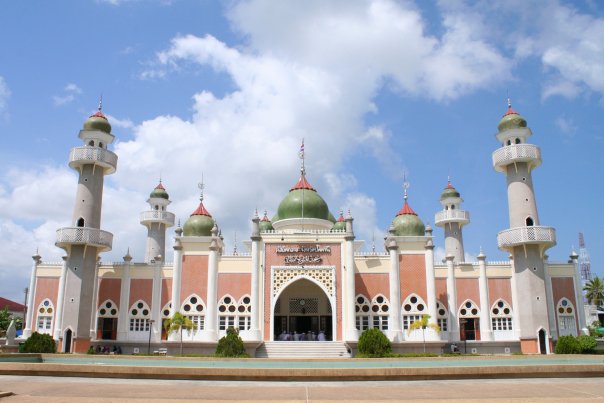
Pattani Central Mosque is the province's number-one landmark, completed in 1963. The building is an elegant white structure with a large green dome and twin minarets on either side. The spot everyone photographs most is the long reflecting pool out front, where the dome and building are mirrored on the water's surface — which is why many people call it "Thailand's Taj Mahal." It sits right in the center of Pattani city, is easy to reach, has convenient parking, and isn't far from the old town or the city market, making it a natural first stop before heading elsewhere. Beyond being a tourist site, it's also a working place of worship for the local Muslim community, so it carries both a peaceful atmosphere and a real sense of sanctity.
The interior is open to visitors roughly from 09:00 to 15:30, and it's closed on Fridays, the day of the main weekly prayers. The best time for photos is in the morning, when the sun isn't too strong yet and the pool's surface is still, giving a clear reflection, or in the evening near sunset when the sky changes color. Admission is free, but dress modestly: women should cover their hair with a headscarf, wear long sleeves and a loose skirt or long trousers, and everyone should remove their shoes before entering the building. If you haven't brought a headscarf, there are sometimes ones to borrow near the entrance. It's worth asking staff or locals before photographing in areas used for prayer, out of respect.
One thing to know plainly before visiting: this is a working place of worship, not a museum. Stay composed, avoid loud noise, and don't photograph people praying up close. The interior may be closed to outsiders during each day's prayer times, so plan for that. The weather here is hot and sunny for most of the day, so coming in the morning or evening is far more comfortable and gives softer light for photos. As for traveling in the deep south provinces, check the current situation and any official advisories before setting out, carry your ID card, and allow extra time at checkpoints along the way. If you're not familiar with the area, going with a local or a guided tour will make the trip easier and give you more context.
- The province's landmark, beautiful and very photogenic — the green dome with its reflecting pool is the iconic image people call Thailand's Taj Mahal
- Right in the center of Pattani city — easy to reach, convenient parking, close to the old town and market, so you can easily continue on elsewhere
- Free admission and doesn't take long, making it a great first stop or a quick detour along the way
- A working place of worship, so you get a genuine sense of the local Muslim community's life, not just a photo spot
- Closed to visitors inside on Fridays, and the interior may not be open to outsiders during each day's prayer times, so plan around that
- Requires modest dress and observing local customs — women must cover their hair and everyone removes shoes, which may be inconvenient if you're not prepared
- Located in the deep south provinces, so check the situation and official advisories, carry your ID card, and allow extra time at checkpoints
Krue Se Mosque — an old brick mosque from the Pattani Darussalam era + the Lim Ko Niao Shrine

Krue Se Mosque is one of the oldest brick mosques in southern Thailand, standing just outside Pattani city along the Pattani–Narathiwat road. It's believed to have been built around the 16th century, during the era when Pattani was a thriving trading port under the Pattani Darussalam dynasty, in the reign of Sultan Mudhaffar Shah. The structure is built of brick and mortar, blending Middle Eastern and European architecture with local craftsmanship. What makes it memorable is its pointed arched doorways and window openings, along with a dome that was left unfinished. Legend has it — tied to the story of the Lim Ko Niao Shrine — that the mosque was cursed to remain forever incomplete. That shared legend is why Krue Se Mosque and the nearby Lim Ko Niao Shrine, so close to each other, are often visited together in a single trip. The Fine Arts Department registered it as a historic site back in 1935, making it a historical landmark that anyone interested in Pattani's story rarely skips.
Visiting here suits people who want to understand Pattani's roots more than those looking for entertainment. The mosque is free to enter, with no admission fee, and has signs telling its history in both Thai and English. You can stroll around the building and take photos comfortably in about 45 minutes to a bit over an hour. The surrounding grounds are an open lawn with some shade trees; mornings or evenings bring softer sun and nicer light than midday. Because it remains a working place of worship, visitors should dress modestly, covering shoulders and knees, and women should keep a headscarf on hand in case they go inside. Stay composed and avoid visiting during prayer times so as not to disturb worshippers. If a caretaker is on site, they're often happy to share extra historical anecdotes.
One thing to be upfront about before visiting: Krue Se Mosque isn't a beautifully decorated or lavish site — it's an old brick ruin whose value lies in its history and its rawness. Visitors expecting a grand photo backdrop may find it smaller and plainer than expected. Another unavoidable point is that this site saw a violent incident in 2004, a wound the local community still remembers. Visits should be made with respect and careful choice of words. The deep south provinces still see periodic security concerns, so check the news and travel advisories beforehand, travel during daylight hours, and if you're unfamiliar with the roads, hiring a driver or local guide will put you more at ease. Facilities nearby are limited, so bring water and a hat or umbrella, and plan to visit the nearby Lim Ko Niao Shrine in the same trip.
- Free admission, a registered historic site since 1935 with high historical value — great for anyone wanting to understand the roots of the Pattani Darussalam era
- A rare style of Middle-Eastern-meets-European curved brick architecture; the unfinished dome and the legend of the Lim Ko Niao curse make for a compelling story
- Close to the Lim Ko Niao Shrine, so you can visit both sites in one trip; bilingual Thai-English historical signage, and caretakers are often happy to share extra stories
- Doesn't take long — about an hour — making it an easy stop on the way in or out of Pattani city without much planning needed
- A plain old brick ruin without lavish decoration; visitors expecting a grand photo backdrop may find it smaller and more ordinary than expected
- The site of a violent incident in 2004, a wound the local community still remembers — visit with respect and careful words
- The deep south provinces still see periodic security concerns — check the news beforehand, travel by day, and note that nearby facilities are limited
Lim Ko Niao Shrine (Leng Chu Kiang Shrine), Pattani

The Lim Ko Niao Shrine, known locally as the Leng Chu Kiang Shrine, sits in the center of the city on Anoru Road. It's an old Chinese shrine that both Thai-Chinese residents and locals across the south have revered for generations. What catches the eye right away is the red pillars, red lanterns, and Chinese-style decor, all still beautifully preserved. Inside sits an image of the goddess Lim Ko Niao, tied to the legend of a young Chinese woman from the Ming dynasty who traveled here searching for her brother. That story became the root of a devotion that continues to this day. Anyone passing through Pattani often stops in to pray for blessings in work, travel, and fortune.
The charm here isn't only the shrine itself but the old-town atmosphere around it. Walk just a few hundred meters from the shrine and you'll find rows of old Chinese-style shophouses still inhabited today, mixed with restaurants and local street food. Next to the shrine is a small museum telling the story of Lim To Khiam, the goddess's brother, and the history of Pattani, giving more context to the legend. The liveliest time to visit is during the Lim Ko Niao procession festival in the third lunar month (around Chinese New Year), when a procession carries the goddess's image through the city streets, a fire-walking ceremony is held in front of the shrine, and at one point people swim across the Pattani River near Dechanuchit Bridge — a spectacle that draws the whole city together.
For anyone planning a visit, admission is free; making a donation or buying incense, candles, and flowers to pray with is entirely up to you. Dress modestly, as this is a sacred site. Morning to late morning has cooler air and beautiful light for photographing the red pillars and lanterns, while anyone wanting to see it lit up should try an early-evening visit. Real reviews from visitors mostly praise it as a worthwhile stop when in Pattani, with volunteers and caretakers who are helpful and kind. Some reviews note that the shrine itself isn't very large, and outside of festival time it's quiet and doesn't take long to see, so it pairs well with a stroll through the old town and a visit to the museum next door.
- Free admission, right in the center of Pattani city, an easy walk from the market and old town
- An old Chinese shrine with red pillars and lanterns, beautiful for photos both day and night
- A museum next door tells the legend of Lim Ko Niao and the city's history, giving more context
- Real reviews praise the kind volunteers and caretakers who help visitors
- The shrine itself isn't very large, and it's fairly quiet on regular days with a short visit time
- During the procession festival, crowds are heavy, parking is scarce, and some streets close
- Best paired with a walk through the old town or the museum, or you may feel you've only seen one spot
Wat Chang Hai Rat Buranaram (birthplace of Luang Pu Thuat), Khok Pho District, Pattani

Wat Chang Hai Rat Buranaram is an old Buddhist temple over 300 years old in Khok Pho District, Pattani, about 31 kilometers from the city. Its significance lies in its connection to Luang Pu Thuat, the revered monk followed by Thais as well as Malaysians and Singaporeans of Chinese descent for generations. Inside the temple grounds are a stupa holding his relics and a shrine linked to him, along with an ordination hall and pavilions for worship. Every day, both locals and travelers from afar stop by to make merit here. One thing many people remember is that the temple sits right along the southern rail line, with Wat Chang Hai railway station nearby, giving it an atmosphere quite different from temples in the city.
Visiting is free, with no entrance fee — only the cost of flowers, incense, candles, and donations as you wish. Inside the temple grounds there are stalls selling amulets and religious items at modest prices. Many visitors like to light firecrackers as a votive offering and crawl beneath the stupa's base for good fortune, according to local belief. Since the temple sits outside the city, driving yourself or renting a car is the most convenient way to get there, taking about half an hour from Pattani city. For those without a car, there are local buses and motorcycle taxis, but allow extra time and agree on a price before setting off. Long weekends and major festivals draw especially large crowds; for a quieter atmosphere, visit on a weekday morning.
One thing to know plainly before visiting: the temple sits in the deep south provinces, so check the current situation and travel advisories beforehand, plan your round trip during daylight hours, and dress appropriately for a temple visit. The weather here is hot and sunny, so bring a hat, umbrella, and water. There are quite a few shops and souvenir stalls inside the temple grounds, so it can get busy at times, with some encouragement to buy amulets — visitors are free to choose as they wish. Overall cleanliness and upkeep are good, with a parking area and restrooms available, making it a good spot for a short stop to pay respects along your Pattani route.
- The temple where Luang Pu Thuat originated, with a stupa holding his relics and a shrine to pay respects at; devotees from Thailand as well as Malaysia and Singapore visit continuously
- Free admission, with donations as you wish, and modestly priced amulets available
- A different atmosphere from city temples — set right along the southern rail line, with Wat Chang Hai railway station nearby
- Has a parking area, restrooms, and shops, making it a good spot for a quick stop to pay respects while touring Pattani
- About 31 km outside the city, with limited public transport — best to have your own or a rented car
- Located in the deep south provinces, so check the situation and travel during daylight hours
- Crowded on holidays and during festivals, with quite a few stalls and some encouragement to buy amulets
Pattani Old Town (Kuedeng Cina) + riverside street art

Pattani's old town, known locally as Kuedeng Cina (Malay for "Chinese market"), is a riverside trading district that once bustled as a trading port back in the reign of King Rama V. What makes it fun to explore is the row of Sino-Portuguese-style shophouses along Pattani Phirom Road and Anoru Road, many of which still retain their original louvered windows, curved archways, and old shop signs, reflecting how Thai, Chinese, and Muslim communities have coexisted in one town. Wander down the side streets and you'll spot old wooden houses, shrines, and mosques alternating with each other — a picture of the deep south unlike anywhere else.
Another draw pulling people in for photos is the murals and 3D street art scattered across walls and alleyways. Many of the pieces depict the community's everyday life — the iconic kolae fishing boats of local coastal fishing culture, scenes of the old market, and patterns blending Thai, Chinese, and Malay motifs. You can wander and photograph freely with no entry fee, stopping along the way to sample southern-style street food, from old-fashioned coffee shops to local sweets and homestyle dishes from the community. It suits anyone who likes to travel slowly, savoring the small details of a town rather than rushing from one check-in spot to the next.
Since this is a neighborhood where people still live and work, walking through it calls for respecting homeowners and shopkeepers — ask permission before photographing people or building interiors, and dress modestly when passing religious sites. Morning and evening bring softer sun and nicer light than midday, and during the rainy season some walkways can get slippery, so carry an umbrella. Pattani is in the deep south provinces, so check the current situation and official advisories before traveling, plan to visit during the day, and ask locals or your accommodation for directions to feel more at ease. Parking around the old town is limited, so if you're driving, arrive early or park in a designated municipal spot and walk from there.
- Free to walk around, no entry fee — see both riverside Sino-Portuguese buildings and 3D street art in one trip
- The murals depict real community life, from kolae boats to old market scenes, giving photo spots with a real story
- Reflects the coexistence of Thai, Chinese, and Muslim communities through old houses, shrines, and mosques in the same neighborhood
- Stop for southern street food, old-fashioned coffee, and local sweets along the way — easy on the wallet
- Located in the deep south provinces — check the situation and official advisories, and plan to visit during the day
- A lived-in neighborhood, so you need permission before photographing people or building interiors, and modest dress passing religious sites
- Parking around the old town is limited, and some walkways get slippery in the rainy season, so arrive early and carry an umbrella
Pattani Bay Skywalk (Somdet Phra Srinagarindra Park) — an elevated walkway over the mangrove forest, looking out over Pattani Bay and Laem Tachi

The Pattani Bay Skywalk is a steel-framed elevated walkway inside Somdet Phra Srinagarindra Park, in Rusamilae Subdistrict, behind Prince of Songkla University's Pattani campus. The walkway rises about 12 meters off the ground and runs roughly 400 meters, stretching over the mangrove forest along Pattani Bay. What people talk about most is the open, all-around view — looking out to see Pattani Bay with Laem Tachi in the frame, while below spreads a dense mangrove forest with an unbroken canopy visible from above. Along the way are rest pavilions at intervals where you can sit, catch the breeze, and take photos. The atmosphere is quieter than attractions in the city, making it a great spot for a gentle morning or evening stroll, with no entry fee.
The charm here is getting two different landscapes in one place — both the sea of Pattani Bay and the mangrove forest, an important local ecosystem. Early morning to late morning brings cooler air and soft light ideal for photos, while many people also love the evening before sunset, when the sky turns beautiful colors over the water. A visit here often pairs well with a stop at the nearby Bana wooden bridge, or continuing on to Rusamilae Beach along the bay, making a well-rounded half-day coastal trip around Pattani. The park has parking and space to stroll, and is easy to reach by car or motorcycle, not far from Pattani city.
One thing to keep in mind honestly before visiting: the walkway is almost entirely outdoors, and midday sun is strong and hot, so it's best to avoid visiting at noon if you don't want to walk in the heat. Bring a hat, sunglasses, and water. The walkway surface is a steel grate you can see through to the ground below, so anyone afraid of heights may feel a bit dizzy at first — walk slowly and hold the railing for reassurance. Some sections of the railing and flooring, after long use, may look worn or be closed for repair, so walk carefully and follow posted warnings. During the rainy season the steel surface gets slippery, so take extra care, and it's worth checking opening hours before setting out, as parts may occasionally close for maintenance. Weather around Pattani Bay changes quickly, so if the sky looks stormy, it's safer to postpone your visit.
- Free, no fee, with parking in the park — an easy, comfortable walk taking in the view in a short time
- See Pattani Bay, Laem Tachi, and the mangrove forest in one sweeping view from a single spot — great for photos
- Quieter atmosphere than attractions in the city, ideal for a relaxed morning or evening stroll
- Close to the Bana wooden bridge and Rusamilae Beach, so you can plan a coastal half-day trip around it
- The walkway is almost entirely outdoors, and midday sun is strong and hot — best to avoid visiting at noon
- The floor is a see-through steel grate — anyone afraid of heights may feel a bit dizzy at first
- Some railings and flooring, after long use, may look worn or be closed for repair — check opening hours before visiting
Talo Kapo Beach — a 10 km stretch of white sand lined with kolae boats (Yaring District, Pattani)

Talo Kapo Beach lies in Yaring District, about 18 kilometers from Pattani city along Highway 42. It's a white sand beach stretching roughly 10 kilometers, with fine sand and fairly calm water, and what sets it apart from an ordinary beach is the row of kolae boats — the vividly colored traditional fishing boats of the Muslim fishing communities along the southern coast — lined up along the shore. It's a scene that tells the story of local fishing life clearly. Many people come here to stroll the sand, photograph the kolae boats, and watch fishermen returning to shore in the morning. The atmosphere is more of a local beach than a commercial tourist beach, so it's quiet and uncrowded compared to the famous beaches on the Andaman side.
What makes visiting easy is that the beach is free, with no entry fee. There are cafés and relaxed seaside spots to stop for drinks and snacks, restrooms available, and a lifeguard on duty at times. It's a great place to spend the morning or evening when the sun isn't harsh and the light is ideal for photos. If you go in the evening, you'll catch the sky changing colors as the sun sets over the long stretch of sand. Near the beach entrance, locals often sell regional street food and fresh seafood to try. Driving or renting a motorcycle from Pattani city makes it an easy trip, with a scenic coastal route the whole way — allow extra time to stop at viewpoints and fishing villages along the road.
Something worth knowing plainly before visiting: Talo Kapo is a natural community beach, so facilities aren't as complete as major tourist beaches. Restrooms aren't always well maintained and may not always be clean, and shops and cafés don't open every day, so it can be very quiet on weekdays outside the season — bring your own water and essentials. During the monsoon season toward the end of the year, waves are strong and the water is murky, so it's not suited for swimming — check the weather before setting out. Another point worth noting is that this area lies in the deep south provinces, so check the current situation and travel advisories beforehand, dress appropriately for a majority-Muslim area, respect community life, and avoid disturbing villagers' boats and fishing gear so you can enjoy the visit with peace of mind.
- A roughly 10 km stretch of white sand, quiet and uncrowded — a comfortable stroll on a beach that feels genuinely local
- A row of vividly colored kolae boats along the shore make for a rare, photogenic scene of southern fishing life
- Free admission, with a seaside café, restrooms, and a lifeguard on duty at times
- About 18 km from Pattani city, with a scenic coastal route the whole way and easy access
- Facilities aren't complete — restrooms aren't always well maintained, and shops/cafés don't open every day
- Strong waves and murky water during the year-end monsoon season make it unsuited for swimming — check the weather first
- Located in the deep south provinces — check the situation and travel advisories beforehand
Namtok Sai Khao National Park, Khok Pho District, Pattani

Namtok Sai Khao is Pattani's largest waterfall, within Namtok Sai Khao National Park in Khok Pho District, about 35 kilometers from the city. The waterfall cascades down the Sankalakhiri mountain range in tiers, totaling several dozen meters in height and stretching down the valley for nearly half a kilometer. Each tier has its own pool for swimming, with water that's cool and fairly clear since it flows straight from the forest headwaters. The surrounding area is lush rainforest with large shade trees, making it a pleasant spot for a family picnic. Another popular stop is "Pha Phaya Ngu," a mountain viewpoint looking down over the plains and Khok Pho District — on a clear day, the view is well worth the climb.
The national park entry fee is very cheap — Thai nationals pay about 20 baht, with foreign visitors charged a higher rate. There's a parking area, restrooms, and small shops selling food near the bottom. Anyone wanting to camp overnight can book a campsite within the park in advance through the National Parks Department. It's an easy drive from Pattani city through Khok Pho District, about 45 minutes, with clear signage. Without a car, you may need to hire a car or motorcycle taxi, since public transport doesn't reach the falls conveniently. The best time for full, beautiful water is after the rainy season, roughly November through January, when the flow is strong and the pools are full; during the dry season the water lessens and some tiers reduce to a small trickle.
Something worth keeping in mind plainly before visiting: the rocks along the waterfall tiers are very slippery, especially where moss has grown, so wear non-slip shoes and watch every step. Long weekends and festivals draw big crowds and it gets fairly busy; for a quieter atmosphere, visit on a weekday or in the morning. During the rainy season the water may flow strong and murky, and the park may close some tiers for safety — check the weather and ask staff before swimming. This area lies in the deep south provinces, so before traveling, follow the news and official announcements, plan your round trip during daylight hours, and bring water, insect repellent, and a bag to carry your trash back out, since this is forest watershed worth protecting.
- A waterfall cascading down several dozen meters, with pools of cool, clear water for swimming at several points amid lush green forest
- Very cheap admission (~20 baht for Thai nationals), with parking, restrooms, a restaurant, and a campsite for overnight stays
- A mountain viewpoint at Pha Phaya Ngu looks out over the plains and Khok Pho District on clear days
- About 35 km from Pattani city, ~45 minutes' drive, with clear signage — visitable in half a day
- The rocks along the waterfall tiers are very slippery, especially where mossy — take care and wear non-slip shoes
- During the dry season the water drops considerably, with some tiers reduced to a small trickle; during the rainy season the water is strong and murky, with some tiers occasionally closed
- Located in the deep south provinces — follow official news and plan travel during daylight hours · public transport doesn't reach the falls conveniently
Rusamilae Beach & Kolae Boat Community, Mueang Pattani

Rusamilae Beach sits at the mouth of Pattani Bay, just about a kilometer from the city — a quick drive or motorcycle-taxi ride away. Its charm isn't crystal-clear water like an Andaman island, but the genuine daily life of a working fishing community. Mornings and evenings bring fishing boats heading in and out, fresh fish stalls, and rows of kolae boats moored along the shore. What most people come specifically to see are the kolae boats themselves — traditional fishing vessels with high, curved bows and sterns, hand-painted with vivid, ornate patterns blending Thai, Malay, and Chinese artistry. It's a folk craft unique to the deep south and hard to find elsewhere. Strolling the beach and watching boatbuilders and fishermen at work gives a side of Pattani quite different from its temples or mosques in the city.
What makes this a great stop is that it's completely free — no fee for the beach or for viewing the boats — and it only takes a short half day, about one to two hours to see it all. It suits anyone staying in Pattani city who wants a photo spot and a taste of local life without traveling far. The kolae boats you'll see include both working vessels that still go out to sea and ones kept mainly to show off their patterns. Some communities in the province still build kolae boats and make miniature versions as souvenirs. Anyone especially interested in this craft can ask locals about the boatbuilders' village in Saiburi District, known for its skilled craftsmen, where you can see the full painting process up close. Rusamilae Beach itself leans more toward a seaside-near-the-city atmosphere and seeing real boats rather than a museum experience.
Things worth knowing plainly before visiting: first, this is a community-life beach, not a sunbathing-and-swimming beach — the water at the bay mouth tends to be murky, with some debris washed in by the waves at times, so it suits strolling and photography more than swimming. Second, the kolae boats are villagers' property and livelihood tools, so always ask the owner's permission before photographing up close or boarding, and don't climb on or touch freshly painted patterns. Third, this area lies in the deep south provinces, so check the situation and official announcements before traveling, dress modestly out of respect for the local Muslim culture, and avoid lingering on the beach after dark. Fourth, the best time to visit is early morning or in the evening before sunset, when the sun is soft and boats are coming and going for good photo opportunities. Bring water and a hat, since there's not much shade along the beach.
- Free — no fee for the beach or viewing the boats — about 1 km from Pattani city, an easy stop in a short half day
- See real kolae fishing boats up close, with high curved bows and sterns hand-painted in vivid patterns — a Thai-Malay-Chinese folk craft rare to find elsewhere
- A genuine working fishing community every day, giving a glimpse of boats coming and going, fresh fish stalls, and a side of Pattani different from its temples or mosques
- A seaside photo spot near the city, with nice light in the early morning and evening — ideal for anyone staying in town who wants a local flavor without traveling far
- A community-life beach, not a swimming beach — the bay-mouth water is murky with some debris washed in at times, so it suits strolling and photos more than swimming
- The kolae boats are villagers' livelihood tools, so you need permission before photographing up close or boarding, and there's little shade along the beach
- Located in the deep south provinces — check the situation and official announcements before traveling, dress modestly, and avoid lingering on the beach after dark
Laem Tachi (Laem Pho) — a white sandbar at the tip of Pattani Bay + a mangrove birdwatching spot
Laem Tachi, known locally as Laem Pho, is a long white sandbar extending from Talo Kapo Beach in Yaring District. The tip of the cape curves around, nearly enclosing half of Pattani Bay. Walk to the very end of the sand and you'll see water on two sides — one being the calmer waters of Pattani Bay, the other opening onto the Gulf of Thailand. Morning and evening bring soft light, ideal for anyone wanting a quiet spot with no entry fee to sit, catch the breeze, and stroll along the wide, uncrowded sand — nothing like the famous beaches in bigger tourist towns. This atmosphere is exactly why Laem Pho is a favorite weekend getaway for locals.
Another charm here is the ecosystem at the bay mouth. Right at the mouth of Pattani Bay lies a large mangrove forest that's a feeding and resting ground for many species of waterbirds, especially during migratory bird season, when shorebirds come down to feed on the mudflats. Nature lovers often take a short boat ride with local fishermen from the city side or the Bana side across to the sandbar and mangrove line. The boat fare is negotiated per trip, varying by group size and distance. Along the way you'll see traditional fishing life, kolae boats, and fish-farming rafts that give a picture of life around the bay. All of this is only about half an hour from Pattani city, making for a trip you can finish in half a day.
Something worth knowing honestly before visiting: Laem Pho is entirely natural, without the full facilities of a major tourist site. Shops and restrooms are few and don't stay open all the time, so bring your own water and food, and carry your trash back out. The sun here is strong since it's an open beach, so bring a hat, sunglasses, and sunscreen. The most convenient way to get there is with your own vehicle, and if crossing by boat, ask locals about the tide times first, since at low tide the mudflats widen considerably and boats have trouble getting in and out. Another thing worth doing is checking the current situation and official announcements before traveling, since this is a deep south area — plan to visit during the day, return before dark, and respect the local Muslim community, dressing modestly to feel at ease for both yourself and your hosts.
- A wide, quiet white sandbar with few crowds and free admission — ideal for a relaxed stroll and photographing sunrise or sunset over the bay
- The tip of the cape shows water on two sides — the calm of Pattani Bay and the open sea — for a broad, restful view
- The mangrove forest at the bay mouth and its waterbirds make it a great spot for birdwatchers and anyone curious about the coastal ecosystem
- About half an hour from Pattani city, finishable in half a day, with a glimpse of traditional fishing life along the way
- Facilities are minimal — shops and restrooms are limited and don't stay open all the time, so bring your own water and food
- An open, sun-exposed beach, and boat crossings depend on the tides — at low tide the mudflats widen and boats have trouble getting in and out
- Located in the deep south provinces — check official announcements beforehand, plan to visit during the day, and return before dark
Where to stay in Pattani?
Choose a place to stay in Pattani city near the old town and Central Mosque for easy access to attractions. Compare prices across 3 sites before booking.
Search hotels on AgodaBook Activities & Tickets in Advance
Pattani's attractions are spread across several districts — booking a car or local guide in advance makes it easy to cover both the cultural sites and the coast.
💡 Know before you go to Pattani
The Pattani Central Mosque and Krue Se Mosque are working places of worship, so dress modestly and covered — women should cover their hair — remove shoes before entering, and avoid prayer times. The Central Mosque often closes to tourists on Fridays.
Pattani is a majority-Muslim province, so halal food is the norm and easy to find, from khao yam and roti to Malay dishes and street food in the Kuedeng Cina old town — try the local specialties as you explore.
The Lim Ko Niao Shrine (Leng Chu Kiang) in the city center is a Thai-Chinese heritage site. During the Chinese New Year procession festival, crowds are big and there's a fire-walking ceremony — visit then if you want to see the tradition.
Attractions like Wat Chang Hai (Khok Pho District) and Namtok Sai Khao lie outside the city, so have a car or local guide, plan your route in advance, and follow the current situation and travel advisories for the area before setting out.
How to plan a Pattani trip that's worth it
Pattani's multicultural sights can be covered fully in 1–2 days. On day one, stay in the city: visit the Pattani Central Mosque and Krue Se Mosque in the morning, continue to the Lim Ko Niao Shrine, walk the Kuedeng Cina old town to photograph the street art and try halal food, then head to the Pattani Bay Skywalk in the afternoon to take in the mangrove forest. On day two, head out of the city: pay respects to Luang Pu Thuat at Wat Chang Hai, visit Namtok Sai Khao, then wrap up at Talo Kapo Beach and Laem Tachi to see the kolae boats and sunset. Pattani combines well with a trip to Yala (Betong) and Narathiwat.
Ready to visit Pattani? Start by picking a place to stay in the city
See Pattani hotels →