📝 Written 2 Jul 2026 · ✅ Fact-checked 3 Jul 2026 · prices and schedules can change — check with the operator before booking
Ratchaburi sits in western Thailand, about 100 kilometers from Bangkok, and packs a lot of variety into one province — the famous Damnoen Saduak Floating Market, the hilltop viewpoint and Buddha statue at Wat Nong Hoi, and Suan Phueng district with its resorts, sheep farms, streams, and cool border-adjacent air, all the way to the dragon-jar pottery town with its distinctive ceramics.
Below we've picked the activities and attractions people review most often, along with the best time to go and what to know before you visit. Damnoen Saduak Floating Market is busiest in the morning, Suan Phueng has the best weather in winter and gets crowded on weekends so book accommodation ahead, while the caves and waterfalls look best in late rainy season into early winter.
Damnoen Saduak Floating Market boat ride (paddle boat/longtail, canal-life sightseeing)
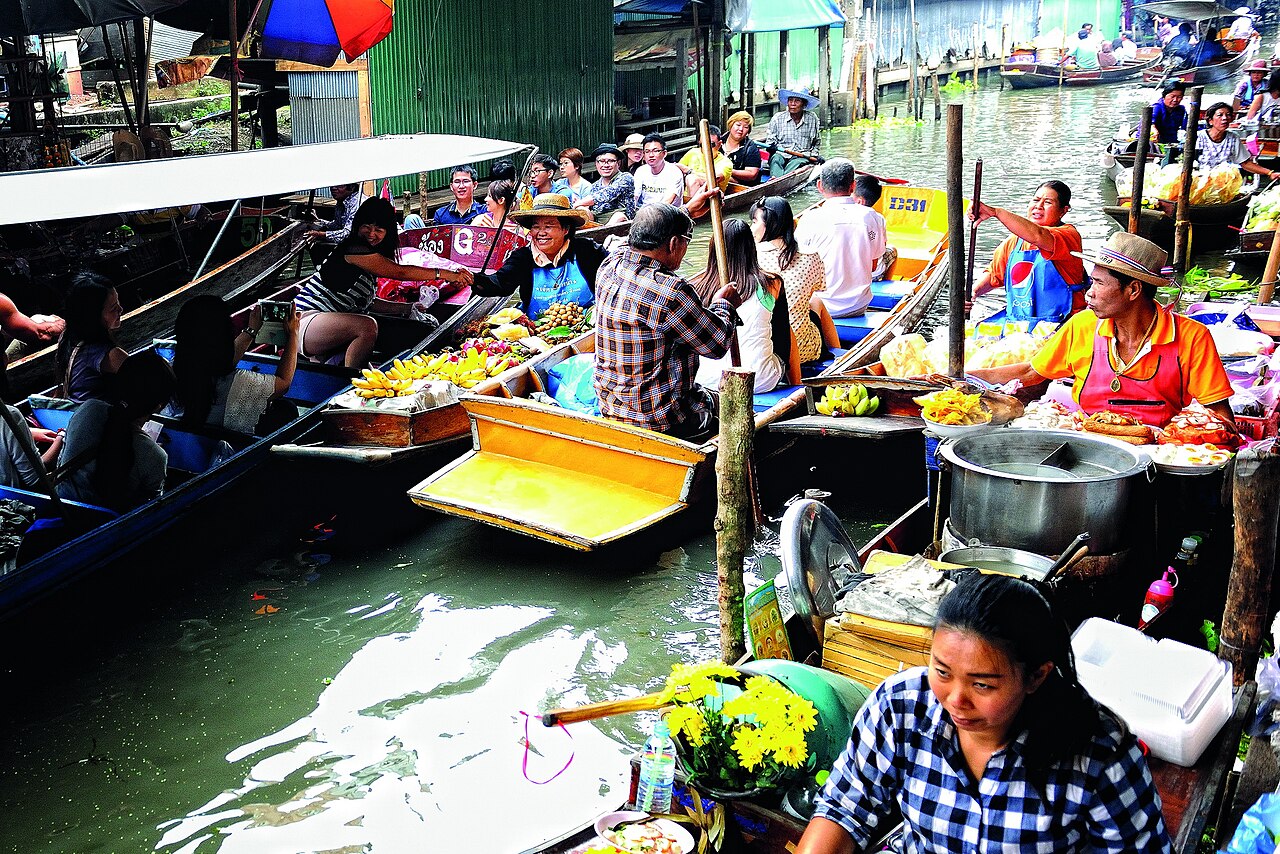
Damnoen Saduak Floating Market is one of Thailand's oldest and best-known floating markets, its canals dug back in the reign of King Rama IV, and it has become the classic image of a Thai floating market recognized around the world. The highlight here is riding a boat to soak up canal life — paddle boats where vendors sell fruit, boat noodles, Thai sweets, and souvenirs one after another, and longtail boats that cruise past both banks of the canal lined with old wooden houses, orchards, and shops. The charm lies in the lively bustle of boats passing each other in the narrow canal, a sight that's hard to find in modern markets. The market is liveliest in the morning from around 8 to 11am; after that the sun gets stronger and tour buses from Bangkok start arriving, making things more crowded and the canal more congested.
Boat rides come in a few options depending on budget and time. Paddle boats suit those who want a slow, quiet pace, seating around five people, priced at roughly four to five hundred baht per forty-to-sixty-minute round. Longtail boats travel farther and faster, seating around six, at roughly eight hundred baht per hour, with some cheaper charter rates available during quiet periods. It's worth stressing that you should agree on the price, route, and time clearly with the boatman before boarding every time, since the posted price and the price actually charged can differ, and some boats charge per person rather than per boat. Booking a half-day or day trip from Bangkok through an online platform in advance usually gets you a price that already includes transport and boat fare, helping you avoid haggling on the spot and know the total cost upfront.
To be upfront about what to expect: Damnoen Saduak is an extremely popular attraction with foreign tourists. On review platforms like Tripadvisor the average score sits around 3.1 out of 5 from over 5,840 reviews, which is middling to below average. Most of the criticism notes that goods are priced higher than normal because prices are set for tourists, that some parts feel more commercial than authentic, and that the canal gets so crowded with boats mid-morning that they jam up. Positive reviews tend to mention the classic atmosphere that's still findable here, trying boat noodles and snacks from the vendor boats, and the fun of riding past both banks of the canal. Ways to improve the experience include arriving early before the tour buses, negotiating the price before boarding, and allowing time to visit nearby markets like Tha Kha or Amphawa Floating Market on the same trip.
- A historic, legendary Thai floating market — the narrow-canal bustle of boats passing each other is a sight that's hard to find in modern markets
- Several boat options to fit your budget and time; paddle boats offer a slower pace, longtail boats travel farther and faster
- Try boat noodles, Thai sweets, and food bought straight from vendor boats mid-canal — a genuinely unique experience
- Only about 1.5–2 hours from Bangkok, so you can visit for half a day and continue on to Tha Kha or Amphawa
- Tripadvisor's average score sits around 3.1 out of 5; many reviews note that goods are overpriced and feel more commercial than authentic
- After 10am it gets crowded, boats jam up in the canal, and the sun gets strong — very different from the morning atmosphere
- Posted boat prices and what's actually charged can differ, and some boats charge per person rather than per boat, so agree clearly before boarding
Wat Nong Hoi hilltop viewpoint + giant Guanyin statue (Wat Nong Hoi, Khao Raeng, Mueang Ratchaburi District)

Wat Nong Hoi sits on a low hill in Khao Raeng Subdistrict, about 12 kilometers from central Ratchaburi. The main draw here is the large white Guanyin (Avalokiteshvara Bodhisattva) statue enshrined at the summit, standing around 16 meters tall and visible from a distance. Once you reach the top there's a wide plaza that serves as a nearly all-around viewpoint over Ratchaburi city — you can see the town, rice fields, and the distinctive limestone mountain ranges that define the province. On clear days the distant ridgelines are visible sharply, making it a good spot for anyone who wants both merit-making and a high-angle city view in one place. The atmosphere at the top is noticeably shadier and quieter than attractions down in town.
Getting up isn't too difficult, since there's a road cut up the hill and a parking area at the top. The temple is open for visits and worship every day from morning until evening, with no entrance fee — donations are welcome. Besides the Guanyin statue there's a prayer hall and other worship points to walk around, plus photo spots overlooking the city that are popular in the early morning and evening when the sun is gentler. Anyone without their own car can book a Ratchaburi day-trip tour that stops here with transport included; per-person pricing depends on how many stops and what's included, so it's worth comparing itineraries to check there's enough time at the top to walk around and take photos.
To be upfront about what to expect: this is a temple and sacred site, so dress modestly — no sleeveless tops, and no short shorts or skirts — and stay respectful. The path up is a hillside route with some sections of stairs or ramps, so anyone who has difficulty walking or is bringing older relatives should allow extra time and rest breaks. The sun can be quite strong at midday up top and shade is limited in places, so bring a hat, umbrella, and water. Long weekends and holidays get especially crowded, and parking may fill up with waits. Some reviews also mention monkeys around the hill, so keep food and bags secured and don't tease or feed them. Early morning or near sunset are the best times for good views and cooler weather.
- A nearly all-around viewpoint over Ratchaburi city, taking in the town, rice fields, and limestone ridgelines — distant views are sharp on clear days
- A large white Guanyin statue at the summit lets you combine merit-making with photos in one spot
- Not a hard climb — there's a road up and a parking area, free entry, open every day morning to evening
- The atmosphere up top is shadier and quieter than attractions in town — good for families and temple-goers
- As a sacred site, you must dress modestly and stay respectful, and the path up includes some stretches of stairs
- The sun is strong at midday and shade is limited, so you need to bring your own hat, umbrella, and water
- Long weekends get crowded and parking may fill up, plus there are monkeys around the hill to watch out for around food and bags
Sheep farm + nature check-in spots in Suan Phueng (The Scenery Vintage Farm etc. — feed sheep, take photos, animal shows)

Suan Phueng District sits in western Ratchaburi, at the foot of the Tenasserim Range that forms the Thailand-Myanmar border. The draw here is wide meadows ringed by mountains, air noticeably cooler than the lowlands, and a string of European-style farms that have sprung up in the area. The most talked-about sheep farm is The Scenery Vintage Farm, decorated as a white Mediterranean-style villa set against meadows and mountain backdrops. Inside it keeps sheep, dwarf goats, Shetland ponies, and mini pigs. The highlight kids love most is carrying a cup of grass in to hand-feed the flock up close, plus a New Zealand-style sheepdog herding show in the afternoon. Beyond this farm, nearby spots like Alpaca Hill and Suan Phueng Highland offer more photo stops on the same trip.
Sheep-farm entry starts at around one hundred fifty baht per person, split into M/L/XL packages that include different activities such as a cup of grass to feed the sheep, tickets for game booths, and access to indoor and outdoor shows. Children under one meter tall usually enter free. The farm is open daily from around 8:30am to 6pm, with extended hours on weekends and holidays. Tripadvisor reviewers give the attraction an average of around 4.0 out of 5 from roughly 94 reviews; most praise the pretty photo spots, well-kept gardens, enthusiastic staff, and say kids have a great time feeding the sheep and watching the sheepdog show. It suits both a day trip and an overnight stay at a resort in the Suan Phueng area.
To be upfront about what to expect: first, timing matters a lot — Suan Phueng looks best and has the best weather in late rainy season into early winter, roughly November to February, when the meadows are green and the air is cool. In summer, midday sun is strong and hot, so go early morning or late afternoon. Second, several reviews note that pricing isn't entirely clear — entry is split across packages, and sheep-feed cups plus extras like archery or horse riding are charged item by item, which can add up more than expected, so ask for the full price breakdown at the counter before paying. Third, some visitors feel the main activities are just photos and feeding animals — if you're not into photography you might not stay long — and some reviews raise questions about the sheep-jumping-through-hoops show; anyone concerned about animal welfare can stick to feeding and walking the farm instead. Finally, Suan Phueng is about 160 km from Bangkok, and the last stretch is a winding mountain road, so having your own car and allowing extra travel time is worthwhile.
- Feed sheep and get up close with dwarf goats, ponies, and mini pigs — kids enjoy feeding grass and watching the sheepdog herding show
- Meadows at the foot of the Tenasserim Range and Mediterranean-style buildings give plenty of good photo spots; Tripadvisor averages around 4.0 out of 5
- Cooler air than the lowlands, especially in late rainy season into winter — a good escape-the-heat trip close to Bangkok that works as a day trip
- Located in the Suan Phueng zone with several farms and cafés nearby, like Alpaca Hill and Suan Phueng Highland, so you can hit several spots in one trip
- Many reviews note unclear pricing — entry is split across packages, and sheep-feed cups plus extras are charged item by item, adding up more than expected
- Main activities are focused on photos and feeding animals — if you're not into photography you might not stay long, and midday summer sun is strong and hot
- About 160 km from Bangkok with a winding mountain road on the final stretch — best with your own car and extra travel time
Pong Yup (Ratchaburi's "Grand Canyon") in Suan Phueng — an eroded-earth photo spot

Pong Yup, which many people call Ratchaburi's Grand Canyon, sits in Tha Khoei Subdistrict, Suan Phueng District. It's an area of earth that's been eroded by water and wind over a long time into cliffs and grooves in unusual ridged shapes — some sections have earthen pillars standing in rows, others show brownish-orange walls layered by soil strata. Most visitors come mainly to take photos, since the area isn't very large and can be walked in a short time. This spot works better as a stop along the way while touring Suan Phueng rather than a full-day destination, and is often paired with nearby attractions like Bo Khlueng hot spring, Khao Ngu Stone Park, or a mountainside café in the Suan Phueng area.
Pong Yup is managed by local landowners, who charge a small entry fee of a few dozen baht per person (children and adults are priced slightly differently and rates may adjust seasonally). The most convenient way to get there is by private car, since public transport barely reaches this spot. The final stretch is a rural access road, so allow extra time and use GPS navigation. The best season to visit is winter into early in the year when the air is dry and the sun isn't too harsh, while the best light for photos is usually early morning or late afternoon, when the angled sun and shadows in the grooves give the images more depth than at midday.
To be upfront: Pong Yup is a small photo spot, and the name "Grand Canyon" may set expectations that don't match the smaller scale of the real thing, so some reviews feel it isn't worth a long trip if this is your only stop. The ground is loose, sandy soil that gets slippery easily, especially after rain or during the rainy season, and there's almost no large tree cover for shade — walking under direct sun gets very hot. Wear shoes with good grip, bring a hat, sunglasses, and water, and avoid climbing on the edges of the earthen cliffs, which can collapse. Most importantly, be careful not to trample or damage the earth formations, since they took nature a long time to create — once collapsed, they won't return to their original form.
- Eroded-earth cliffs and grooves in unusual ridged shapes give photo angles different from typical attractions
- Entry costs just a few dozen baht and the visit is short — good as a stop along the way while touring Suan Phueng
- Located in the Suan Phueng area with several nearby attractions, so you can pair it with other stops in one day
- Not as crowded as more famous attractions, so you can take photos comfortably without competing for angles
- The real scale is smaller than the name "Grand Canyon" suggests, and many reviews feel it isn't worth it as a standalone stop (Tripadvisor 2.5/5)
- The ground gets slippery easily after rain, and there's almost no shade — walking under direct sun gets very hot, so avoid the rainy season and midday
- Public transport barely reaches this spot, so you need your own car, and the final road is a rural stretch requiring extra travel time
Khao Bin Cave — large stalactite-stalagmite cave, Hin Kong Subdistrict, Mueang District, Ratchaburi

Khao Bin Cave sits in Hin Kong Subdistrict, Mueang Ratchaburi District, about twenty kilometers from the city center, off Phetkasem Road near Hin Kong. It's a large limestone cave that locals consider the province's most beautiful stalactite-stalagmite formation. Inside it's divided into about eight connected chambers, each with stalactites, stalagmites, rock curtains, columns, and oddly shaped rock formations that took thousands of years to form. What makes the walk enjoyable is the concrete pathway and colored lighting installed throughout the route, which brings out the rock surfaces and nooks and crannies clearly without needing to bring your own flashlight. The cave's name comes from a rock formation inside that looks like a duck or bird in flight — "Khao Bin" means "flying mountain."
Entry costs around twenty baht per person, very cheap given the size of the cave and the lighting system in place. There's a parking area, shops, and often local student volunteers who offer to guide you through and explain the origin of each rock formation, for a tip of your choosing. Walking through all the chambers takes about half an hour to an hour depending on your pace, since the path loops through without needing to backtrack. Sitting right along a main road, Khao Bin Cave is a popular stop for people driving from Bangkok heading south or touring Ratchaburi in a single day, easily paired with the floating market, Suan Phueng, or a nearby temple. On Google Maps, Khao Bin Cave averages around 4.4 out of 5 from over 1,582 reviews; most say the cave is bigger than expected, the rock formations are beautiful, and it's well worth the tiny entry fee.
To be upfront about what to expect: first, the air inside the cave is hot and humid, getting warmer the deeper you go, causing you to sweat easily — wear breathable clothing and carry water. Second, paths and steps inside the cave are slippery, especially where water drips from the ceiling and rocks are wet, so wear sneakers or shoes with good grip, walk carefully, and hold the railing on stairs. Third, lighting in some sections is fairly dim, so anyone uneasy in tight or dark spaces should stay with the group and not wander off alone. Fourth, some stalactites and stalagmites show signs of being touched and scratched, so view with your eyes and avoid touching the rock surfaces to prevent further wear. Also check opening hours before you go, since the cave usually closes in the evening — arrive too late and you may only get to see the outside.
- A large stalactite-stalagmite cave split into about 8 connected chambers, with plenty of rock curtains, columns, and unusually shaped formations to see
- A concrete pathway and lighting are installed throughout the route, making it easy to walk without needing your own flashlight — good for families
- Entry costs only around 20 baht per person, very cheap for the size of the cave; Google reviews average around 4.4 out of 5
- Sits right along a main road near Ratchaburi city, visitable in half a day and easy to pair with the floating market or Suan Phueng on the same trip
- Paths and stairs inside the cave are slippery, especially where water drips and rocks are wet — wear grippy shoes and walk carefully
- The air inside is hot and humid, getting warmer the deeper you go, causing easy sweating, and lighting in some sections is fairly dim
- Some stalactites and stalagmites show wear from being touched and scratched, and the cave usually closes in the evening, so check hours before you go
Khao Ngu Stone Park, Photharam

Khao Ngu Stone Park is a public park that turned an old limestone quarry into a rest-and-photo spot close to central Ratchaburi. This area was once a major site for blasting and crushing stone dating back to the early Rattanakosin era; once quarrying stopped, the deep pits filled with water and became an emerald-green lake ringed by steep rock cliffs. The spot most people photograph is the long suspension bridge stretching across the water beneath the cliffs — you can walk across it, and it's a photo angle you'll see often on social media. Around the area there are lakeside walking paths, open plazas, and paddle boats for rent to ride out onto the lake — good for anyone wanting an attraction close to Bangkok that doesn't take long but delivers great photos.
Another part of what gives Khao Ngu its historical value is caves carved into the hillside, containing Buddha statues and ancient rock carvings you can go in and pay respects to and view, such as Tham Fa Tho and Tham Chin, remnants of Dvaravati-era art that survive to this day. Visiting here combines both natural views from an old quarry pit and a taste of an archaeological site in one place. The highlight is free or near-free entry, convenient parking, and being only about ten minutes from central Ratchaburi, making it an easy stop en route to Damnoen Saduak Floating Market, cave temples, or other Ratchaburi attractions. Around the park there are shops and food stalls to rest at after walking and taking photos.
To be upfront about what to expect: parts of the park show wear over time — many reviews note that some structures and signage lack upkeep, and cleanliness could improve. Midday sun is strong and hot since the area is open with little shade, so bring an umbrella, hat, and water. The most comfortable times to visit are morning or evening, when the sun softens and the light is better for photos. Another thing to watch for is a fairly large number of monkeys living along the roads and around the park — drive slowly, keep food and snacks secured, don't feed them, and watch out for monkeys grabbing items. Walking the suspension bridge can get crowded on holidays, and keep a close eye on young children since the area is next to water.
- The standout photo spot is the suspension bridge stretching beneath rock cliffs over a green lake — great photos without traveling far from Bangkok
- Free or near-free entry, convenient parking, and only about ten minutes from central Ratchaburi
- Combines natural views from an old quarry pit with Dvaravati-era Buddha cave shrines in one place
- Paddle boats are available to rent on the lake, plus shops and food stalls to rest at after walking and taking photos
- Parts of the park and signage show wear over time — many reviews note concerns about upkeep and cleanliness
- Midday sun is strong and hot with an open area offering little shade — you'll need to bring your own umbrella and water
- A large number of monkeys live along the roads and around the park — watch out for them grabbing items and drive slowly
Wat Khanon — watch a nang yai (giant shadow puppet) performance + the Nang Yai Museum (Photharam District, Ratchaburi)

Wat Khanon in Photharam District is one of the few places in Thailand still keeping the art of nang yai — giant shadow puppetry — alive as a living performance. Nang yai involves holding puppets cut from cowhide or buffalo hide, intricately carved into characters from the Ramakien epic. Performers hold the figures and dance in front of a white screen lit from behind, accompanied by narration and a live piphat ensemble. The temple keeps over 300 old puppet figures in its collection, many over a hundred years old, and has set up a Nang Yai Museum for visitors. Beyond viewing the old pieces, this is also a school teaching local children and youth to make puppets, perform, and play traditional Thai music, keeping the art form alive with a new generation rather than leaving it purely behind glass.
The regular nang yai performance is normally held on Saturdays around 10am, with no entry fee — there's a donation box for anyone who wants to support the troupe. The performance usually opens with an explanation of the origins of nang yai and its instruments, followed by a short scene from the Ramakien. Anyone who can't make it on Saturday can still walk the museum and watch apprentices practicing puppet-making on weekdays, since the museum is open daily during the day. Groups or tours wanting to see a performance on another day can contact the temple in advance to arrange a special showing, though this comes with a cost by arrangement. Since schedules and times can shift around merit-making events or festivals, calling ahead or checking the temple's page before setting off helps you not miss the show.
To be upfront about what to expect: if you're hoping to catch the full performance, you need to plan around Saturday or the annual nang yai festival, since on weekdays you'll mostly see just the museum and coin-operated model puppets, with no live troupe performing. The performance itself is fairly short, around 20 minutes, and focuses more on explaining the art form than delivering flashy entertainment, so anyone expecting a long show may feel it's brief. Midday heat can be intense and some areas lack air conditioning, so bring water and dress modestly since this is temple grounds. Parking is reasonably available but gets busy on long holidays or during merit-making events, so arrive a little before showtime for a good seat without rushing.
- One of the few places in Thailand still holding live nang yai shadow puppet performances — very rare to see today
- Watching the performance and visiting the museum is free, with over 300 intricately cut antique puppet figures on display
- Reviews praise the temple staff as friendly and welcoming, explaining the origins of the art form and instruments clearly
- A genuine school passing the craft on to youth — you see apprentices practicing making and performing puppets, not just pieces behind glass
- The main live performance is only on Saturdays, so you need to plan around that day — weekdays only offer the museum and model puppets
- The show itself is fairly short, around 20 minutes, and focuses on education — anyone expecting a longer show may feel it's brief
- Midday heat can be intense with some areas lacking air conditioning, and long holidays or merit-making events bring crowds and full parking
Suan Phueng's natural waterways — Bo Khlueng hot spring + Nine-Tier Waterfall (soak in hot springs, play in waterfalls seasonally)

Suan Phueng is a district along Ratchaburi's western border, a forested mountain area popular with Bangkok residents driving up on days off, since it doesn't take long to reach but delivers a full dose of mountain scenery and natural waterways. The most talked-about spot is Bo Khlueng hot spring, a natural hot spring that bubbles up from underground, with both foot-soaking pools and larger pools you can sink into to relax sore muscles, the water naturally warm at a comfortable temperature. Another draw is the cluster of waterfalls in the Suan Phueng area, like the Nine-Tier Waterfall, which cascades down a rock face in stepped tiers; during rainy season into early winter the water runs high and strong, making for fun water play. The two experiences offer different things — soak in the hot spring to relax, or dive into the cool waterfall — and you can pick either based on your mood.
Visiting these natural waterways is best suited to those with their own car or a rental, since the various spots are spread out along routes within the district, about sixty to seventy kilometers from central Ratchaburi. Entry to each spot is charged separately and isn't expensive, mostly in the tens to low hundreds of baht per person, with children usually cheaper. Visitors to Suan Phueng typically build a half-day to full-day trip, soaking in the hot spring in the morning and following up with a waterfall or a mountain-view café nearby. Many stay overnight at resorts in Suan Phueng, which offer a wide range of options from mountain views to nature-adjacent settings, letting you enjoy the area without rushing back the same day. The overall atmosphere is quiet, the air noticeably cooler than in the city, and it suits an unhurried, relaxing pace.
To be upfront about what to expect: first, waterfall water volume depends clearly on the season — during the dry season, roughly February to April, water often runs low, leaving the waterfall as a thin trickle, and some spots may have almost no water to play in at all. If you want to see full water flow and enjoy playing in it, go in late rainy season into early winter. Second, the hot spring water is naturally warm, so ease in gradually and don't soak too long, especially if you have an underlying health condition or are bringing young children. Third, rocks along the waterfall get very slippery when wet, so wear shoes with good grip and be careful when climbing around. Fourth, long holidays bring crowds and traffic on the roads into the district, so set off early and allow extra time. Finally, many of these spots are natural areas with limited facilities, so bring a change of clothes, a towel, water, and cash, since phone signal can be unreliable in places.
- Combines soaking in a natural hot spring at Bo Khlueng with playing in a cool waterfall in one trip — choose to relax or dive in as the mood strikes
- Close to Bangkok for a same-day round trip, with a quiet forested atmosphere and noticeably cooler air than the city
- Entry to each spot isn't expensive, mostly in the tens to low hundreds of baht per person, with children usually cheaper
- The Suan Phueng area has resorts, mountain-view cafés, and other natural attractions nearby to visit on the same trip
- Waterfall water volume depends on the season — during the dry season roughly February to April, water often runs low, leaving some spots with almost nothing to play in
- Spots are spread out within the district, most convenient with your own car, and rocks along the waterfalls get very slippery when wet
- Many spots are natural areas with limited facilities, unreliable phone signal in places, and long holidays bring crowds and traffic
Dragon-jar pottery town + Tao Hong Tai kiln (Tao Hong Tai : d Kunst) — view, shop, and café at Ratchaburi's ceramics hub

Ratchaburi has long been known for its dragon jars, and Tao Hong Tai is the name that comes up most often when people talk about the town's ceramics. This site was once one of Ratchaburi's earliest ceramics factories, producing dragon-pattern jars for over half a century, before part of the space was converted into a contemporary art gallery called Tao Hong Tai : d Kunst, blending the old factory, ceramic artwork, and a café together. Walking in you'll find dragon jars lined up, the original kiln's brick walls, and contemporary clay artwork scattered throughout the grounds. It's a popular spot to stroll, take photos, and see how a local craft has been extended into art. Entering most of the grounds is free — you only pay for café drinks, souvenirs, or a workshop if you choose to do one.
The activity people usually do after walking around is sitting down for coffee or a cold drink in a café corner decorated with ceramic pieces, and trying a pottery or ceramic-painting workshop to make a piece of your own. It suits anyone who wants a hands-on experience rather than just looking. Workshop prices are charged per piece and design chosen, so it's worth asking on-site or via their page in advance if you want to plan your budget. Opening hours are generally midday to evening, and the site is usually closed on Wednesdays. Checking the official page for hours before setting off helps you avoid a wasted trip, since exhibitions or special events sometimes close parts of the space temporarily. This spot is in central Ratchaburi right next to Ratchaburi National Museum, so you can continue on to the museum easily in the same trip.
To be upfront about what to expect: this is a learning and art space, not a theme park or a large café, so anyone expecting picture-perfect photo corners everywhere may find the space rawer and simpler than what's shown on social media — it's still an old factory at heart. Some areas are working sections with clay dust and limited viewing access. Dress comfortably, wear shoes suited for concrete floors, and avoid touching displayed pieces. Long holidays get fairly crowded, with parking and café seating potentially full. For a quieter atmosphere and better light, aim for a weekday morning. Anyone interested in the workshop should arrive early, since sessions and materials are limited each day, and allow time for pieces that need to be fired or picked up later.
- Entering most of the grounds is free — walk among dragon jars, the old kiln, and contemporary ceramic art in one place
- A café set in an art-factory atmosphere for a break, plus a pottery/painting workshop to make your own ceramic piece
- A landmark telling the story of Ratchaburi's pottery roots — good for both art lovers and families
- Located centrally next to Ratchaburi National Museum, easy to continue sightseeing on the same trip
- An art space and old factory that's rawer and simpler, not a large café or a place with abundant ready-made photo corners
- Some areas are working sections with clay dust and limited access, and exhibitions occasionally close parts of the space
- Long holidays get crowded, with parking and café seating potentially full, and workshop sessions and materials are limited per day
Walk Ratchaburi's old town + Ratchaburi National Museum by the Mae Klong River

Ratchaburi's old town is a walkable district that packs the charm of a river city along the Mae Klong within easy walking distance of each other. The usual starting point is Ratchaburi National Museum, a Rama VI-era building converted into a museum telling the city's story from prehistoric times, Dvaravati culture, and the ethnic groups of Ratchaburi — Thai, Chinese, Mon, Lao, and Khmer — through to the textile and pottery work the province is known for. The building itself is attractive and shaded, entry is cheap, and walking through takes roughly an hour to an hour and a half to get a full picture of the city. From the museum, continuing along the old street you'll find wooden shophouses, old row houses, and traditional stores still open for business — good for anyone who likes photographing streets with a sense of time.
Strolling from the old town down to the Mae Klong riverside brings a different atmosphere. By the river there's Ratchaburi's town market, a shrine, and several riverside cafés opening onto river views, where you can sip coffee or iced tea watching boats and the slow-flowing river — a fitting pause after a morning of sightseeing. Many of the cafés blend old-and-new styles, some converted from old riverside shophouses, giving you both the view and the atmosphere together. In the evening, the shade and breeze by the river turn pleasant, and it's when locals come out to stroll and relax. Planning a loop from the museum, through the old town, and finishing at a riverside café lets you keep moving without doubling back by car.
To be upfront about what to expect: the museum is closed Mondays-Tuesdays and public holidays, open roughly 9am-4pm, so check hours before setting off since they can shift. Walking this district means walking mostly under the sun, and it gets fairly hot at midday in summer, so aim for morning or late afternoon and bring an umbrella or hat and water. Sidewalks in some stretches are narrow with traffic passing, so be careful crossing streets. Some old shops and cafés keep inconsistent hours and some open only on holidays, so if you're set on a particular place, check its opening hours via their page first. Parking in the old town district is limited, so on busy days go early or park outside the district and walk in.
- Attractions are within walking distance of each other — from the museum to the old shophouse district, the market, and riverside cafés — easy to plan as a loop
- Ratchaburi National Museum is cheap to enter, the building is attractive and shaded, and it covers the city's history and ethnic groups thoroughly in a short visit
- Along the Mae Klong River there are cafés and spots to relax with a river view, pleasantly cool in the evening — a good rest after sightseeing
- Visitable in half a day at low cost — good for a day trip or a stop en route to somewhere else
- The museum is closed Mondays-Tuesdays and public holidays — you may find it closed if you don't check hours first
- Walking is mostly under direct sun, fairly hot at midday in summer, with narrow sidewalks and traffic in some stretches
- Parking in the old town district is limited, and some cafés keep inconsistent hours or open only on holidays
Where to Stay in Ratchaburi?
Choose a mountain-view resort in Suan Phueng, or a hotel in Ratchaburi city-Damnoen Saduak — compare prices across 3 sites before booking
Search Hotels on AgodaBook Activities & Tickets in Advance
Suan Phueng resorts and Damnoen Saduak floating market tours fill up fast on holidays — booking ahead is more convenient
💡 Know Before You Go: Ratchaburi
Damnoen Saduak Floating Market is liveliest and busiest with boats in the morning (roughly 7am–11am); go later and it's quieter. Watch prices for goods and boat fares — agree before boarding.
Suan Phueng District has resorts, sheep farms, and streams, with the best weather in winter. It gets crowded on weekends and accommodation fills up fast, so book ahead.
Pong Yup (Ratchaburi's "Grand Canyon") and Suan Phueng's waterways look best in different seasons — water is highest in late rainy season. Check conditions and watch for slippery surfaces.
Ratchaburi is famous for its dragon-pattern pottery, with shops and factories you can visit and buy souvenirs from — an easy stop while touring the city.
How to Plan a Worthwhile Ratchaburi Trip
If you're focused on the floating market, go to Damnoen Saduak early, then continue to Wat Nong Hoi (the sheep-shaped hill viewpoint) and the dragon-jar town in the afternoon — doable as a day trip. If you'd rather relax in nature, stay overnight in Suan Phueng for one night, visiting the sheep farm, Pong Yup, the waterways, and a mountainside café — that way you get the floating market, culture, and nature all in one trip.
Ready to visit Ratchaburi? Start by choosing a hotel in Suan Phueng or in the city
See Ratchaburi Hotels →