📝 Written 2 Jul 2026 · ✅ Fact-checked 3 Jul 2026 · prices and schedules can change — check with the operator before booking
Songkhla is a southern province with a bit of everything — a charming old town, the Gulf of Thailand, Songkhla Lake, and Hat Yai, the South's biggest commercial hub. Getting there is easy: fly into Hat Yai Airport, then take a car onward into Songkhla town. The highlights range from old-town street art to Samila Beach with its mermaid statue, Ko Yo island, and a string of viewpoints and nature spots around the city.
The activities below are the ones travelers review most. We've summed up who each one suits, what makes it worth doing, and what you should know before you go — drawn from real reviews, both the praise and the honest gripes. Songkhla town and Hat Yai sit about 30 km apart, so planning your days by zone gets you more out of the trip.
Walk Songkhla Old Town — Nang Ngam, Nakhon Nok & Nakhon Nai Roads (street art, Sino-Portuguese shophouses, local eats)

Songkhla Old Town is the historic quarter of Bo Yang in Mueang Songkhla District, laid out along three roughly parallel streets — Nakhon Nok Road, Nakhon Nai Road, and Nang Ngam Road — that are all an easy walk apart. What draws people here is the old Sino-Portuguese shophouses, a blend of Chinese, Thai, and Western craftsmanship. Many buildings still keep their original facades; some have been turned into cafes, souvenir shops, and small galleries. Street art is scattered across the walls throughout the neighborhood — bright paintings, ceramic wall pieces, and murals designed so you can stand inside the scene for a photo. It's an old town that's still genuinely lived in and worked in, not just a backdrop for pictures.
Another draw of the area is the local food you can pick up along the way. Nang Ngam Road is known for its long-running shops — old-style Thai sweets, coconut ice cream, tao khua (a local sweet-savory bean dish), traditional-recipe stewed rice, and coffee shops that have been open for decades. Many sit in old buildings that keep their original character. Keep walking and you'll come across old shrines and merchant houses that tell the story of this port city's Chinese roots. There's no entry fee to explore the district, so most of your budget goes toward food and cafes. If you don't want to walk the whole way, bikes are available to rent, and there are tram or tuk-tuk services for parts of the tour. It suits an unhurried half-day out. On platforms like Tripadvisor, Songkhla Old Town gets consistent praise for quality street art and a neighborhood that's genuinely fun to explore on foot — many reviewers say it holds up well against old towns in nearby cities.
A few honest things to know before you go. First, midday sun here is intense and it gets very hot — walking in the afternoon is more tiring than you'd expect, and several reviews consistently suggest walking in the morning or evening instead. Second, the most popular street-art photo spots get crowded and you may have to wait your turn, especially on weekends — come early if you want an empty shot. Third, many of the old food shops keep limited hours or close early, and some sell out by afternoon, so check opening hours ahead and don't arrive late. Fourth, some stretches of road are narrow with cars passing through, so be careful standing in the street for photos — and parking in the area is fairly limited, so if you're driving, allow extra time to find a spot or park outside the district and walk in.
- Free to walk, no entry fee — the three main streets run roughly parallel and connect in a short walk, so a half-day trip wraps up comfortably
- Street art scattered throughout the neighborhood, from paintings to ceramic pieces to murals you can stand inside for a photo — real reviews praise the quality
- Sino-Portuguese shophouses still keep their original look; many now house cafes and souvenir shops in old buildings, with the atmosphere fully intact
- Local food available all along the route, from old-style Thai sweets and tao khua to stewed rice and long-running coffee shops on Nang Ngam Road
- Midday sun is intense and it gets very hot — walking in the afternoon is more tiring than expected, and reviews recommend walking in the morning or evening instead
- Some famous street-art photo spots get crowded and require waiting in line, especially on weekends
- Many old food shops close early or sell out by afternoon, and parking in the district is limited — allow extra time to find a spot
Samila Beach + Golden Mermaid Statue + the Guardian Cat and Rat Statues (Songkhla's Laem Samila landmark)
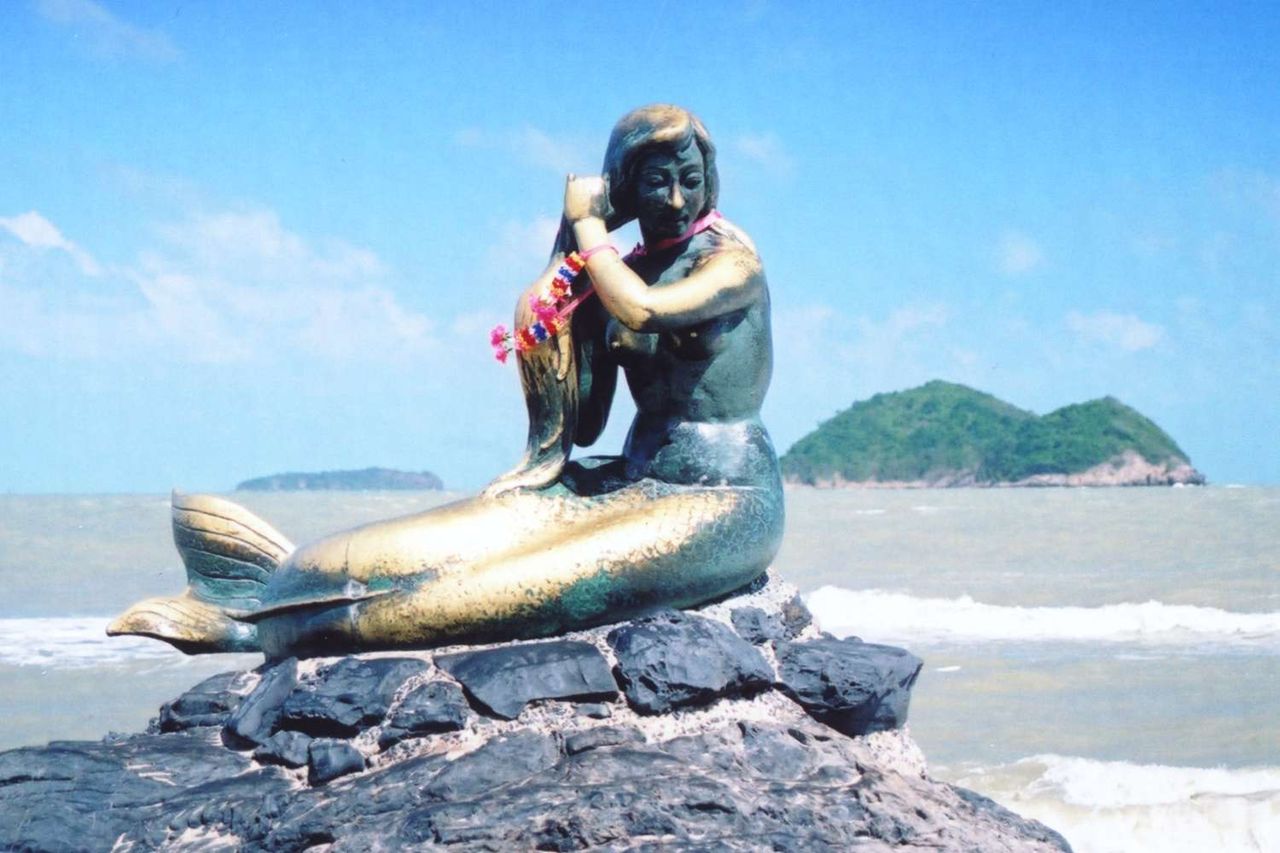
Laem Samila is the beach in the middle of Songkhla town where locals and visitors alike come to stroll from morning until evening. The must-stop spot is the Golden Mermaid statue seated on a rock by the sea, cast back in 1966 and now the province's signature symbol — instantly recognizable as Songkhla. Further along toward Laem Son On stand statues of a white cat and rat, known locally as the guardian cats, referencing the legend of Ko Nu Ko Maeo, the two islands floating just offshore. You can photograph all three landmarks in a single trip. The beach here is fairly wide, with a row of pine trees offering shade, and Ko Nu Ko Maeo makes a lovely backdrop as the sun starts to set.
Part of the appeal is that it costs nothing to visit — park and start strolling. The most popular time is between about 4 and 6 pm, when the sun softens and the sea breeze cools things down. There are plenty of seafood restaurants, ice cream shops, and food carts along the beach. Many people rent bikes or four-wheeled pedal carts to ride along the shore, and in some spots you can rent mats and inner tubes if you want to get in the water. Laem Samila's location isn't far from Songkhla Old Town, Khao Tang Kuan, and other attractions in town, so it's easy to fold into a single day. It suits anyone who wants Songkhla's iconic image without much planning.
A few things worth bearing in mind, per real reviews: midday sun is intense here since it's an open beach, so morning or evening is more comfortable. Weekends and holidays get very crowded, especially around the mermaid statue, where you'll likely wait for a photo. Some reviews note the beach isn't always spotless, with debris washing up from waves and visitors, and the water isn't as clear as beaches on the Andaman side — so this spot suits strolling and photos more than serious swimming. Evening parking on weekends is fairly tight, so arrive early or be ready to walk a bit further, and bring an umbrella or hat plus water on sunny days.
- The Golden Mermaid statue is Songkhla's signature symbol — great photos and the province's iconic image in one spot
- Free to visit, no entry fee — a comfortable evening beach stroll with a cool sea breeze and pine trees for shade
- Three landmarks in one trip: the mermaid, the guardian cat-and-rat statues, and the view of Ko Nu Ko Maeo
- Central location near Songkhla Old Town and Khao Tang Kuan, easy to combine into one day
- Midday sun is intense since it's an open beach — best visited in the morning or evening
- Crowded on weekends, with waits for mermaid photos and tight evening parking
- The sea isn't as clear as the Andaman coast, and some days see beach debris — better suited to strolling and photos than swimming
Ko Yo + the Institute for Southern Thai Studies (Folklore Museum) — cross the Tinsulanonda Bridge, eat lakeside seafood, see Ko Yo weaving

Ko Yo is a small island in the middle of Songkhla Lake, connected by the Tinsulanonda Bridge. It's about a 20-30 minute drive from Songkhla town — no boat needed. The main destination on the island is the Institute for Southern Thai Studies, home to the Folklore Museum, a set of southern-style hip-roofed buildings arranged on a hillside by the lake. Inside, exhibits bring southern Thai life to life — tools for making a living, local woven textiles, pottery, antique weapons like the kris dagger, and rooms devoted to shadow puppetry and Manora dance. A leisurely visit takes about an hour and a half to two hours, and the view from the institute looking out over the wide lake and long bridge is a favorite photo spot for many visitors.
Another draw of Ko Yo is its food and craftwork. Seafood restaurants line the shore around the island, many built as wooden houses extending over the water where you can sit and enjoy the cool breeze. The star ingredients are sea bass raised in lake pens and plump oysters farmed nearby — prices per person aren't steep if you're in a group sharing dishes. For shopping, Ko Yo's famous woven fabric is a local specialty — the Kao Kaeo and Ratchawat patterns are signature designs, tightly hand-woven and sold as sarongs, scarves, or fabric lengths to take home. Many shops let you watch the actual weaving looms in action. A trip to Ko Yo covers sightseeing, eating, and shopping all in one outing.
A few honest things to know before you go. First, the institute's buildings are spread across a hillside, so you'll do a fair amount of walking up and down — allow extra time and rest stops if you're not up for much walking or are traveling with elderly family members. Second, midday sun by the lake is fairly strong, so go in the morning or late afternoon and bring a hat and water. Third, museum admission is priced separately for Thai and foreign visitors, and some exhibit labels are mainly in Thai — foreign visitors wanting more detail should ask staff or arrange a guide. Fourth, some lakeside seafood restaurants get very crowded on weekends, so go before noon or call ahead to reserve a table, and check per-dish prices before ordering, especially weight-based seafood dishes, to avoid a surprise at the bill.
- Everything in one place — the southern folklore museum, lakeside seafood, and Ko Yo weaving — perfect for a half-day trip
- Easy to reach, about 20-30 minutes over the Tinsulanonda Bridge from Songkhla town, no boat required, drive straight to the institute
- The museum rates well on Tripadvisor at about 4.4 out of 5, ranked #2 among things to do on Ko Yo, and holds a Travelers' Choice award
- The view from the institute overlooking Songkhla Lake and the long bridge makes a great photo spot, and admission is inexpensive for what you get to see
- Buildings are spread across a hillside, requiring a fair amount of walking up and down — allow extra time and rest stops if traveling with elderly family or anyone who tires easily
- Many exhibit labels are mainly in Thai, so foreign visitors wanting more detail need to ask staff or hire a guide, and admission is priced separately for Thais and foreigners
- Some lakeside seafood restaurants get very crowded on weekends and midday sun is strong — go before noon or reserve a table, and check weight-based menu prices before ordering
Hat Yai + the Khao Kho Hong Cable Car + Phra Phutthamongkol Maharat (Hat Yai Municipal Park viewpoint)

Hat Yai is the biggest commercial and shopping hub in the South, and most visitors spend the whole day wandering Kim Yong Market, Santisuk Market, and the malls in the center of town. But the spot that gives you the real big picture of Hat Yai sits atop Khao Kho Hong, inside Hat Yai Municipal Park. You can reach the top either by a cable car that glides a long stretch across the hillside, or by a road for driving up yourself. The destination at the summit is Phra Phutthamongkol Maharat, a huge golden blessing-pose Buddha image visible from many parts of the city. There's also a Guanyin shrine and a Phra Phrom (Brahma) shrine up top, making this a single stop for both paying respects and taking in the bird's-eye city view. It fits neatly into a Hat Yai shopping trip without eating up a whole day.
The cable car itself is the highlight many people come to try, since gliding above the treeline reveals Hat Yai stretching out toward distant mountains. Ticket prices differ for Thai and foreign visitors, and there are both one-way and round-trip options — check at the ticket counter before buying, since prices shift with the season and promotions. If you'd rather skip the cable car, you can drive or take a hired car up and park at the top with no cable car fee. The most popular time to go up is late afternoon into evening, as the air cools and the city lights come on. Booking tickets or a Hat Yai city tour package that includes this stop in advance makes it easier to compare prices and check whether hotel transfers are included.
A few honest things to bear in mind: the cable car occasionally closes for maintenance or suspends service, and some reviews mention arriving to find it shut, so check its status before you go. Foreign-visitor ticket prices are considerably higher than for Thais, enough that some reviews felt it wasn't great value for the distance covered. Holidays and festivals bring crowds and long queues for the cable car. Sun at the summit is fairly strong at midday with little shade, so bring a hat, water, and comfortable shoes, since you'll need to climb stairs to reach various points. During the southern rainy season (roughly May through December), frequent rain can shroud the view in cloud, so check the forecast and have a backup plan.
- One stop covers both paying respects at the giant Phra Phutthamongkol Maharat and a bird's-eye view of Hat Yai — easy to add to a half-day shopping trip
- The cable car glides above the treeline for a long stretch, revealing the city stretching out toward the mountains — many reviews call it fun and scenic
- Choose between the cable car or driving up yourself depending on budget and convenience, and the park itself is free to enter
- Evening brings cooler air and city lights coming on, ideal for photographers
- The cable car occasionally closes for maintenance or suspends service — check its status before going, since some reviews arrived to find it shut
- Foreign-visitor ticket prices run considerably higher than for Thais, and some reviews felt it wasn't great value for the distance
- Holidays and festivals bring crowds and long queues, and the summit gets strong sun with little shade
Khao Tang Kuan — hillside elevator, pay respects at Phra Chedi Luang, and view Songkhla town and the lake

Khao Tang Kuan is a low hill in the middle of Songkhla Old Town, standing roughly two thousand feet above sea level, and it's a landmark locals have long felt attached to. The main draw is standing at the summit and taking in the whole of Songkhla town at once — Songkhla Lake on one side, Samila Beach and the Gulf of Thailand on the other, and the old rooftops of Nang Ngam Road below. The summit also holds the town's iconic white Phra Chedi Luang, an old lighthouse, and the Red Pavilion, making this both a viewpoint and a place to pay respects in one visit. It suits anyone touring Songkhla Old Town who wants to close out the trip with a bird's-eye view.
There are two ways up. The first is climbing the stairs yourself, which costs nothing but takes real effort, with rest points and views along the way. The more popular option is the elevator (some call it a cable car or tram) that runs through a tunnel to the summit in just two to three minutes. The one-way fare is cheap, around thirty baht for adults and less for children — ideal for elderly visitors, small children, or anyone who'd rather skip the long stairs. Check opening hours before you go, since weekday and weekend hours differ: weekdays tend to open later, while Saturdays, Sundays, and holidays open earlier, and both close in the evening. Late afternoon before sunset is the best time for lovely light and cool, comfortable air for photos.
A few honest things worth knowing before you go: long holidays and festivals bring bigger crowds and longer elevator queues, sometimes longer than the ride itself. The elevator station and summit are home to a large population of monkeys — mostly used to people and not aggressive, but keep food and plastic bags out of sight, don't tease or feed them, and keep sunglasses and valuables tucked away. There's little shade at the summit and midday sun is fairly strong, so bring a hat, sunglasses, and water. Some of the walkway around the chedi has stairs and uneven ground, so anyone with elderly companions or a stroller should watch their step, and dress modestly since this is a chedi grounds and a sacred site for the town.
- A single panoramic view of Songkhla town, taking in Songkhla Lake, Samila Beach, the Gulf of Thailand, and the old town district all at once
- The tunnel elevator reaches the summit in just 2-3 minutes at a cheap fare — great for elderly visitors, small children, and anyone who'd rather skip the stairs
- Pay respects at the town's iconic chedi and see the old lighthouse and Red Pavilion — a viewpoint and place of worship in one
- Located within Songkhla Old Town, an easy walk onward to Nang Ngam Road-Nakhon Nai Road and Samila Beach
- Long holidays and festivals bring crowds and long elevator queues, sometimes longer than the ride itself
- A large monkey population lives around the station and summit — keep an eye on food and valuables
- Little shade at the summit with strong midday sun, and some walkways around the chedi have uneven stairs
Irrawaddy dolphin-watching boat trip, Songkhla Lake (rare Irrawaddy dolphins) — conservation-minded

The Irrawaddy dolphin, known locally as the 'blunt-headed dolphin,' is a rounded-headed freshwater dolphin with no beak, with only a few dozen left in Songkhla Lake. It's the last remaining brackish-water pod in Thailand and is critically endangered. A boat trip to see them isn't just a sightseeing activity — it's a chance to see a rare animal in its actual habitat. Boats depart from community piers along upper Songkhla Lake and gradually move into the calm waters where the dolphins tend to feed. The boat operator, typically a local fisherman, watches the surface closely and waits for the moment a dolphin comes up to breathe. The best chance of a sighting is early morning to mid-morning, when the water is calm and the wind is still, making the dolphins' curved backs and rounded heads easier to spot than during the day.
One thing to understand clearly before booking: this activity does not guarantee a dolphin sighting. They're a rare, wide-ranging wild population — some trips see one up close, some only from a distance, and some see none at all. Go in with the mindset of enjoying the lake's natural scenery first; a dolphin sighting is a bonus if it happens. The single most important factor is choosing an operator that runs a genuinely conservation-minded trip — one that doesn't chase the dolphins, doesn't gun the engine to close in on the pod, and cuts power or slows down near them, since boat noise and propellers are among the reasons this population has declined. Supporting a conscientious community tour also helps give locals income from protecting the dolphins, rather than seeing them as competition for fish in the lake.
For preparation, book ahead and ask clearly what time the boat departs, how many hours the trip runs, and whether life jackets are provided for everyone. Sun on the lake is very strong, so bring a hat, sunglasses, sunscreen, and your own water. A zoom-capable camera captures dolphins better than a phone, since the boat needs to keep a respectful distance and not disturb the animals. The best season to go is the dry months from roughly February to July, when the water is clear and winds are light; the year-end monsoon brings rougher waves and poorer visibility, and many operators may cancel trips. If you get seasick easily, take motion-sickness medicine ahead of time, and only bring small children along when conditions are genuinely calm.
- See the Irrawaddy dolphin, a critically endangered species, in its real habitat — the last remaining pod of its kind in Thailand, found in Songkhla Lake
- A community-run tour that helps generate income for local fishermen and encourages the community to help conserve the dolphins
- Songkhla Lake at dawn is peaceful, with fishing life and waterbirds to see along the way — worth the trip even on days without a dolphin sighting
- The chartered boat is flexible on time and group size, so going as a group or family brings the per-person cost down
- No guarantee of a dolphin sighting, since it's a rare, wide-ranging wild population — some trips see them only from a distance or not at all
- You need to vet the operator yourself, since some run the engine too aggressively or chase the dolphins, which disturbs and endangers this fragile population
- Sun on the lake is strong, the year-end monsoon brings rough water and possible trip cancellations, and there's no aggregated review score from a platform to check beforehand
Ton Nga Chang Waterfall (Ton Nga Chang Wildlife Sanctuary, Hat Yai District, Songkhla)

Ton Nga Chang Waterfall is Hat Yai District's major waterfall, sitting inside a wildlife sanctuary of the same name about 26 kilometers from central Hat Yai — under an hour's drive. What makes this waterfall memorable is tier 3, where the water splits into two streams cascading side by side down the cliff face, earning it the nickname 'Nga Chang' (elephant tusks) for its resemblance to a pair of tusks. The waterfall has seven tiers in total. The lower tiers, 1 and 2, are an easy, short walk in, suiting anyone bringing children or older visitors for a relaxed swim. Reaching the Elephant Tusks tier and the ones above requires a fairly steep, slippery climb, but visitors who've made it say the valley views and cascading water are worth the effort.
The waterfall is at its most beautiful during the rainy season into early cool season, roughly October through January, when the water runs high and strong and the surrounding forest is at its greenest — a contrast to the dry season, when the water thins out and some tiers barely flow at all. Visiting really doubles as a light hike, with a nature trail running alongside the stream; some stretches pass schools of fish in pools and wild monkeys. Entry is charged as a wildlife sanctuary fee, with Thai nationals paying considerably less than foreign visitors. Anyone without their own transport can arrange a car or book a full-day tour from Hat Yai, which often pairs Ton Nga Chang with other nearby attractions, making it an easy day trip without worrying about the return journey.
A few things worth knowing per reviewer feedback: the path up from tier 3 is fairly steep and slippery, especially after rain when the rocks get wet and risk of slipping goes up — wear shoes with good grip and take care. Past the upper tiers, the trail becomes less clear with fewer signs, so first-timers unfamiliar with hiking shouldn't push on alone. Some visitors have encountered snakes or bees along the way, so avoid loud noise and stay clear of beehives. Another common complaint is the foreign-visitor fee feeling steep relative to the facilities on offer, plus the hassle of arranging return transport if you didn't book one in advance. Plan your transfer ahead, bring water and rain gear for the wet season, and arrive in the morning for less sun and smaller crowds.
- A seven-tiered waterfall, with tier 3's twin cascading streams resembling elephant tusks as the standout — reviewers say it beats many other waterfalls in the area
- Close to Hat Yai, under an hour's drive, doable as a day trip — tiers 1-2 are an easy walk in, suiting children and older visitors alike
- Rainy season into early cool season brings strong water flow and lush green forest, with a peaceful, shaded nature trail alongside the stream
- Full-day tours and car-hire services from Hat Yai pair it with other attractions, helping with transport if you don't have your own car
- The climb from tier 3 upward is steep and slippery, especially after rain, and the upper tiers have fewer signs and a less clear trail
- The foreign-visitor fee is fairly steep relative to the limited facilities available
- Arranging a return ride is difficult without your own transport, and some visitors encounter snakes or bees along the way
Songkhla National Museum + Wat Matchimawat (Wat Klang) + Songkhla City Gate (an old-town history walk)

If you want a deeper feel for Songkhla beyond a seaside seafood lunch, walking these three old-town stops together is the most worthwhile way to do it. Start at the Songkhla National Museum, housed in the former residence of the Na Songkhla family, the province's old ruling clan. The building is a century-old blend of Chinese and European architecture — the wooden structure, central courtyard, and light wells still preserve much of the original atmosphere. Inside, exhibits range from prehistoric artifacts, pottery, and mother-of-pearl furniture to the story of the trade and the Chinese community that shaped this city. A relaxed visit takes about an hour to an hour and a half and gives you a solid overview of the town. From there, it's a short walk to Wat Matchimawat, known locally as Wat Klang, the town's landmark temple with a beautiful ordination hall and old mural paintings — a spot where locals come to pay respects and visitors stop to photograph the Thai-Chinese architecture.
Finish with a stroll and photos at Songkhla City Gate and along the old-town streets of Nakhon Nok, Nakhon Nai, and Nang Ngam, lined on both sides with Sino-European shophouses, old wooden houses, coffee shops, food stalls, and street art that brings color and life to the district. All three stops are within walking distance of one another, no transport needed — perfect for anyone who likes to walk slowly, stop for coffee, and soak up the atmosphere of this old port town. Museum admission is inexpensive, with Thai visitors paying only a small fee, while the temple and city gate are free to visit — making this a full, satisfying outing even on a tight budget. Anyone with half a day free in Songkhla town and no clear plan will find this old-town route covers history, art, and great photo spots all at once.
A few honest things to know before you go. First, the National Museum is closed on Mondays and Tuesdays and public holidays — check opening days and hours before setting out, since many visitors have arrived to find it shut. Second, walking the old town in the midday sun, especially from noon to mid-afternoon, gets quite hot — go in the morning or evening instead, when the light is also better for photos, and bring water, a hat, and an umbrella. Third, many shops and cafes in the district only open Friday through Sunday or keep irregular hours — some may be closed if you visit on a weekday, so plan accordingly. Fourth, dress modestly when entering Wat Matchimawat, covering shoulders and knees, and keep your voice down, since it's a working temple still used for religious ceremonies. If you're driving, parking in the old town is fairly limited on holidays — it's more convenient to park outside the district and walk in or rent a bike to explore.
- Covers three old-town highlights in one half-day trip — the museum, the landmark temple, and the city gate — all within walking distance, no transport needed
- The National Museum sits in an old governor's residence blending Chinese and European architecture, offering both history and great photo spots in one place
- Budget-friendly and still satisfying — museum admission is only a small fee for Thai visitors, while the temple and city gate are free
- The old town has Sino-European buildings, cafes, food shops, and street art, making for an enjoyable stroll suited to families, couples, and solo travelers
- The museum is usually closed Mondays, Tuesdays, and public holidays — check opening days first, or risk arriving to find it shut
- Walking the old town at midday to mid-afternoon gets fairly hot, and many cafes mainly open Friday through Sunday, with some closed on weekdays
- Parking in the district is limited on holidays, and entering the temple requires modest dress covering shoulders and knees
Ko Nu Ko Maeo + Laem Son On (Songkhla seaside viewpoint and sunset spot)

Ko Nu Ko Maeo (Rat Island and Cat Island) are two small islands in the middle of the bay that have become one of Songkhla's symbols, clearly visible from the adjoining shores of Laem Samila and Laem Son On. The islands' name comes from a folk legend about a dog and a cat that swam after a junk boat and turned to stone; seen from shore, their shapes resemble a rat and a cat crouched in the sea. This spot is free to visit all day, with no entry fee — you can stroll the shaded, pine-lined beach with a cool sea breeze. Nearby stands the Golden Mermaid monument and the cat-and-rat sculpture, both signature Songkhla photo spots, making Laem Son On a favorite stroll for both locals and visitors passing through town.
The busiest time here is the evening before sunset, since Laem Son On faces the direction where the sun gradually dips below the horizon. The view of Ko Nu Ko Maeo set against the golden evening light is a shot many people come specifically to catch. There's a wide open area to sit and rest, plus seafood restaurants and snack stalls along the beach to browse while you wait. Some visitors rent a motorbike or bicycle to ride along the shore from Samila Beach all the way to Laem Son On in one trip, since the distance is short and the route hugs the coast the whole way. It works well as a closing activity after a daytime tour of Songkhla Old Town, ending the day by the sea in the evening.
A few honest things worth bearing in mind: evenings on weekends get fairly crowded, with both the parking area and popular photo spots requiring a wait — arrive about half an hour before sunset to find parking and pick your spot comfortably. The sea here suits strolling and photos more than swimming, since it's a city beach; some reviews mention debris and oil residue at times, so it isn't ideal for a proper swim. The year-end monsoon brings strong winds and high waves, and the sky can turn cloudy enough to obscure the sunset — check the forecast beforehand. If you want to get genuinely close to Ko Nu Ko Maeo, you'll need to charter a local fishing boat separately and agree on a price before boarding, since the islands themselves have no pier for landing — most visitors view and photograph them from shore only.
- Free to visit all day, no entry fee — a comfortable, shaded stroll under pine trees with a cool breeze throughout, suiting all ages
- A great sunset spot, with Ko Nu Ko Maeo silhouetted against golden evening light — scenic photos and one of Songkhla's symbols
- Adjoins Samila Beach and sits near the Golden Mermaid monument, easy to combine by bike or motorbike along the coast in one trip
- Seafood restaurants and beachside snacks are available to enjoy while waiting for sunset, making it a satisfying way to close out the day
- Weekend evenings get crowded, with both parking and popular photo spots requiring a wait — arrive about half an hour before sunset
- This is a city beach suited to strolling and photos rather than swimming, and some reviews mention occasional debris and oil residue
- Getting genuinely close to Ko Nu Ko Maeo requires chartering a local fishing boat separately and agreeing on a price, since the islands have no pier for landing
Where to stay in Songkhla?
Choose old town, Samila beachfront, or Hat Yai — compare prices across 3 sites before booking
Search hotels on AgodaBook activities & tickets in advance
The Hat Yai cable car and city tours get long queues on holidays — booking ahead is more convenient
💡 Know before you visit Songkhla
Hat Yai Airport (HDY) has plenty of flights. From the airport into Songkhla town is about 30 km, with vans, taxis, and Grab available
Songkhla town (old town-Samila-Ko Yo) and Hat Yai (shopping-cable car-Khlong Hae) are separate towns — plan separate days for each
Nang Ngam, Nakhon Nok, and Nakhon Nai Roads are easy to walk or cycle for street art, old buildings, and food — go morning or evening to avoid the heat
The blunt-headed dolphins of Songkhla Lake are a critically endangered rarity, and sightings aren't guaranteed — choose a boat operator that doesn't chase them, for conservation's sake
How to plan your activities for the best value
With two days, spend the first on the Songkhla side — walk the old town for street art, head up Khao Tang Kuan for the view, enjoy Samila Beach and mermaid photos, then cross the bridge to Ko Yo for seafood. Spend the second day in Hat Yai — take the Khao Kho Hong cable car, pay respects, go shopping, and browse Khlong Hae Floating Market if it falls on a weekend. Nature lovers can add Ton Nga Chang Waterfall to get a full mix of town, sea, and nature.
Ready to visit Songkhla? Start by picking your hotel
See Songkhla hotels →