📝 Written 2 Jul 2026 · ✅ Fact-checked 3 Jul 2026 · prices and schedules can change — check with the operator before booking
Ubon Ratchathani sits at the far southeastern edge of Isan, bordering Laos and Cambodia, on the banks of the Mekong and Mun rivers. It's easy to reach by plane (several daily flights), train, or bus. The main draw here is striking riverside nature, ancient civilization, and deep-rooted festival culture — especially the nationally famous Candle Festival.
The activities below are the ones travelers review the most. We've broken down who each one suits, what makes it special, and what you should know before you go — drawing on real reviews, both the praise and the honest gripes. Many spots are seasonal: Sam Phan Bok, for example, can only be visited in the dry season when the Mekong's water level drops, and the Candle Festival happens once a year around the start of Buddhist Lent (July) — so plan around the season.
Pha Taem National Park — Catch the First Sunrise in Siam + Prehistoric Rock Paintings

Pha Taem is a steep sandstone cliff along the Mekong River in Khong Chiam district, at the very eastern tip of both Ubon Ratchathani province and Thailand itself. What makes this place famous is that it's the first patch of land in Siam to catch the sunrise each day. Many travelers plan an overnight stay nearby or set off from town at three or four in the morning just to stand on the rock ledge before dawn, waiting to watch the sun slowly rise over the ridgeline on the Laotian side, above the wide sweep of the Mekong below. New Year's is especially crowded, since catching the year's first light here is considered special, but on an ordinary weekday morning the atmosphere is calm and quiet, with plenty of room to find a good spot for photos.
The other highlight of Pha Taem is its prehistoric rock art, roughly 3,000–4,000 years old, painted along a stretch of cliff wall several hundred meters long — over 300 images in total, including human figures, handprints, animals, and Mekong giant catfish, offering a glimpse into the lives of the ancient people who once lived along this river. The nature trail runs along the cliff edge, letting you view the paintings group by group as you walk. You can choose a shorter route of about 1.5 kilometers or the full 4-kilometer trail, passing several scenic viewpoints over the Mekong along the way, as well as a cluster of mushroom-shaped rock pillars carved by wind and water erosion. It all adds up to a morning that combines views, history, and a light forest walk.
To be upfront about what you should know before going: Pha Taem is quite far from Ubon town, roughly 90 to 100 kilometers, with no convenient public transport, so most visitors drive themselves or hire a car with a driver. If you want to catch the sunrise, you'll need to set off in the middle of the night, so it's worth booking accommodation in Khong Chiam in advance. Parts of the cliffside trail are rocky and don't have railings the whole way, so wear shoes with good grip and be especially careful near the edge, particularly in the dark or on wet ground. The rainy season brings slippery rocks and fog that can block the sunrise, so the best time to visit is from late rainy season through winter, roughly November to February, when the air is cool and the sky is clear. There are almost no shops on the cliff top, so bring your own drinking water, a warm or windproof jacket, and a flashlight for the pre-dawn hours.
- The first place in Thailand to catch the sunrise — watch the sun rise over the Mekong and the Laotian side from the rock ledge
- Over 300 prehistoric rock paintings more than 3,000 years old, lined up along the cliff, viewable up close along the nature trail
- Plenty to see in one place: Mekong viewpoints, mushroom-shaped rock pillars, and a light forest walk you can adjust to your own pace
- Very cheap park entry fee for Thai visitors, and most reviews praise how well-managed and orderly the trails are
- Far from Ubon town, about 90–100 km, with no convenient public transport — you'll need to drive or hire a car, and set off in the middle of the night for sunrise
- Parts of the cliffside trail are rocky without railings the whole way — extra caution needed in the dark or on wet ground, especially in the rainy season
- Rainy season brings slippery rocks and fog that can block the sunrise, and there are almost no shops on the cliff, so bring your own water and food
Sam Phan Bok — Thailand's Grand Canyon, a Rock Basin in the Middle of the Mekong (Pho Sai District, Ubon Ratchathani)

Sam Phan Bok is a massive rock formation in the middle of the Mekong River in Pho Sai district, Ubon Ratchathani, often called the Grand Canyon of Thailand. Its main feature is a wide expanse of rock riddled with thousands of round holes and basins scattered across the surface, formed over millions of years as the Mekong's swirling currents carried sand and gravel that slowly ground deep hollows into the sandstone. The name Sam Phan Bok comes from a local dialect meaning "three thousand holes," referring to the countless basins found here — so many they're almost impossible to count. Some are as small as a palm, while others are deep and wide enough to be called potholes. Many have been named after the shapes they resemble, such as the dog's-head rock, a heart-shaped basin, and a spot popular for photos that looks like a Mickey Mouse silhouette, making the whole area feel like a maze of rock shapes to explore.
Something to know before planning your visit: Sam Phan Bok can only be visited in the dry season. The best time is roughly January through May, when the Mekong's water level drops enough for the rock field to emerge fully and be walked across. Once the rainy season arrives, the whole rock formation floods over and disappears back beneath the wide river. There's no entrance fee — you can walk straight down from the parking area, or take a local shared truck or skylab closer to save your energy. Another popular option is a boat ride along the riverside rapids from Had Sung Beach or nearby points, cruising past rock pillars and oddly shaped formations on the way to Sam Phan Bok, revealing angles you can't reach on foot and taking in the scenery on both the Thai and Lao sides.
Another charm reviews mention often is sunset. The evening light hits the rock field and the pools of water collecting in the basins, creating a scene many say feels like another world entirely, so it's worth coming in the late afternoon to early evening to avoid the midday heat and catch the best light. Wear shoes with good grip, since some parts of the rocky surface are uneven and can be slippery, and bring drinking water and a hat, as there's little shade and few shops out on the rock field. The roughly two-hour-plus drive from Ubon town might seem far, but most visitors agree it's worth the trip, especially for those who love nature that hasn't become overcrowded — and foreign tourists still haven't discovered it in large numbers.
- Thousands of oddly shaped rock basins and grooves, great for exploring and photos — including a heart-shaped basin and a spot that looks like Mickey Mouse
- Free entry, no admission fee — just walk down from the parking area, or take a local shared truck or skylab into the rock field
- Sunset light hitting the rock field and pooled water is stunning, making it one of the most-praised photo spots in reviews
- Still uncrowded, with few foreign tourists — you get a quiet, spacious atmosphere
- Only visitable during the dry season (roughly Jan-May) — the rainy season floods the entire rock formation underwater
- Far from Ubon town, requiring about 2-2.5 hours by car with no direct public transport
- You'll need to walk across a rocky surface that's uneven and slippery in places, with little shade and few shops — not ideal for those with mobility difficulties
Wat Sirindhorn Wararam Phu Prao (The Glowing Temple) — A Bodhi Tree That Glows After Dark

Wat Sirindhorn Wararam Phu Prao, popularly known as "the glowing temple," sits on the Phu Prao hill in Sirindhorn district, about 80 kilometers from Ubon Ratchathani town, near the Chong Mek border crossing with Laos. What put this temple on the map is the large Bodhi tree mural on the back wall of the ubosot, made from mosaic tiles coated with a fluorescent, glow-in-the-dark material. By day it looks like an ordinary silver-toned tree pattern, but once night falls completely, the tree and the stars around it slowly begin to glow blue-green — a sight that draws people to drive long distances just to photograph it. The piece was designed by craftsman Kunakorn Parinyapunno, who personally laid each mosaic tile by hand.
The temple's appeal isn't limited to the glowing tree. Since it sits on high ground, walking up gives you sweeping views of Sirindhorn Lake and the mountain range on the Laotian side. Late afternoon, just before sunset, is the most popular time to visit, since you can catch both the sunset over the mountains and then wait until dark to see the tree glow, all in one visit. The temple is free to enter and stays open until around 8pm, but the glow is most visible on moonless nights or when the sky is clear of clouds — the light from the tree becomes more vivid once it's fully dark and your eyes adjust. Visitors who come during a full moon or before it's dark enough sometimes find the glow fainter than what they see in postcards.
As for getting there, keep in mind that the temple is quite far from town, and the final stretch of road climbs uphill. Without a private vehicle, you'll likely need to rent a car or charter a taxi both ways, and since the main draw is after dark, the return trip means driving at night on rural roads — plan your driver and timing carefully. On long weekends and holidays, crowds pick up, and the parking area and the photo spot behind the ubosot can get quite packed, sometimes requiring a wait to get a shot of the glowing tree without other people in frame. It's also a sacred site, so dress modestly, keep your voice down, and avoid using flash or other lights that might disturb others setting up long-exposure shots.
- The glowing Bodhi tree mural on the back wall of the ubosot is a rare sight you won't easily find elsewhere — most reviewers say it's well worth the wait until dark
- Set on high ground, with beautiful sunset views over Sirindhorn Lake and the mountain range along the Thai-Lao border as a bonus
- Free entry, no admission fee — easy to fit into a trip around the Chong Mek side, or as a stop before or after crossing the border
- Calm, shaded atmosphere, great for both families and couples, and one of Ubon's most popular photo spots
- Far from Ubon town, about 80 km — without a private vehicle you'll need to rent a car or charter a taxi, and the return trip means driving at night
- The glow is only clearly visible when it's fully dark and on a moonless night — on brighter moonlit nights, or if it's not dark enough yet, the glow appears faint
- Crowded on long weekends — parking and the photo spot behind the ubosot require waiting in line, making it hard to get a shot without other people in it
Sao Chaliang + Pha Chana Dai, Pha Taem National Park (Natural Rock Pillars + Mekong and Sunrise Viewpoint)

Sao Chaliang and Pha Chana Dai are two highlights of Pha Taem National Park in Khong Chiam district, at Thailand's easternmost border along the Mekong River. Sao Chaliang is a cluster of natural rock pillars, shaped by wind and water erosion over millions of years into giant mushroom-like formations, wider at the top than at the base, standing in rows across an open rock field for close-up viewing and photos. It's close to the park entrance, an easy stroll with no strenuous climbing required. Just past Sao Chaliang is the Pha Taem cliff itself, home to prehistoric rock paintings thousands of years old, left behind by ancient peoples — giving this single spot both natural beauty and historical value.
Pha Chana Dai, meanwhile, is a viewpoint on a high cliff facing east, looking out across the Mekong to the Laotian side, and is one of the first places in Thailand to see the sunrise each day. Early-rising travelers often make a point of driving up before dawn to sit and wait for the sun to appear over the ridgeline on the Laotian side, above the river. The atmosphere is cool and quiet. Getting to Pha Chana Dai means driving further in from the Sao Chaliang area along a forest road, then walking a short distance along a viewing trail. Along the way there are several smaller viewpoints and rock outcrops where you can stop to rest and take photos — ideal for travelers wanting a natural getaway that isn't as crowded as more popular attractions.
A few honest things to know before you go: first, the distance from Ubon town is considerable, around 90 to 100 kilometers — without a private vehicle, it's worth renting a car or booking a chartered tour, since public transport doesn't reach here easily and the various spots within the park are spread apart. Second, the hot season brings intense heat with little shade across the rock field, so bring a hat, sunglasses, water, and sunscreen. Third, if you want to catch the sunrise at Pha Chana Dai, you'll need to leave your accommodation late at night or stay somewhere near the park, since it takes a fair amount of time to drive to the viewpoint. Fourth, parts of the cliffside trail don't have railings the whole way, so be extra careful, especially with young children or after rain when the rocks get slippery. And don't forget that the entrance fee for foreigners is several times higher than for Thai visitors, so bring cash to pay at the gate.
- See natural rock pillars shaped like giant mushrooms, formed by millions of years of erosion — easy to view and photograph up close without any strenuous climbing
- Pha Chana Dai is a Mekong-side viewpoint and one of the first places in Thailand to see the sunrise, with a calm atmosphere that isn't as crowded as more popular attractions
- Located within the same park as the prehistoric rock paintings on the cliff face, combining nature and history in a single trip
- Entry fees are affordable for Thai visitors, making it a good option for families and budget-friendly nature trips
- Far from Ubon town, about 90–100 km, difficult without your own vehicle, and the various spots within the park are spread apart requiring further driving
- Very hot in the dry/hot season with almost no shade across the rock field — bring sun protection and water
- Parts of the cliffside trail don't have railings the whole way — extra caution needed with young children and after rain when rocks get slippery, and foreign visitor fees are several times higher than for Thais
Saeng Chan Waterfall (Waterfall Through the Rock Hole), Khong Chiam — A Waterfall That Flows Through a Hole in the Stone

Saeng Chan Waterfall, known locally as the "waterfall through the rock hole," is located in Ban Thung Na Mueang, Na Pho Klang subdistrict, Khong Chiam district, Ubon Ratchathani, within the forested area of Pha Taem National Park. What sets this waterfall apart from most is that the water doesn't fall straight down a cliff face — instead, it flows through a gap or hole in the rock slab above before dropping down as a single stream. When light passes through the water flowing through the hole, it creates a shimmering effect that resembles moonlight, which is how the waterfall got its name ("Saeng Chan" means moonlight). The most beautiful time to visit is from the rainy season into early winter, roughly July through November, when there's enough water to clearly see the stream flowing through the hole. In the dry season, water levels drop or nearly dry up entirely, so you may not see the waterfall as hoped.
The walking trail to the waterfall isn't long or steep — about a 5-10 minute walk from the parking area to reach the falls, making it an easy visit for families and those who aren't experienced hikers. Many visitors combine a trip to Saeng Chan Waterfall with other spots in the Khong Chiam-Pha Taem area on the same day, such as Sao Chaliang at Pha Taem, the prehistoric rock paintings on the cliff, and the Two-Colour River in Khong Chiam town, since they're all along the same route. One thing worth knowing: nearby, about 2 kilometers away, is Thung Na Mueang Waterfall, which some people also call the "waterfall through the rock hole," leading to confusion. Check the exact coordinates and ask for directions clearly before heading out to make sure you're going to the right one.
To be honest about what to expect: this waterfall depends heavily on seasonal water levels. If you visit outside the rainy season, you may find the stream thin or almost non-existent, missing out on the signature "water through a hole" feature that's the main draw. The route from Ubon town to Khong Chiam is fairly long, and part of it runs through district roads, so leave enough travel time and fill up on fuel beforehand. There's no direct public transport to this spot — most visitors drive themselves or hire a car with a driver. During the rainy season, rocks around the waterfall get slippery, so wear shoes with good grip and walk carefully. Facilities here are limited — shops and restrooms aren't as plentiful as at bigger attractions — so bring your own drinking water and food, and carry your trash back out to help keep the forest clean.
- An unusually shaped waterfall, with water flowing through a hole in the rock and falling as a beam resembling moonlight — a rare sight among typical waterfalls
- Easy to reach, about a 5-10 minute walk from the parking area to the falls, with no steep sections — good for both families and couples
- Located along the same route as Pha Taem, the Two-Colour River, and Kaeng Tana, letting you combine several spots into one Khong Chiam day trip
- Cheap or nearly free entry, a budget-friendly nature stop compared to paid activities
- Only beautiful from rainy season into early winter — visiting in the dry season may mean low or nearly no water, missing what you came to see
- Shares its nickname ("waterfall through the rock hole") with the nearby Thung Na Mueang Waterfall about 2 km away, which can cause confusion — check coordinates before going
- Far from Ubon town with little public transport access — most visitors need to drive or rent a car, and facilities here are limited
Khemarat Walking Street (Old Khemarat Town, Riverside — Old Wooden Houses, Cultural Street)
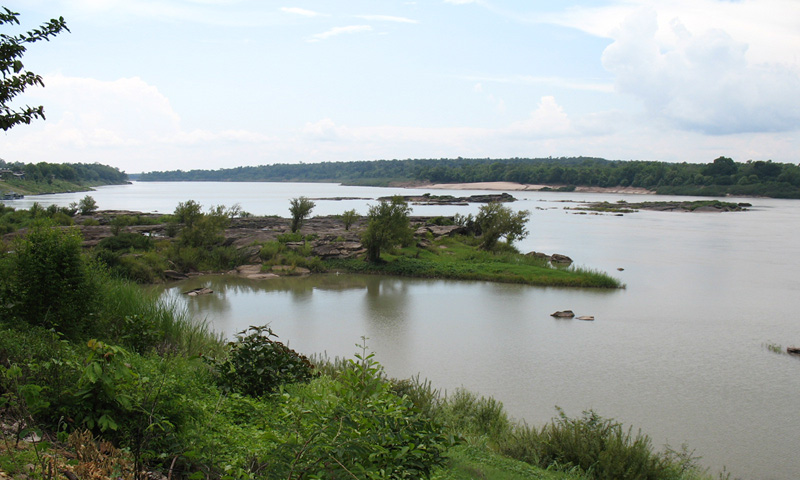
Khemarat is an old town on the banks of the Mekong River at the northernmost point of Ubon Ratchathani province, originally named Khemarat Thani. It was once a bustling riverside trading port, which is why it left behind a legacy of old wooden houses and historic commercial buildings lining the streets of the town center, some nearly two hundred years old. Every Saturday evening, the local community and municipality close off the cultural street to create a walking market, starting around 5pm and running until night. The Hak Na Khemarat group started this event back in 2013 to breathe life back into the old town district, recreating a nostalgic atmosphere. Along both sides of the street are stalls selling local Isan food, old-fashioned sweets, handwoven cotton, traditional clothing, souvenirs, and cafés set in old wooden houses to relax in, all punctuated by a stage where locals put on traditional folk dance performances themselves.
The charm of this place lies in being a small town that hasn't yet been swallowed up by tourism. Most walkers are locals along with slow-travel tourists who've made a point of dropping by — it's not crowded or chaotic like walking streets in bigger cities. You can wander leisurely, taking photos in front of the old wooden houses and antique archways. Food here is priced like a community market, filling you up for just a few tens of baht. Walking to the end of the street brings you to the banks of the Mekong, looking across to the Laotian side, with sunset being the most beautiful time for light. Many visitors like to arrive before dark to catch the riverside view, then loop back to the market once the lights come on. The atmosphere is warm, like an old town that's still genuinely lived in, not just a set piece for photos.
To be upfront about what you should know before going: the walking street operates only on Saturday evenings — visiting on any other day means finding the town quiet, with most shops closed, so plan your day carefully. Khemarat is quite far from Ubon town, requiring about an hour and a half to two hours of driving, mostly along rural roads, so set off early in the day and leave time for the night-time return trip. Accommodation within the district is limited, mostly small guesthouses or homestays, which can fill up quickly during festivals or long holidays, so book ahead. Some food stalls sell out quickly, so arrive early if you want to try the signature dishes before the crowds. Bring cash too, since many community vendors don't yet accept app or card payments.
- An old riverside town with century-old wooden houses and historic commercial buildings to admire and photograph
- A relaxed, uncrowded atmosphere unlike walking streets in bigger cities — most people here are locals, giving a genuine taste of community life
- Affordable local Isan food and handwoven cotton souvenirs — fill up for just a few tens of baht, plus traditional folk dance performances
- Walk to the end of the street to reach the Mekong riverbank, looking across to Laos, with beautiful light at sunset for photos
- Only open on Saturday evenings — visiting on a weekday means finding a quiet town with most shops closed
- Far from Ubon town, about 1.5–2 hours by car, requiring extra time for the night-time return trip
- Limited accommodation within the district, mostly small guesthouses, and many community vendors accept cash only
Kaeng Tana National Park — Mid-River Rock Rapids + Suspension Bridge Over the Mun River (Khong Chiam, Ubon Ratchathani)

Kaeng Tana is a small national park in Khong Chiam district, at the point where the Mun River flows into the Mekong before heading out toward Laos. Its main feature is "Kaeng Tana" itself, a rock formation in the middle of the river split by Don Tana Island, which divides the water into two channels flowing through rocky rapids. During the dry season, roughly November through April, water levels drop and the rocks emerge as a wide, open field, perfect for walking and photos. Another highlight is a long suspension bridge across the Mun River that you can walk across to the other side — as you cross, you can see the rapids and the current flowing beneath your feet, a photo spot many visitors mention. There's also a small Tat Ton waterfall, a short nature trail, and a viewpoint looking across to Pha Taem on the opposite bank, all within the same trip.
This spot suits travelers who want peaceful nature without having to compete for photo spots, since it draws fewer crowds than the more famous parks up north or down south. Most visitors drive here themselves from Ubon town, about an hour and a half away, or include it as part of a route through Khong Chiam-Pha Taem-Sam Phan Bok. Park entry fees are split between Thai and foreign rates, with a small extra charge for vehicles. Inside, there's a camping ground and park lodges for those who want to wake up to the morning air by the river. There are some restaurants and shops, though not many, so bring your own drinking water and food, especially if traveling as a family or large group.
To be upfront about what to expect: during the rainy season, roughly June through October, the Mun River rises high enough to completely submerge the rock rapids, so you won't see the formation many people come specifically to view. Isan afternoons get very hot, with no shade over the rock field, so plan to visit in the morning or late afternoon and bring a hat, sunglasses, and shoes suited to walking on slippery rock, since some areas get wet and mossy. The suspension bridge sways a little when several people cross at once, so those afraid of heights should prepare themselves. Restrooms and facilities here are limited and not as well-maintained as at larger parks. Swimming in the rapids isn't recommended, as the current is strong and there have been past drowning incidents — stay on the bank and follow posted warnings from park staff strictly.
- See mid-river rock rapids at the point where the Mun and Mekong rivers meet, and walk across a long suspension bridge over the Mun River, all in one place
- Uncrowded and peaceful, ideal for those who don't enjoy busy tourist spots
- Cheap entry fee for Thai visitors, easy to combine with Pha Taem-Sam Phan Bok-Khong Chiam in a single trip
- Camping grounds and park lodges available for an overnight stay close to nature by the river
- Rainy season (Jun-Oct) raises water levels high enough to submerge the rapids completely — best to visit in the dry season instead
- Intense sun with no shade on the rock field, and restrooms and facilities are limited
- Strong currents in the rapids with a history of drowning incidents — swimming is not allowed, and extra caution is needed with children
The Two-Colour River, Khong Chiam — Where the Mekong Meets the Mun River + a Riverside Sandbar

The Two-Colour River at Khong Chiam is the spot where the Mun River flows into the Mekong, creating a striking image of two differently colored streams meeting at the river mouth. The Mun side tends to run a bluish-green, while the Mekong is thicker and murkier, running a reddish-brown from the sediment it carries. The color line is at its clearest during the dry season, roughly March through May, when the water is calmer and carries less sediment, making the divide sharper than in the rainy season, when floodwaters blend the two into a single color. The main viewpoint is right on the edge of Khong Chiam town — just walk from the parking area to see it, no entrance fee required, with a pavilion where you can sit and take in the river at a relaxed pace.
The best way to see the two-colour effect up close is to take a longtail boat, which you'll find waiting for passengers along the riverbank. The boat cruises right along the dividing line between the two currents, giving you a full view of the color contrast, then loops around to take in views of both banks, with Laos on the other side. Boat rental is priced per boat and seats several people, so ask about the price and confirm the route before boarding. During the dry season, when water levels drop, the Mekong reveals a wide sandy bank you can walk down to for photos. Some stretches have riverside restaurants and rafts where you can sit and eat river fish while taking in the view. The surrounding Khong Chiam area also connects to other attractions, like Pha Taem National Park with its prehistoric rock paintings and the first sunrise viewpoint in Thailand, so you can combine everything into a single trip.
A few honest things to keep in mind before you go: how clearly you see the two colors depends heavily on the season and water levels. Visiting during the rainy season or high-water periods may mean the dividing line isn't as sharp as hoped, since both currents turn murky. Go in the morning when the sun isn't too strong yet and the water is calm — the light helps bring out the color contrast more easily. For the longtail boat, always agree on the price and timing before setting off, since there's no fixed price list and some boats may charge more for a longer loop. Wear the life jacket provided on the boat, and be careful getting on and off since the riverbank can be slippery. Khong Chiam town itself is fairly far from Ubon town, along rural roads that are easy to drive but require extra travel time, so fill up on fuel in advance — shops and gas stations along the way are spaced out and less frequent than in the city.
- See the striking two-colour meeting of the Mun and Mekong rivers, a rare sight elsewhere and a signature feature of Khong Chiam
- Free entry at the main viewpoint — just walk from the parking area, with a relaxed pavilion for river views
- Take a longtail boat for a closer look at the confluence, at an affordable per-boat price when split among a group
- Easy to combine with Pha Taem and the sunrise viewpoint in a single trip, plus a sandy riverbank to stroll during the dry season
- How clear the color divide appears depends heavily on the season — during the rainy season or high water, the line may be less distinct since both rivers turn murky
- Longtail boats have no fixed price list, requiring negotiation and agreement on timing before setting off
- Fairly far from Ubon town, requiring extra driving time, with fewer shops and gas stations spaced out along the way
Walk Old-Town Ubon — Thung Si Mueang Park, Wat Thung Si Mueang, and Ubon-Style Kuay Jub in the Old Town

Thung Si Mueang is a public park in the heart of Ubon Ratchathani where locals go to walk, exercise, and hold annual events. Around the park stand model candle-festival pillars and a gateway that has become a symbol of the city. During the Candle Festival in July, this space transforms into a display ground for the huge carved candle floats that draw the whole city together. On an ordinary day, it's just as pleasant for a relaxed stroll under the shade of the trees. A short walk from the corner of the park brings you to Wat Thung Si Mueang, home to its standout feature: a scripture hall built entirely of wood, standing in the middle of a pond to keep termites and ants away — a piece of craftsmanship blending Thai, Lao, and Burmese influences, considered one of the oldest and best-preserved water-set scripture halls in Isan. The temple also has an old ordination hall and mural paintings worth a quiet look.
The charm of walking this area lies in how compact it is — Thung Si Mueang Park, Wat Thung Si Mueang, and old local food shops are all within easy walking distance of each other, no need to drive around looking for parking multiple times. Walking out from the temple along the old-town streets, you'll find shops selling Ubon-style kuay jub, a distinctly Isan take on the noodle soup that looks quite different from the thick, dark broth typical of Bangkok-style kuay jub. The noodles here are round and chewy, made from rice flour, in a clear broth infused with black pepper and fried garlic, topped with minced pork, pork belly, and tender stewed offal, with some shops adding crispy pork rinds for crunch against the hot broth — served with coriander, spring onion, and chili flakes to taste. Many of these shops have been open for decades and have become spots locals bring their guests to, with prices still affordable at just a few tens of baht a bowl.
The best time to walk this area comfortably is early morning before the sun gets strong, or in the evening once the air cools down — Isan afternoons get very hot, so bring water, a hat, and sunscreen. Many of the famous kuay jub shops are morning establishments, opening at dawn and often selling out before noon, so if you're set on visiting a well-known shop, go before midday to avoid missing out. Dress modestly for the temple — no tank tops or shorts above the knee — since Wat Thung Si Mueang is still an active temple with resident monks and worshippers making merit. Take your time walking this area, soak in the old-town atmosphere, photograph the scripture hall, then finish with a hot bowl of kuay jub for a genuine taste of everyday life in Ubon.
- Attractions within easy walking distance of each other — Thung Si Mueang, Wat Thung Si Mueang, and old food shops are all close by, no need to drive around for parking
- Wat Thung Si Mueang features an all-wood scripture hall in the middle of a pond, blending Thai-Lao-Burmese craftsmanship — a rare and photogenic sight
- Ubon-style kuay jub is a distinctly Isan version with round chewy noodles and a fragrant clear broth spiced with black pepper and fried garlic — bolder in flavor than the thick-broth version, and affordably priced
- Free to walk the park and temple, making it a great budget-friendly trip suitable for all ages
- Isan afternoons get very hot, making the walk tiring in direct sun — avoid midday and bring water and a hat
- Many well-known kuay jub shops are morning-only and sell out before noon — arriving late risks missing out
- Very crowded and hard to find parking during the Candle Festival in early July
Ubon Ratchathani Candle Festival Parade + Wat Phra That Nong Bua (Bodh Gaya-Style Pagoda)
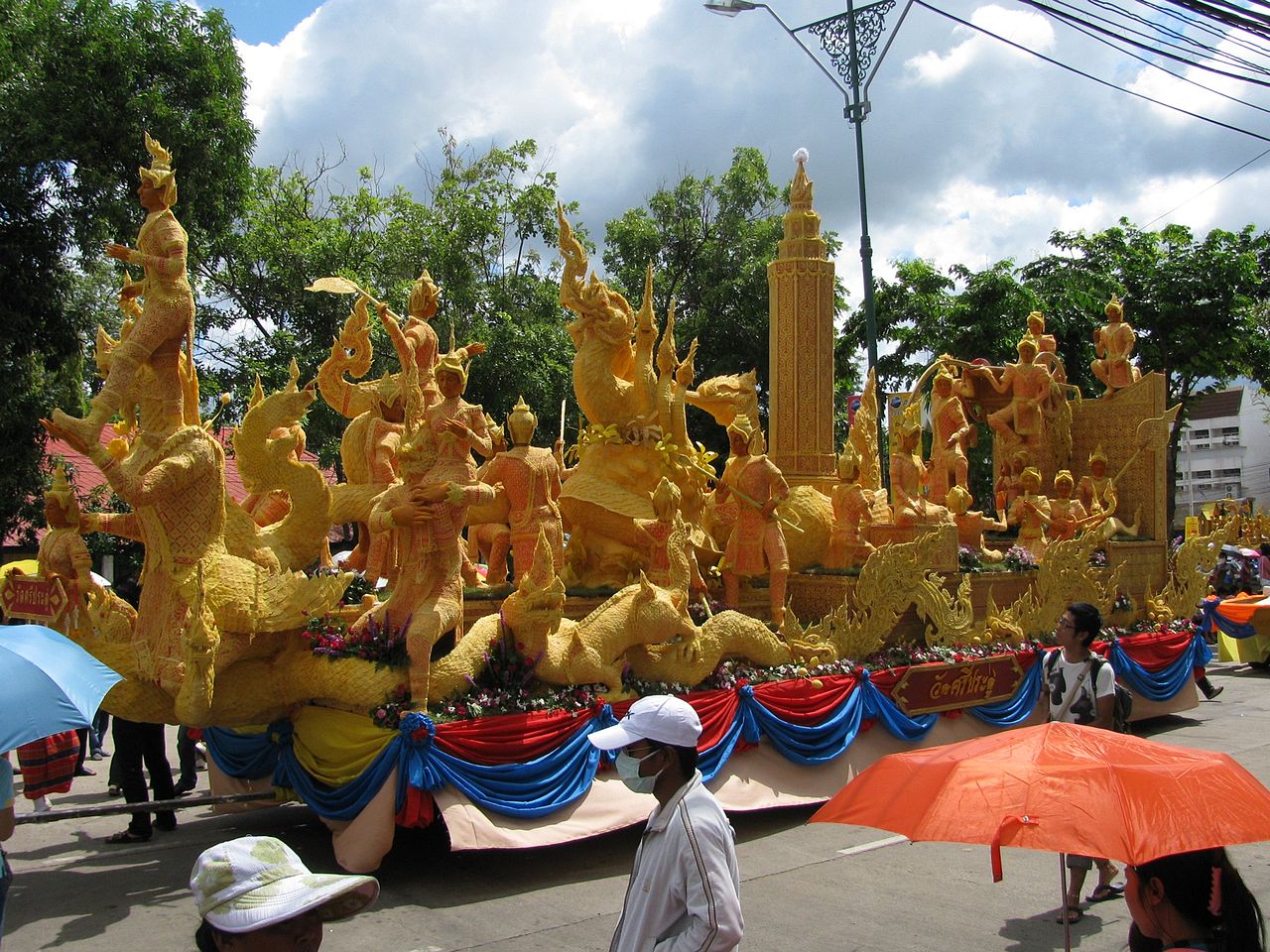
Ubon Ratchathani is famous for its Candle Festival, held continuously every year during Buddhist Lent around July. The highlight is a series of enormous candle floats, carved and stamped with intricate patterns by local craftsmen depicting Buddhist stories, then mounted on parade vehicles that circle the streets around Thung Si Mueang in the city center. There are both carved and stamped-pattern categories, allowing visitors to compare craftsmanship. Daytime viewing shows off the fine details of the candle patterns clearly, while some years also feature evening displays with lighting. This is an annual event that Ubon locals take great pride in, drawing visitors from across the country, so it's worth planning accommodation and travel well in advance, as hotels in town tend to fill up quickly.
Paired with the seasonal candle festival is a spot you can visit year-round: Wat Phra That Nong Bua, to the north of town. Its most talked-about feature is the white Sri Maha Bodhi pagoda, modeled after the Mahabodhi Temple in Bodh Gaya, India, giving it a distinctly different shape from typical Thai pagodas. Around the pagoda are stucco patterns and decorative archways to walk around and admire, and inside are enshrined Buddha relics, revered by locals. The temple grounds are spacious, comfortable for photos, and free to enter, with donations at your discretion. If you're visiting during the candle festival, it pairs well with a visit to the temple in the same trip, since they're in the same town and not far to drive between.
To be upfront about what to expect: the Candle Festival can only be seen during Buddhist Lent, and on the main parade day, crowds get very heavy, the sun is intense, and parking is difficult — arrive early, bring a hat and water, and leave time to find a good spot to watch the parade. Some prime grandstand seats require a reservation or ticket, so check that year's event layout in advance. As for Wat Phra That Nong Bua, it's a sacred site, so dress modestly, remove your shoes in designated areas, and keep your voice down since worshippers come to pray and make merit. The white pagoda reflects fairly harsh sunlight at midday, so photos come out better in the softer light of morning or evening. Neither site charges direct admission, but if you'd rather not drive yourself, booking a half-day city tour that includes transport makes it easier to hit several spots conveniently.
- The Candle Festival is a unique annual event, with intricately carved candle floats made by skilled Ubon craftsmen — watch the parade for free right in the city center
- Wat Phra That Nong Bua features a Bodh Gaya-style pagoda unlike typical Thai pagodas, praised in reviews for its beauty and architecture
- Both sites are free to enter — watching the candle parade costs nothing, and the temple accepts donations at your discretion, great value on a limited budget
- Both are in the same town, not far to drive between, making it easy to combine into a single festival-season trip
- The Candle Festival can only be seen during Buddhist Lent around July — not something you can visit year-round
- Very crowded on the main parade day with intense sun and difficult parking, and some good grandstand seats require a ticket
- Wat Phra That Nong Bua is a sacred site requiring modest dress and quiet behavior, and the white pagoda reflects harsh midday sun, making photos difficult around noon
Where to Stay in Ubon?
Choose accommodation in the city center or near Thung Si Mueang — compare prices across 3 sites before booking
Find Hotels on AgodaBook Activities & Tickets in Advance
Riverside tours (Pha Taem-Sam Phan Bok) and transfers help save time since the attractions are far apart
💡 Know Before You Go to Ubon
If you want to catch the first sunrise in Siam, you'll need to leave town in the early hours (Pha Taem is ~90 km away)
The rock basins only emerge when the Mekong's water level drops, roughly Jan-May — flooded during the rainy season, so check water levels before going
Khong Chiam-Pha Taem-Sam Phan Bok are 80-100 km from town — a car or joining a tour is the most convenient option
The Candle Festival parade is held once a year, around July (Asalha Puja-Start of Buddhist Lent) — accommodation fills up quickly, so book ahead
How to Pick Activities to Make the Most of Your Trip
If you have 2 days, we'd suggest spending day one in the Khong Chiam-Pha Taem area (head out before dawn to catch the sunrise at Pha Taem, plus Sao Chaliang, the Two-Colour River, and Saeng Chan Waterfall), then on day two continue to Sam Phan Bok (dry season only) or Kaeng Tana, and drop by Wat Sirindhorn Wararam Phu Prao in the evening to see the glowing temple. If you're visiting during Buddhist Lent, don't miss the Candle Festival at Thung Si Mueang — that way you'll get nature, art, and tradition all in one trip.
Ready to explore Ubon? Start by picking accommodation in the city center
See Ubon Ratchathani Hotels →