🔄 Updated 21 Jun 2026
Udon Thani's sights are spread wide. The town itself has Nong Prajak lake, the Pu-Ya Shrine and a city museum, all easy to do on foot. But the real highlights sit outside town and need a car: the Red Lotus Sea at Kumphawapi to the south, Ban Chiang to the east, Phu Phra Bat and Wat Pa Phu Kon to the west and north, while Kham Chanot is further out toward Ban Dung. The smartest way to do it is to keep one direction per day and avoid criss-crossing the province back and forth.
Top Udon Thani attractions (by how often people mention them)
The order below isn't a ranking of which place is better — it just follows how often first-time visitors to Udon end up at each one. Pick and mix to suit your direction and your own style.
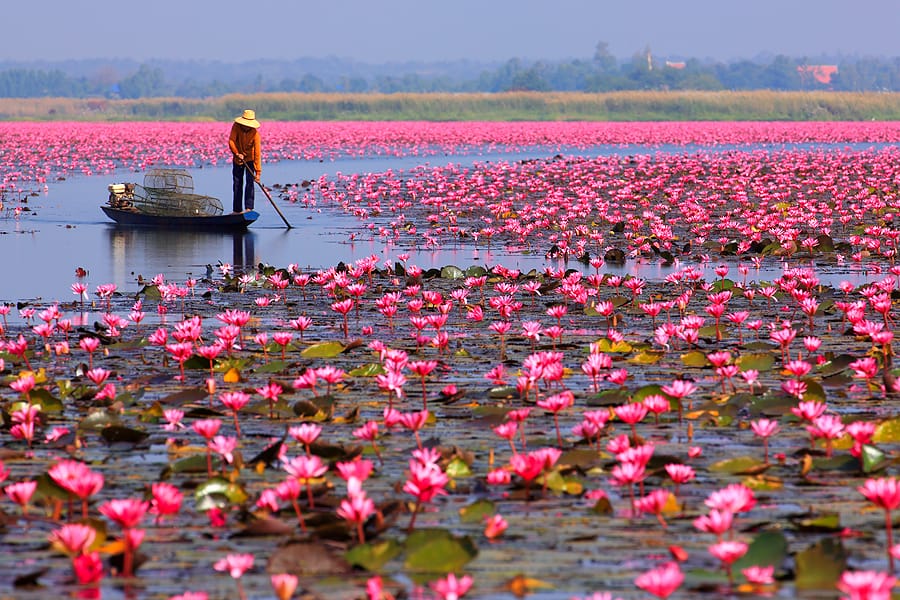
Red Lotus Sea (Nong Han Kumphawapi)
A lake over 20,000 rai wide where red lotuses cover the water in the cool season. Head out by boat in the morning and you'll see the blooms against the mist and early light — the postcard image of Udon that travelers worldwide recognize. Peak bloom runs roughly December to February.
Ban Chiang World Heritage Site
A prehistoric archaeological site that UNESCO inscribed as World Heritage back in 1992. The Ban Chiang National Museum and the Wat Pho Si Nai excavation pit let you walk among painted pottery thousands of years old, with a walking street and weaving shops around it.
Kham Chanot (Wang Nakhin)
A forest grove that locals believe is a floating island that never sinks — the dwelling of Phaya Si Suttho, the Naga king. People come to pay respects and ask for blessings all year round. Cross the bridge onto the island to see the sacred well and the old chanot palms. Dress modestly.
Phu Phra Bat Historical Park
Thailand's newest World Heritage site, inscribed by UNESCO in 2024. It's a sandstone plateau of oddly shaped rock pillars, Dvaravati-era boundary stones and prehistoric rock paintings, with shaded forest trails. The highlight is Ho Nang Usa, a striking rock shelter formation.
Wat Pa Phu Kon
A forest temple in the Na Yung reserve, with a grand white sanctuary set on a hill. Inside lies the reclining Buddha Phra Phutta Saiyas Lokkanat Sasada Maha Muni, carved from white Italian marble and about 20 metres long, with green mountains on every side. The temple lends modest cover-ups.
Nong Prajak Silpakhom Public Park
A big lake in the middle of town with an island and a footbridge across it. Udon locals come here every evening to walk, run and pedal the little duck boats, and there are exercise areas and snack stalls by the water. It's the most accessible everyday escape in the city.
Pu-Ya Shrine & Chinese Garden
A shrine that Udon's Thai-Chinese community holds dear, coming to ask for blessings on trade and health. Behind it is a Chinese garden by the water with a red bridge, a pavilion and a koi pond — a pleasant spot to walk and take photos.
Wat Pa Ban Tat (Wat Kesorn Silakhun)
The forest meditation temple of the late Luang Ta Maha Bua, revered across Thailand. The grounds are shady, quiet and calm, with a museum stupa holding his relics and belongings to pay respects to. A good fit if you're after somewhere peaceful.
Udon Thani City Museum
Set in the lovely old colonial-style Rachinuthit building, the museum tells Udon's story from prehistory through Krom Luang Prachak founding the city, all the way to the U.S. air base era during the Vietnam War. Good for anyone who wants to understand how the city came to be.
Phu Foi Lom National Park
A forested upland on the Phu Phan Noi range in the south of the province, with cool, comfortable air, a botanical garden of native plants, nature trails and a campground. Good for nature lovers who want to escape town and sleep out in the cool-season breeze.
Wat Santi Wanaram (Lotus Ordination Hall, Ban Chiang)
A white lotus-shaped ordination hall over the water, designed as a single blooming lotus — the only one of its kind in Thailand — set in a pond that mirrors it beautifully. It's inside the Ban Chiang Buddhist park, easy to pair with the Ban Chiang World Heritage site in the same area.
Udon Walking Streets & Night Markets
From evening into the night, Udon has several walking markets, both around the shopping district and the night market by Nong Prajak. They sell Isan food, Vietnamese dishes, souvenirs and crafts — an easy way to graze and round off the day.
Planning tip
The Red Lotus Sea only works in the cool season (roughly November to February), and you have to go early, before 9–10am, because by late morning the flowers close and the sun gets harsh. If you come outside that window, skip it for the World Heritage and faith trails instead. Kham Chanot and Wat Pa Phu Kon sit in different directions and are both far out, so it's best to keep them on separate days rather than cramming both into one.
Want more out of Udon Thani? Book tours & activities
Booking online ahead on Klook or GetYourGuide is usually cheaper than the gate and skips the queue. Pick only the experiences you actually want — prices and availability are shown live on each site.
Nature and seasonal spots
Udon's nature is mostly lakes and low hills — some spots only work in season, others are fine year-round. Choose by the time of year you visit.
Red Lotus Sea
Red lotuses cover the water in the cool season. Take a boat out in the morning to see the blooms against the mist — the postcard image of Udon.
Phu Foi Lom
Forested hills on the Phu Phan Noi range with cool air, a plant garden and a campground — good for sleeping out in the cool breeze.
Nong Prajak
The lake in the middle of town where Udon locals walk and run every evening, with an island and duck pedal boats. Free.
Phu Phra Bat
A World Heritage sandstone plateau with oddly shaped rock pillars and shelters in the forest. Cool and pleasant to walk year-round.
History and World Heritage
Udon is the only province in Thailand with two World Heritage sites — Ban Chiang, the prehistoric archaeological site, and Phu Phra Bat, inscribed only in 2024 — plus a city museum that ties the story together. Perfect for a day when you want to travel and learn at the same time.
- Ban Chiang World Heritage Site — the museum and excavation pit of painted pottery thousands of years old
- Phu Phra Bat Historical Park — Thailand's newest World Heritage site, with rock pillars and Dvaravati boundary stones in the forest
- Udon Thani City Museum — an old colonial building telling the city's story from its founding to the air-base era
- Krom Luang Prachak Monument — the city-centre roundabout that marks the start of Udon's history
Faith and forest temples
Upper Isan is a land of forest temples and Naga belief. Udon has Kham Chanot, where crowds come to ask for blessings, Wat Pa Phu Kon up in the hills, and Wat Pa Ban Tat of Luang Ta Maha Bua. Dress modestly — cover your shoulders and knees — and keep quiet when you enter forest-temple grounds.
- Kham Chanot — the Kham Chanot island believed to be the palace of Phaya Si Suttho, the Naga king; cross the bridge onto the island to pay respects
- Wat Pa Phu Kon — a 20-metre white marble reclining Buddha in a white sanctuary set among green mountains
- Wat Pa Ban Tat — the forest temple of Luang Ta Maha Bua, with a museum stupa holding his relics; a calm setting
- Wat Santi Wanaram — the only lotus-shaped ordination hall over water in Thailand, near Ban Chiang
A sample unrushed plan
Here's a two-day sample that keeps each day in one direction — adjust the times to suit. Having your own car or a rental makes everything much smoother, since Udon's sights are outside town and public transport isn't convenient.
South–East (Red Lotus + Ban Chiang)
West–North (World Heritage + forest temple)
Getting around the province
In town it's easy to call a Grab or a tuk-tuk (skylab), but the real highlights — the Red Lotus Sea, Ban Chiang, Phu Phra Bat, Kham Chanot and Wat Pa Phu Kon — are far apart in different directions. Public transport either doesn't reach them or means several transfers, so renting a car to drive yourself, or joining a local day tour, is the most worthwhile and least tiring option.
Want a full day-by-day plan for Udon Thani?
See the Udon Thani travel guide →