🔄 Updated 21 Jun 2026
Udon Thani is one of the easier Isan cities to reach, with an airport, train line, and bus routes all serving it. The thing people most often get wrong when planning is the season, because the headline sight — the Red Lotus Sea — only shows up from the cool months through early March. Weather and budget aren't complicated, but knowing them in advance means you'll pack right and keep spending in check instead of guessing on the spot.
When is the best time to visit Udon Thani?
The most comfortable stretch is November to February — dry, cool air, and you can be out sightseeing all day without wilting. It also lines up perfectly with Red Lotus season. March to May is Isan's hot season, with strong sun and serious heat, so midday walking doesn't last long. June to October is the rainy season — lush, green, and quieter, but build in a buffer for afternoon downpours.
Nov–Feb (cool season)
Udon's prime window: cool, dry air, the Red Lotus Sea in full bloom, and easy walking at Phu Foi Lom and Phu Phra Bat. Just expect hotels and lotus boats to book up fast over long weekends.
Mar–May (hot season)
Full-on Isan heat, and the red lotuses fade from early March. Lean into indoor spots — malls, cafés, museums, and temples — and save outdoor time for early morning and evening.
Jun–Oct (rainy season)
Green rice fields, waterfalls like Than Ngam running full, fewer crowds, and cheaper rooms. Just keep a backup plan ready to dodge the afternoon rain.
If you're coming specifically for the Red Lotus Sea
Lock in your dates for mid-December to mid-February — that's when the blooms are densest. By March they slowly fade. In good-rain years the bloom can stretch into early March, but don't count on it — check the destination's official page again before you travel.
Red Lotus Sea season — what to know before you go
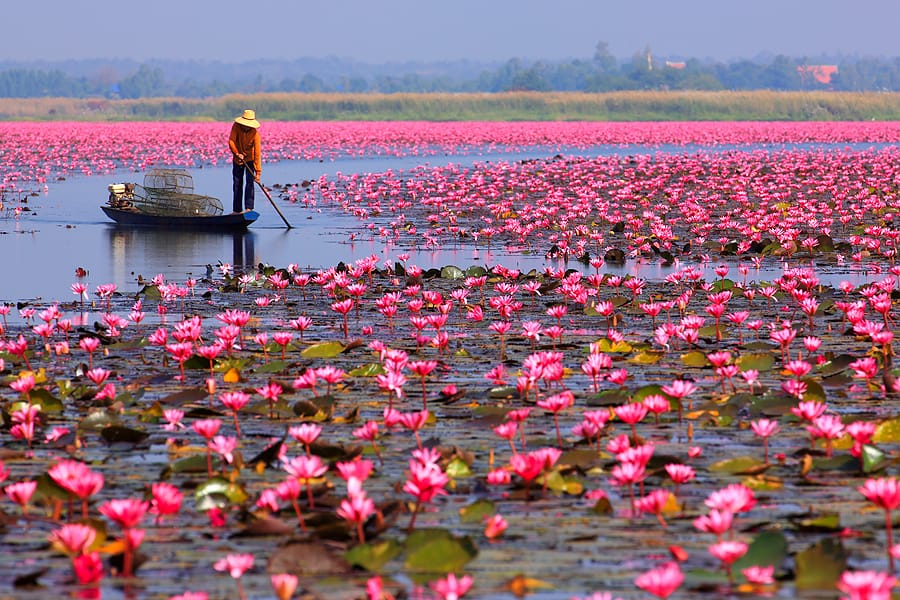
The Red Lotus Sea is at Nong Han Kumphawapi, in Kumphawapi district, about 40 km from Udon Thani city. It's a large freshwater lake that fills with pink lotus blooms in the cool season. The key thing: the flowers open at their best from dawn until around 11am, then start closing up — so you really do need to get there early for it to be worth it.
- Bloom season — roughly Nov–Mar, densest Dec–Feb, then slowly fading after that
- Boat hours — daily, around 6am–5pm. Aim to board before 8am while the flowers are still open and the light is soft
- Boat fare — small boats seating 2–3 people run about 150 THB/person; larger boats seating 6–10 run about 600 THB/boat, with a ride of around 1–1.5 hours
- Getting there — driving yourself is easiest: take Highway 2 (Udon–Khon Kaen) and exit at Kumphawapi. No car? Take the Udon–Kumphawapi bus from the bus terminal, then a local ride to the pier
Get used to an early start
If you're staying in Udon Thani city, plan to leave around 5–6am to allow for the 40 km drive and still make an early boat, while the flowers are open and the sun isn't strong yet. Bring a light jacket too — out on the lake in the morning, the breeze is cooler than you'd expect.
Month-by-month weather — pack the right clothes
Udon's weather swings clearly with the seasons. In the cool season, mornings and evenings genuinely get chilly — especially up in the hills around Phu Foi Lom and Phu Phra Bat. In the hot season, the Isan sun is every bit as fierce as central Thailand's. Pack along these lines and you'll be comfortable.
- Cool season (Nov–Feb) — warm and pleasant by day, but chilly mornings and nights. Bring long sleeves or a light jacket, and an extra warm layer if you're heading up into the hills
- Hot season (Mar–May) — go for breathable clothing, a hat, sunglasses, sunscreen, and water on you at all times
- Rainy season (Jun–Oct) — pack a foldable umbrella or rain jacket and non-slip shoes for the muddy paths around waterfalls and rice fields
- Visiting temples — whatever the season, bring modest clothing that covers shoulders and knees for Wat Pa Ban Tat, Wat Pa Phu Kon, and the Chao Pu-Ya Shrine
Rough daily budget
Udon is easy on the wallet — Isan food is cheap and there are rooms at every level. Your main costs are getting to the city itself and the transport for reaching sights outside town. Here are rough per-person, per-day figures once you're in Udon.
- Getting to Udon — flights from Bangkok start in the low four figures THB (cheaper if booked ahead); buses run about 400–600 THB; trains range from a few hundred to a few thousand THB depending on class
- Accommodation — guesthouses and small hotels around 400–800 THB/night; mid-range hotels around 900–1,800 THB/night
- Food — market stalls and local shops at 40–80 THB a dish; sit-down spots or cafés around 100–250 THB a meal
- Getting around town — tuk-tuks and motorbike taxis in town from a few tens to low hundreds of THB; motorbike rental around 250–300 THB/day; car rental around 1,000–1,500 THB/day
- Red Lotus Sea — boat fare 150 THB/person (small boat) plus fuel or transport to and from Kumphawapi
- Budget total — easygoing in-town sightseeing runs a Thai traveler around 700–1,200 THB/day (not counting the cost of getting to the city)
Making out-of-town trips worth it
Many of Udon's highlights are spread far apart — Kumphawapi, Phu Foi Lom, Kham Chanot, Phu Phra Bat. Renting a car to drive yourself or hiring a car with driver for the day is far more practical and flexible than public transport. With a group it works out much cheaper per head. Agree on the price and the stops clearly before you set off.
What to wear — by place and by season
Udon has no strict dress code — comfort for the weather comes first. But a few spots are worth dressing right for, so you don't feel out of place on arrival and your photos come out well.
- Temples and sacred sites — at Wat Pa Ban Tat, Wat Pa Phu Kon, Kham Chanot, and the Chao Pu-Ya Shrine, cover your shoulders and knees, skip spaghetti straps and shorts, and carry a light shawl just in case
- Red Lotus Sea — you're boarding the boat at dawn, so bring a light windbreaker, a hat, and sunglasses for later when the sun picks up
- Hills (Phu Foi Lom, Phu Phra Bat) — comfortable walking shoes with good grip; add a jacket in the cool season
- Around town, cafés, night markets — dress however you like; go for light, breathable clothes in the hot season
What to pack
Udon is a big city, so anything you forget is easy to pick up at malls and convenience stores. Still, a few things are much handier brought from home — especially if you're heading out of town at dawn. Here's a list that actually earns its place in your bag.
- Sunscreen + sunglasses + hat — the Isan sun is strong, and the Red Lotus Sea and open fields have no shade
- Light warm or windproof layer — cool-season mornings and evenings get chilly, especially on the boat and up in the hills
- Foldable umbrella or rain jacket — sun protection in open fields, rain cover in the wet season
- Comfortable walking shoes — forest-temple paths, waterfalls, and hills are rough; skip flimsy flip-flops
- Small-denomination cash — boat fares, markets, and small shops still run on cash
- Power bank — a full day out with navigation and lots of photos drains your battery fast
- Personal meds + antihistamine/anti-diarrheal — handy backup for tucking into bold Isan street food
SIM, data, and paying
Mobile coverage in Udon Thani city is solid — Thai travelers can use their usual SIM as normal, and foreign visitors can grab a tourist SIM at the airport or a convenience store. For payments, many in-town shops and cafés take QR scan-to-pay, but market stalls, boat fares, and shops outside the city still run mainly on cash — keep enough on you.
Nailing your first day — a sample if you're here for the Red Lotus Sea
If the Red Lotus Sea is your main target, make it day one and head out at dawn, then pick up other sights along the same route through late morning and afternoon. Here's a timing rhythm that's realistic to keep.
Dawn lotus boat, then sights along the way
All set? See the full lineup of places to stay and a complete Udon Thani plan.
See the Udon Thani guide →