🔄 Updated 21 Jun 2026
If you're planning an Amphawa trip and want somewhere that isn't just another floating market, Wat Bang Kung fits the bill nicely. The star here is a small chapel over 200 years old that big trees have completely engulfed, their roots winding right across the walls. People named it the "Bot Prok Pho," and it's often called the only chapel inside a tree in Thailand. The land all around is Bang Kung camp, an old riverside army camp on the Mae Klong that played a real part in the history of Siam's recovery after the fall of Ayutthaya.
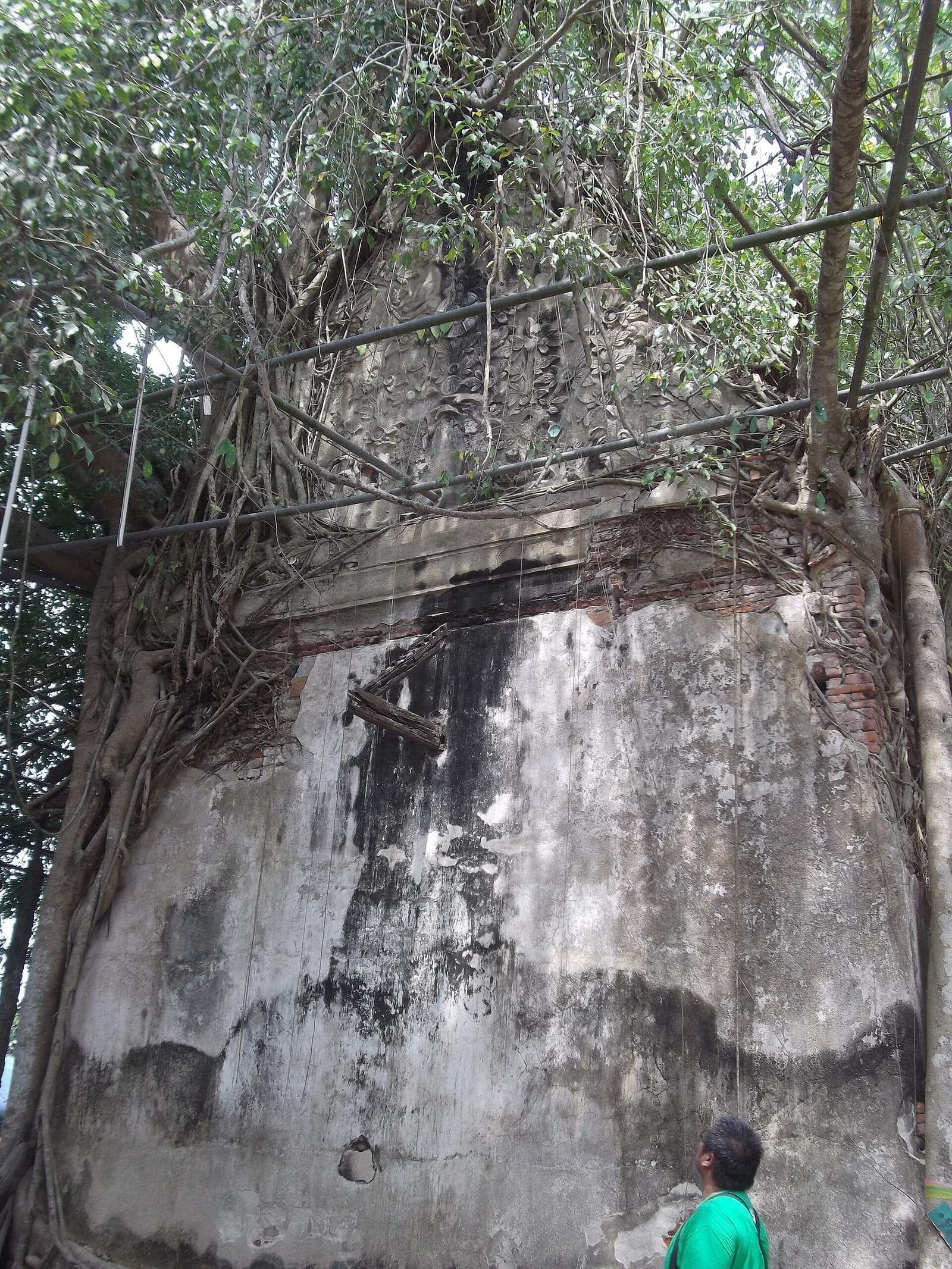
Bot Prok Pho — roots wrapped around the whole chapel
Bot Prok Pho is a "maha ut" chapel (a chapel with a single doorway and no windows), built back in the late Ayutthaya period. After it sat abandoned for a long time, big trees slowly grew over the building until it became the sight you see today. The part most people come to look at is the roots and trunks gripping tightly onto the brick walls, as if nature itself is holding the whole chapel up.
- Four kinds of tree wrapping the chapel — bodhi, banyan, sai and krang trees have grown over it together, which is why people lump them under the name Bot Prok Pho (bodhi-shrouded chapel)
- Luang Pho Nin Mani (Luang Pho Dam) — the principal Buddha image inside, a large late-Ayutthaya image in the subduing-Mara pose, carved from red sandstone; people like to go in and pray for blessings
- A maha ut chapel — with just one doorway, believers consider it a potent spot for charm, popularity and protection from harm, so there's a steady stream of people stopping by to make a wish
For better photos
Morning light and late afternoon are softer than midday, so the roots wrapping the walls show more depth and it's easier to get the whole chapel in frame, with fewer people around than in the middle of the day too.
Want more out of Samut Songkhram? Book tours & activities
Booking online ahead on Klook or GetYourGuide is usually cheaper than the gate and skips the queue. Pick only the experiences you actually want — prices and availability are shown live on each site.
Bang Kung camp — a true story from the Thonburi era
The grounds around the temple aren't just a pretty backdrop; there's a real story behind them. Back in the late Ayutthaya period, around 1765, the Burmese army marched in to take Ayutthaya, so the capital ordered the southern coastal towns to send a fleet up to set up a camp and build a wall around Wat Bang Kung, known as "Bang Kung camp." When Ayutthaya fell for the second time in 1767, the camp was left abandoned for a while.
After King Taksin the Great founded Thonburi, he had Chinese settlers gathered from Rayong, Chonburi, Ratchaburi and Kanchanaburi to form a garrison guarding the old camp at Bang Kung, which is why it also picked up the name "Bang Kung Chinese camp." Later, in 1768, the King of Ava sent an army through Kanchanaburi to lay siege to the camp. King Taksin ordered Phra Maha Montri (Bunma) to march out and help, and together they fought until the Burmese force was routed. It counts as one of the first battles Siam won against the Burmese after Thonburi was founded, which is why many people call this the starting point of the nation's recovery.
- A replica camp wall — the temple has built a mock-up of the Bang Kung camp wall so you can picture what the camp looked like back then
- Statues of soldiers and commanders — there are statues of soldiers and field commanders on both the Thai and Burmese sides, plus figures in Muay Thai poses, dotted around the grounds
- Monument to King Taksin the Great — a spot where people stop to pay respects and remember the battles fought at this camp
Making the most of it — what you can do
Pay respects to Luang Pho Nin Mani
Step into Bot Prok Pho to bow to the principal Buddha image and pray for charm, popularity and protection from harm; it's the highlight people come for.
Walk the camp and the statues
Stroll around the replica camp wall, look at the Thai and Burmese soldier statues and Muay Thai poses, and pick up the history as you go.
Take photos by the Mae Klong River
The temple sits right on the Mae Klong, with a shady, relaxed feel and a riverside pier, so it's a pleasant place to wander and snap photos.
It takes about 45 minutes to an hour to see everything, which makes it a good stop to slot into an Amphawa trip without setting aside the whole day.
Opening hours, entry fee and how to get there
- Opening hours — the temple grounds and camp are open roughly 08:00-16:30; you can go in to pay respects to Luang Pho Nin Mani inside Bot Prok Pho at any time
- Entry fee — free; you can make a donation as you see fit at the donation boxes in the temple
- Location — Ban Khai, Moo 4, Bang Kung subdistrict, Bang Khonthi district, Samut Songkhram province, right on the Mae Klong River
- By car — about an 11-minute drive from Amphawa Floating Market; cross the Somdet Phra Si Suriyendra Bridge and follow the riverside along Thanon Phonlamai (Fruit Road); there's parking at the temple
- By boat — you can take a tour boat from Amphawa Floating Market and land at the pier in front of the temple; the riverside ride is enjoyable and works well if you're visiting on a Saturday or Sunday
Straight talk
On long weekends it gets crowded and hot, so if you want a calmer atmosphere and easy photos, come on a weekday morning. Dress modestly since it's a temple, and watch your step in spots where roots run across the ground.
More to see around here
The nice thing about Wat Bang Kung is that it's on the same route as several old temples along the Mae Klong, so you can easily string them into a half-day trip.
- Wat Bang Khae Noi — an old temple on the Mae Klong, known for its ordination hall carved entirely from teak; it's on the same route
- Wat Phummarin Kudi Thong — an old temple along the way from Amphawa to Bang Kung, with a golden monk's quarters as its highlight
- Tha Kha Floating Market — a local floating market open on select days, with a simple, orchard-village feel; best in the morning
- Amphawa Floating Market — the popular floating market for eating your way along the canal and taking an evening firefly boat trip, just over ten minutes away
Want a full Samut Songkhram plan? Check the complete guide to what to see, eat and where to stay
See the Samut Songkhram travel guide →