🔄 Updated 21 Jun 2026
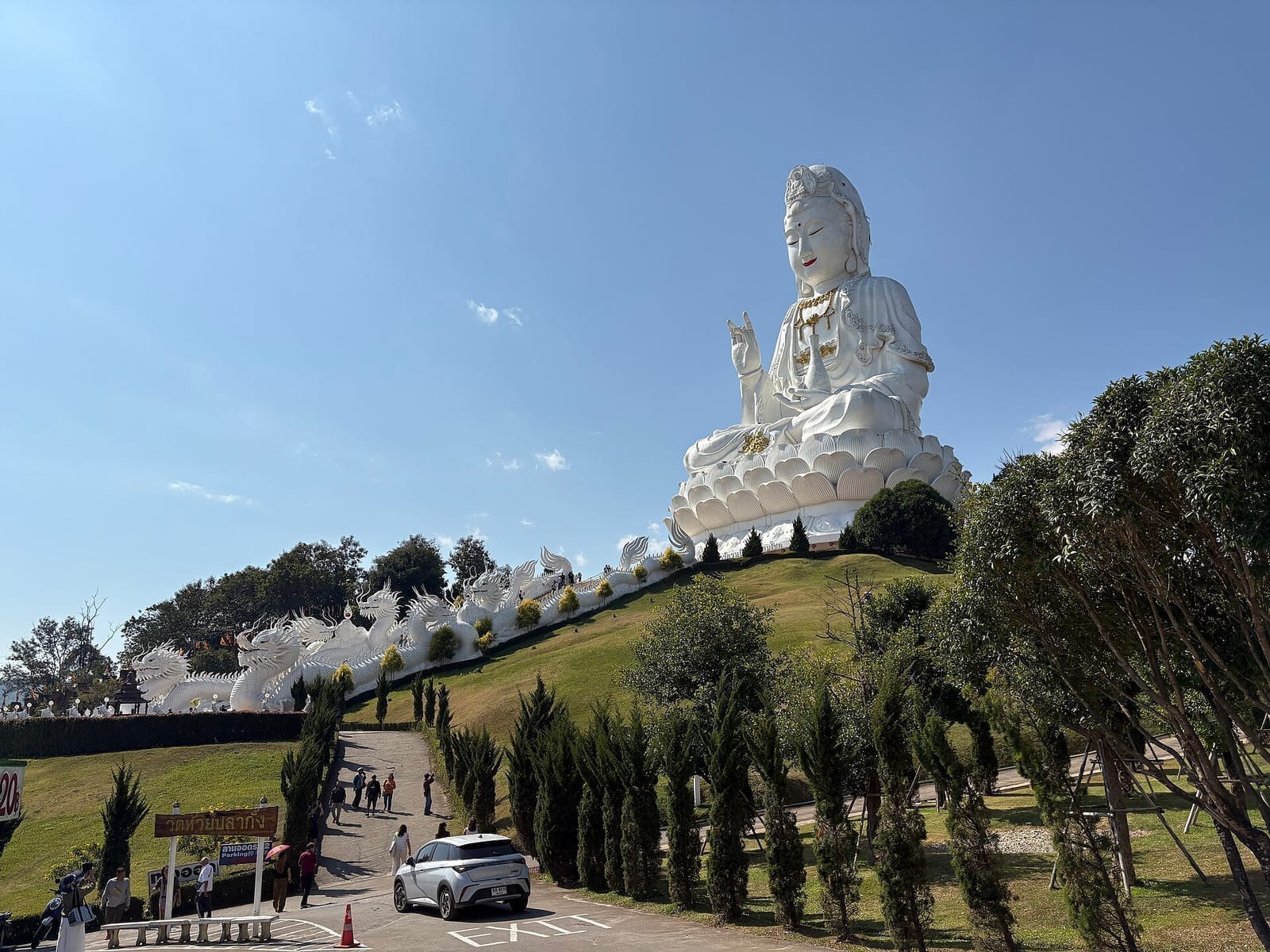
If you've seen photos of a giant white Guan Yin statue standing on a hill in Chiang Rai, that's Wat Huay Pla Kang. The temple started out as a small monastery before slowly growing into the large complex you see today, with architecture that mixes Chinese and Lanna styles. Locals come here regularly to make merit, while travellers usually stop by for the 9-tier pagoda and the Guan Yin statue. The whole temple is free to enter — there's no admission fee.
What not to miss inside the temple
The grounds are fairly large and spread across a slope. There are three main things people come to see: the giant Guan Yin (Bodhisattva of Compassion) statue, the 9-tier Chinese pagoda, and the white ordination hall. Wandering the whole place takes about 1–1.5 hours at an easy pace.
- Giant Guan Yin statue — a white figure roughly 69 metres tall standing on the hill. It's hollow inside, with a lift that takes you up to a viewpoint near the top, looking out over the city of Chiang Rai and the surrounding mountains.
- 9-tier pagoda (Phop Chok Dhamma Chedi) — a white, Chinese-style nine-storey pagoda. Each level enshrines a different form of Guan Yin, and you can walk up tier by tier to see them all.
- White ordination hall — detailed stucco work and decoration; it's another of the temple's favourite photo spots.
- Prayer halls and shrines — several spots to light incense and make a wish. Many people come to pray to Guan Yin for blessings around health and family.
Want more out of Chiang Rai? Book tours & activities
Booking online ahead on Klook or GetYourGuide is usually cheaper than the gate and skips the queue. Pick only the experiences you actually want — prices and availability are shown live on each site.
Taking the lift up for the city view
The thing people talk about most is heading up inside the Guan Yin statue. A lift takes you to the viewpoint near the top, and the fee is around 40 THB per person (a donation toward the temple's upkeep). Up top there are windows looking out over Chiang Rai from above; on a clear day you can see all the way out to the mountains. It's best to come in the morning or late afternoon when the sun isn't harsh and the air is clear.
Tip
The viewpoint up top is fairly small. On long weekends it gets crowded and you may have to queue for the lift, so arriving in the morning soon after the temple opens is a lot easier.
Opening hours, costs, and dress code
- Opening hours — open daily, roughly 07:00–21:30 (it's nicely lit up at night, but the lift up the Guan Yin statue only runs during daytime).
- Temple entry — free, no admission fee.
- Lift up to the viewpoint — around 40 THB per person.
- Dress code — this is a temple, so dress modestly and cover your shoulders and knees. If you turn up in a sleeveless top or shorts, it's worth carrying a cover-up with you.
- Time needed — walking the grounds and taking the lift comes to about 1–1.5 hours in total.
Getting to Wat Huay Pla Kang
The temple is in Rim Kok subdistrict, Mueang Chiang Rai, about 8 km from the downtown clock tower — roughly a 15-minute drive. The route is straightforward and easy to follow with a maps app.
Driving / car rental
The easiest option, with parking at the temple. Great if you plan to visit several temples in one day, for example continuing on to Wat Rong Suea Ten or the tea plantations.
Grab / taxi
Easy to call from town, but finding a ride back can be tricky since the temple is outside the city. It's worth asking your driver to wait or booking the return trip in advance.
Songthaew / chartered tuk-tuk
Charter one for the whole day and have it loop you around several spots. Agree on the price and timing before you get in — good value if you're a group.
Plan your next stop
Wat Huay Pla Kang is on the north side of the city, so you can pair it with Wat Rong Suea Ten (the Blue Temple) or the Choui Fong tea plantation in a single day — a nice temple-and-nature loop around Chiang Rai.
See more things to do and places to stay around Chiang Rai
See the Chiang Rai guide →