🔄 Updated 21 Jun 2026
One thing worth clarifying upfront: there are two temples named "Wat Khao Rup Chang" in Songkhla province. The one that shows up constantly on social media — the white marble pagoda — is at Tambon Padang Besar, Amphoe Sadao, not in Songkhla city itself. This article is about that Padang Besar temple. If you're already in Songkhla city and want a hilltop city view, Khao Tang Kuan is a much closer option.
What Is Wat Khao Rup Chang and What Makes It Special
The temple was founded in 1968 by Phra Mongkol Yan (Juang Jia Yasaro), a Singaporean monk who discovered a natural cave on the Khao Rup Chang hill and gradually developed it into a full temple complex. What people remember most is the white marble pagoda modeled on the Mahabodhi Temple in India, blended with Chinese-style sculpture and murals — a Thai-Chinese mix you rarely see elsewhere, all set against a lush mountain backdrop.
Because it sits right on the Thai-Malaysian border, worshippers here include Thais, Singaporeans, and Malaysians. The current abbot is also Singaporean, which gives the temple a distinct Mahayana-Chinese Buddhist atmosphere layered into the Thai setting.
Want more out of Songkhla? Book tours & activities
Booking online ahead on Klook or GetYourGuide is usually cheaper than the gate and skips the queue. Pick only the experiences you actually want — prices and availability are shown live on each site.
The Two-Level Pagoda — What's Inside
The pagoda is split into two levels. The ground floor holds the main Buddha image, flanked by dragon-carved pillars and vivid murals covering every wall. Climb the stairs to the second level and you can walk around the top of the pagoda with an open view of the Khao Kaew range — this is where most visitors linger longest for photos.
- Level 1 — Main Buddha image, dragon pillars, colorful murals; this is where you pay respects and make offerings
- Stairway to Level 2 — Lined with mural paintings on both sides; not a long climb
- Level 2 / Pagoda Terrace — Open-air viewpoint overlooking the Khao Kaew range; the best photo spot in the temple
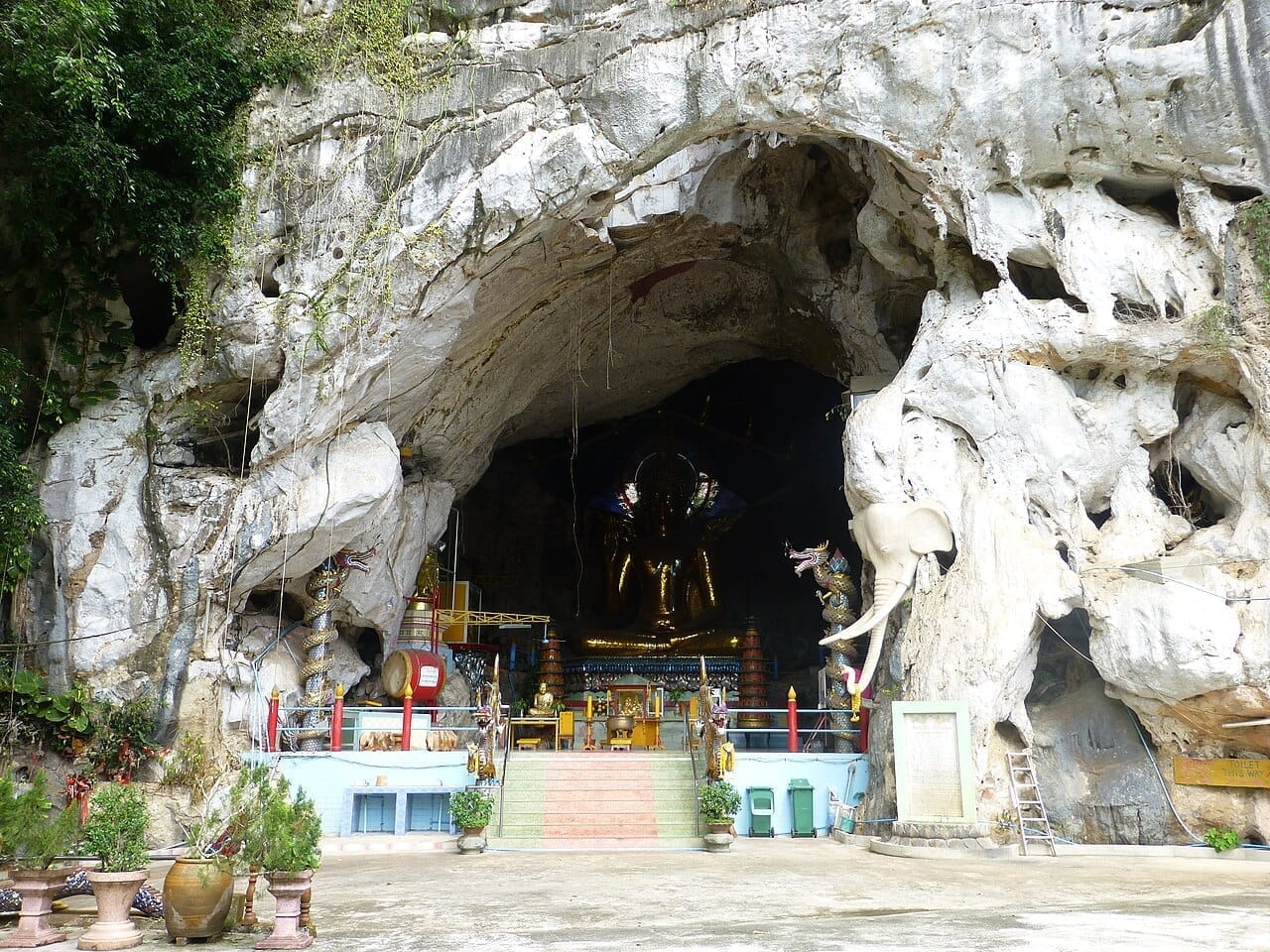
- Cave Shrine — Natural cave with stalactites and stalagmites, enshrining Buddha images and a Guanyin statue; cool and peaceful inside
Dress Code
This is an active temple. Cover your shoulders and knees — sleeveless tops and shorts above the knee aren't appropriate. You'll be climbing stairs and entering the cave, so wear shoes that are easy to slip off and comfortable to walk in.
Photo Spots and Best Time to Visit
The go-to shot is the white marble pagoda against the green hillside. For good light without the midday heat, aim for 8–10 am or late afternoon before 5 pm. Midday sun here is harsh and the shadows fall flat, making images look harder than they should. After rain, the hills go an intense green and the sky clears — noticeably better results than in the dry season.
White Pagoda vs. Green Hill
Stand at the lower courtyard and frame the full pagoda with the hillside behind it — the classic shot of this temple
Level 2 Terrace
Walk the upper terrace for wide-open views of the Khao Kaew range, with a breeze that makes the heat bearable
Inside the Cave Shrine
Natural light filtering through the cave entrance onto the Buddha images — a calm, atmospheric shot completely different from the exterior
Getting There, Opening Hours & Admission
The temple is in Moo 6, Tambon Padang Besar, Amphoe Sadao — about 55 km from Hat Yai city (roughly an hour's drive) and about 13 km from Padang Besar market. The last stretch is a hill road. If you're driving yourself, search "Wat Khao Rup Chang Padang Besar" in Google Maps and follow the route.
- Opening hours — Daily, approximately 08:00–18:00
- Admission — Free; donations welcome
- From Hat Yai — About 55 km by car; plan 1–1.5 hrs to walk the pagoda and cave properly
- Popular pairing — Most visitors combine this with a shopping run to Padang Besar market on the same trip
Honest Note
There's no convenient public transport to this temple. If you don't have your own vehicle, hire a driver from Hat Yai or join a day-trip tour. And since this is a border area, carry your ID card or passport — you may hit a checkpoint on the way.
What Else to See Near Padang Besar & Sadao
Being this close to the border actually makes the logistics easy — you can pair the temple with a shopping stop in a single half-day. This whole zone is Thai-Malaysian border trade territory, so the food and goods have a distinct Malaysian edge you won't find in central Songkhla.
Padang Besar Border Market
A busy cross-border market selling food, household goods, and Malaysian products — easy to extend the temple visit with a shopping run
Sadao Border Crossing
Another major trade checkpoint in Songkhla, right on the road back to Hat Yai — worth a quick stop if you have time
Southern Thai Food in Hat Yai
Wrap up the trip back in Hat Yai with a proper dim sum breakfast or a plate of fiery southern Thai food
Plan your full Songkhla–Hat Yai trip in one place
See the Songkhla Travel Guide →