🔄 Updated 21 Jun 2026
Wat Mahathat Worawihan is a third-class royal temple sitting on the west bank of the Phetchaburi River, on Damnoen Kasem–Bandai It Road, right in the centre of the old town. Locals have treated it as a spiritual heart of the city for generations. Visitors usually come for one of two reasons: to pay respects to the revered Buddha image, or to see the Phetchaburi stucco work that's hard to find elsewhere. The nice part is that entry is free, it's easy to walk, and it's close to the food and local treats of the old town — which makes it a natural first stop on a trip.
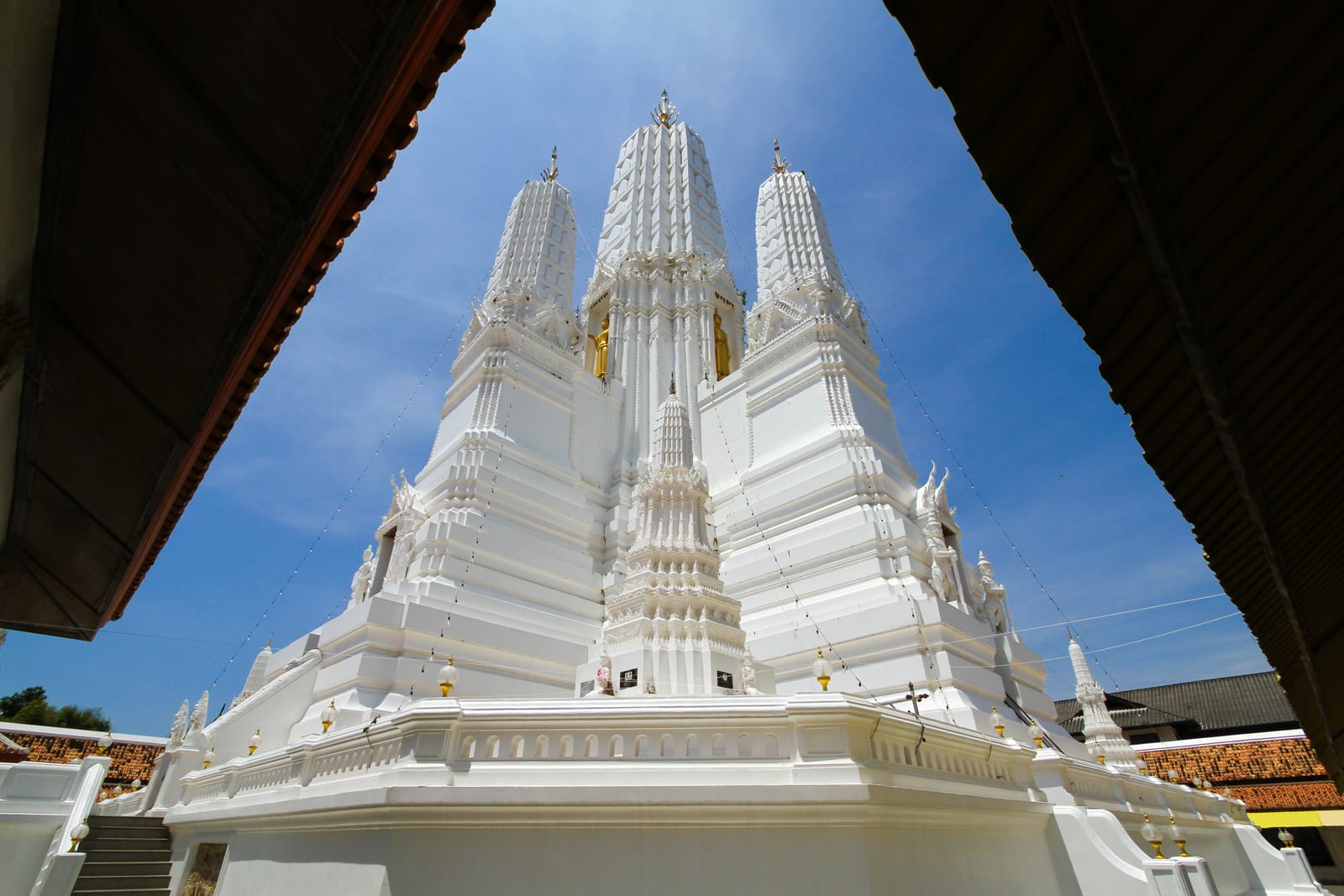
The five-spire prang — a landmark you can see across town
The five-spire prang is the symbol of both the temple and the city of Phetchaburi. The central spire stands over 40 metres tall, surrounded by four smaller corner prangs. The shape draws on Khmer–Lopburi influence, plastered and painted white so it stands out sharply against the sky, with a trident (sam-ngam) at the very top. Inside the prang are enshrined relics of the Buddha. Because it's the tallest structure in the temple grounds, you can spot it from far off no matter which direction you enter town from.
- Central main spire — over 40 metres tall, enshrining Buddha relics; a favourite spot for circumambulating.
- Four corner prangs — set at the corners, giving the whole structure its balanced five-spire silhouette.
- All-white finish — best photographed in the soft light of early morning or late afternoon, when a clear sky sets off the white prang.
Photo angles
The plaza in front of the prang is wide, so you can step back and fit all five spires in one frame. For a reflection shot, walk over to the far bank of the Phetchaburi River in the late afternoon — you'll see the white prang floating above the old town.
Want more out of Phetchaburi? Book tours & activities
Booking online ahead on Klook or GetYourGuide is usually cheaper than the gate and skips the queue. Pick only the experiences you actually want — prices and availability are shown live on each site.
Phetchaburi stucco — the real thing, best seen looking up
Phetchaburi has been famous for its stucco craftsmen since ancient times, and Wat Mahathat is one of the clearest places to see that skill. Stucco work spreads across pediments, doorway arches and building bases throughout the temple. The spot where people tend to linger longest is the pediment shaped as Narayana riding Garuda grasping a naga, with monkey deities supporting the Garuda below, set against curling kanok foliage threaded with figures of garudas, nagas and giants in fine detail. It's work you have to look up at slowly to appreciate how good it is.
- Royal viharn pediment — stucco of Narayana riding Garuda, packed edge to edge with kanok patterns; the temple's highlight.
- Arches and building bases — walk around and you'll find small stucco details tucked in many spots, some with playful caricature figures the craftsmen slipped in.
- Mirror-glass inlay — the small viharn has coloured mirror-glass inlay paired with stucco that catches the light beautifully in daytime.
Get the most out of it
Phetchaburi stucco lives in the small details. If you have time, walk slowly around the buildings and look up at each pediment one by one — you'll notice the patterns are different on every one.
The revered Buddha and what's inside the viharn
The royal viharn enshrines Luang Pho Saksit, the temple's principal Buddha image, long revered by Phetchaburi locals and a place people come to pay respects every day. The inner walls of the viharn also carry murals depicting Jataka tales and assemblies of deities, while the ordination hall (ubosot) holds a large principal Buddha in the subduing-Mara posture. The atmosphere is quiet and calm — a good spot to sit and rest for a moment before moving on to the rest of the grounds.
- Luang Pho Saksit — the temple's principal Buddha image in the royal viharn; the main spot for paying respects.
- Murals — Jataka scenes and deity assemblies, painted in a style spanning the late Ayutthaya to Rattanakosin periods.
- Temple museum (Sala Mrs. Amphon Boonprakong) — displays blue-and-white ceramics, Buddha images and rare phra bot cloth paintings, open to view within the temple.
Hours, getting there and costs
- Hours — daily, roughly 06:00–17:00 (easy to visit during the day).
- Entry — free, no admission charge.
- Location — Damnoen Kasem Road, central Phetchaburi, on the west bank of the Phetchaburi River, about 1.5 km from Khao Wang (Phra Nakhon Khiri).
- Getting there — from Bangkok, drive Rama 2 Road for around 2 hours, or take a train/minivan into Phetchaburi town and a short local hop from there.
- Dress code — dress modestly and remove your shoes before entering the worship buildings.
Busy times
Weekends and public holidays get more crowded than weekdays. If you want room to walk and clear shots, arriving early when the temple opens is your best bet.
Where to go next in a single day
The upside of Wat Mahathat is that it sits in the middle of the old town, so a short walk or drive gets you to the next stop easily. It works well as a half-day to full-day trip.
Phra Nakhon Khiri (Khao Wang)
A hilltop palace in the middle of town, just about 1.5 km from the temple. Ride the funicular or walk up for views over Phetchaburi.
Old-town templeWat Yai Suwannaram
Another temple known for its old woodcarving and historic murals, in the same town.
Where to eatPhetchaburi local eats
After the temple, walk around for Phetchaburi sweets and khao chae, the local specialities worth trying at least once.
Want a full Phetchaburi day plan covering temples, food and where to stay
See the Phetchaburi travel guide →