🔄 Updated 21 Jun 2026
Wat Mahathat sits in the inner zone of Sukhothai Historical Park, a UNESCO World Heritage Site. This is more than a pile of old brick — it was the religious and political centre of the Sukhothai kingdom over 700 years ago, laid out at the exact middle of the city and ringed by moats and walls. If you only have half a day in Sukhothai, this is the first place to come.
Why Wat Mahathat is the heart of the Old City
In the Sukhothai era, Wat Mahathat served as the royal temple of the capital — the home of the Buddha's relics and the site of the kingdom's most important ceremonies. Its position at the centre of the city reflects the old belief in a cosmic centre: everything in town was laid out in relation to this temple. Walk in and you can see why the people of that era gave this place more weight than any other temple.
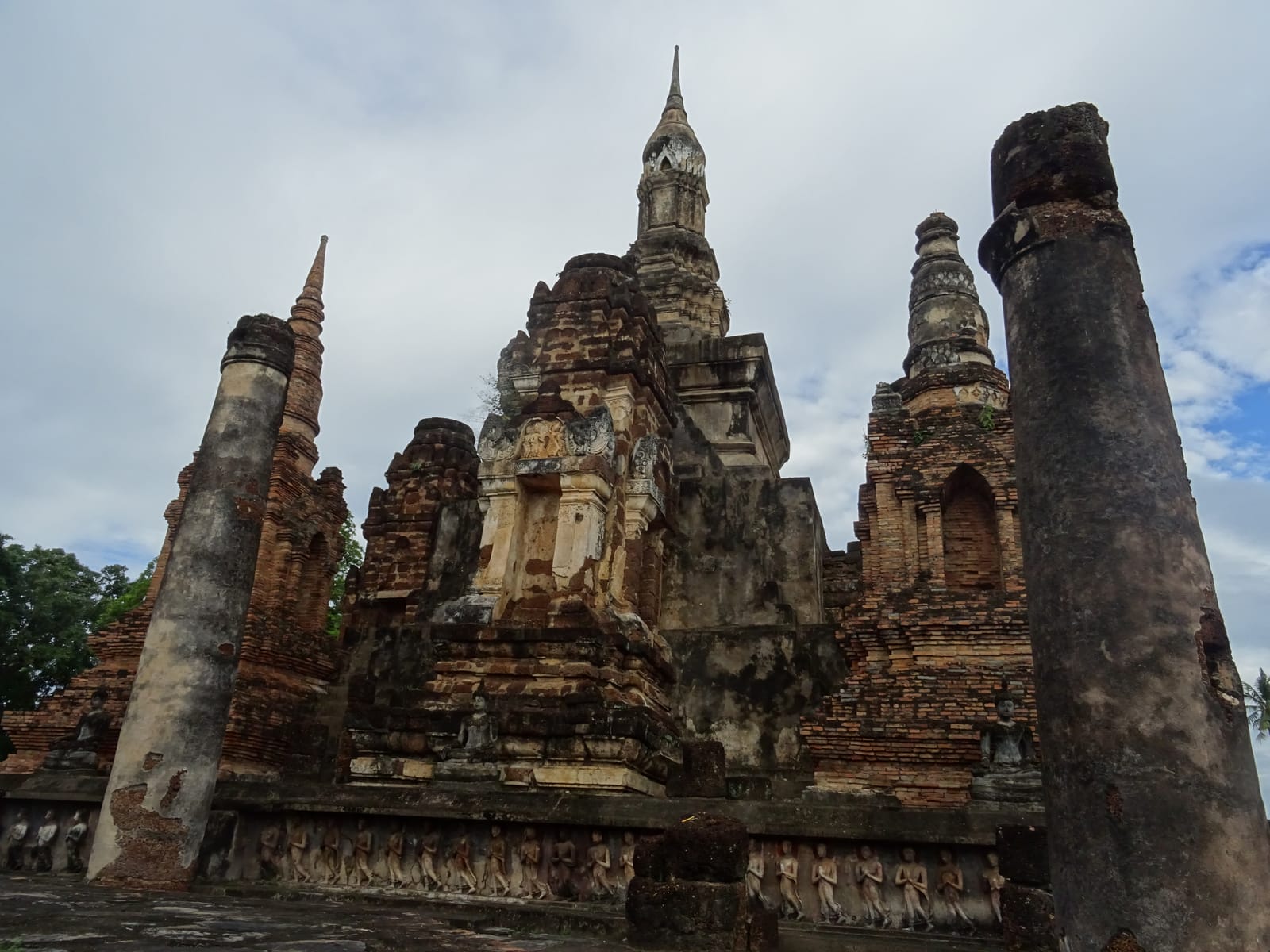
- The lotus-bud central stupa — the focal point of the whole temple, visible from a distance.
- More than 200 satellite chedis — ringing the central stupa, many in different shapes that reflect the various artistic influences of the time.
- The royal assembly hall and ordination-hall base — rows of laterite columns are all that remain, but they help you picture the original buildings.
- The seated principal Buddha — set in front of the central stupa, the spot where people most like to pose for photos.
Want more out of Sukhothai? Book tours & activities
Booking online ahead on Klook or GetYourGuide is usually cheaper than the gate and skips the queue. Pick only the experiences you actually want — prices and availability are shown live on each site.
The lotus-bud stupa — a shape you rarely see elsewhere
The top of the central stupa has the shape known as "phum khao bin", or lotus-bud — a finial that tapers upward and bulges in the middle like a lotus flower that hasn't yet opened. This is pure Sukhothai art, developed locally rather than copied from anywhere, which is why it became a marker you recognise instantly as Sukhothai. The stupa is thought to have been completed during the reign of King Lithai, around the mid-14th century.
Around the base of the stupa runs a row of stucco figures of the Buddha's disciples, walking with their hands pressed together in prayer — a detail many people walk straight past without noticing. Step in for a closer look and you'll see the work of Sukhothai craftsmen still clearly preserved.
Phra Attharot and the rows of Buddha images
On either side of the central stupa, two mondops once housed large standing Buddha images known as "Phra Attharot" — a name that refers to a Buddha roughly 18 cubits tall, a standing form that was popular in the Sukhothai period. The mondops have lost most of their walls now, but the figures still stand tall enough to show their scale, and people like to stand beside them to see just how large they are.
Beyond the Phra Attharot, the temple grounds hold more seated Buddhas and image bases scattered across several spots. The rows of Buddha figures, together with the assembly-hall columns that lead toward the central stupa, give photos of Wat Mahathat real depth — it isn't just a single stupa on its own.
See all of it
Walk a full loop around the central stupa before you start taking photos — you'll find each side gives a different angle. The front pairs the seated principal Buddha with the stupa, the sides give you the standing Phra Attharot, and the back is quieter and far less crowded.
Photo spots worth your time
Seated Buddha with the central stupa
The classic Sukhothai shot. Stand in front to fit both the seated Buddha and the lotus-bud finial in one frame. Early morning gives soft light with fewer people around.
Reflection in the pond
The pond around the temple mirrors the hall and stupa on its surface. On a still day the reflection is sharp — a spot photographers like to wait for.
Late light behind the stupa
As the sun gets low it drops behind the central stupa, giving you a dark silhouette against an orange sky. Best if you stay until evening.
During the Loy Krathong and Candle Festival at the end of the year, Wat Mahathat is lit up and hosts a sound-and-light show, giving the place an atmosphere completely different from the daytime. If you can plan your visit for then, you'll see a side of the temple that not everyone gets to.
Opening hours, entry fees and what to know before you go
- Opening hours — daily, roughly 06:00–21:00 (ticket sales close around 18:00; in the evening the ruins are floodlit).
- Inner-zone entry fee — around 20 THB for Thais and 200 THB for foreigners. Each zone is now ticketed separately — there's no longer a combined ticket (prices may change, so check at the ticket booth).
- Bringing in a vehicle — around 10 THB for a bicycle and 20 THB for a motorbike (cars are not allowed into the inner zone).
- Best time to visit — early morning after opening, or late afternoon before closing, when the sun is gentler and the light is nicer than at midday.
Getting there and getting around the zone
Wat Mahathat is in the Old City, about 12 km from the new town of Sukhothai. If you don't have your own transport, there are songthaew (shared pickup trucks) on the Sukhothai–Old City route leaving the bus station roughly every 30 minutes, with fares around 20 THB; they drop you right at the entrance to the historical park.
- Rent a bicycle — there are rental shops by the park entrance for around 20–50 THB a day. This is the most popular way to get around, since the temples in the inner zone are close together and easy to cycle between.
- Tram / sightseeing cart — a tram runs tours around the inner zone, good for anyone who'd rather not cycle or who's travelling in a group.
- On foot — if you'd rather take it slowly and focus on photos, you can walk from Wat Mahathat to nearby temples such as Wat Sri Sawai and Wat Sra Sri, which aren't far away.
Plan your time
Wat Mahathat alone takes about 45 minutes to an hour, but if you want to make the inner-zone ticket worth it, set aside half a day for Wat Mahathat, Wat Sra Sri, Wat Sri Sawai and the King Ramkhamhaeng Monument.
Want to see all of Sukhothai — the temples, the food and where to stay?
See the Sukhothai travel guide →