🔄 Updated 21 Jun 2026
Wat Pho dates back to the Ayutthaya era and was given major restorations under Rama I and Rama III, growing into a vast collection of knowledge inscribed on its walls and pillars — traditional Thai medicine texts, the rishi self-stretching poses, literature, and astronomy. That's why people call it Thailand's first open university. Beyond the Reclining Buddha, the grounds hold four great stupas and well over a hundred smaller ones that are a pleasure to wander among.
Opening hours and entry fee
Wat Pho is open daily, 08:00–18:30, though the Reclining Buddha hall and a few of the key buildings tend to close their doors a little before the temple itself shuts. If you want to see the Reclining Buddha hall without the rush, come before late afternoon. You pay once and can explore the whole temple all day.
- Foreign visitors — 300 THB per person, including one free bottle of water at the pick-up point inside
- Thai nationals enter free — show your ID card
- Children under 120 cm tall — free entry
- Time to allow — budget around 1.5–2 hours if you want to see the Reclining Buddha and walk the full set of stupas
Timing tip
Wat Pho closes later than the Grand Palace (which stops selling tickets at 15:30), so it works well as your afternoon stop. Start at the Palace in the morning, come to Wat Pho in the afternoon, then cross the river to Wat Arun in time for sunset.
Want more out of Bangkok? Book tours & activities
Booking online ahead on Klook or GetYourGuide is usually cheaper than the gate and skips the queue. Pick only the experiences you actually want — prices and availability are shown live on each site.
The giant Reclining Buddha — the temple's highlight
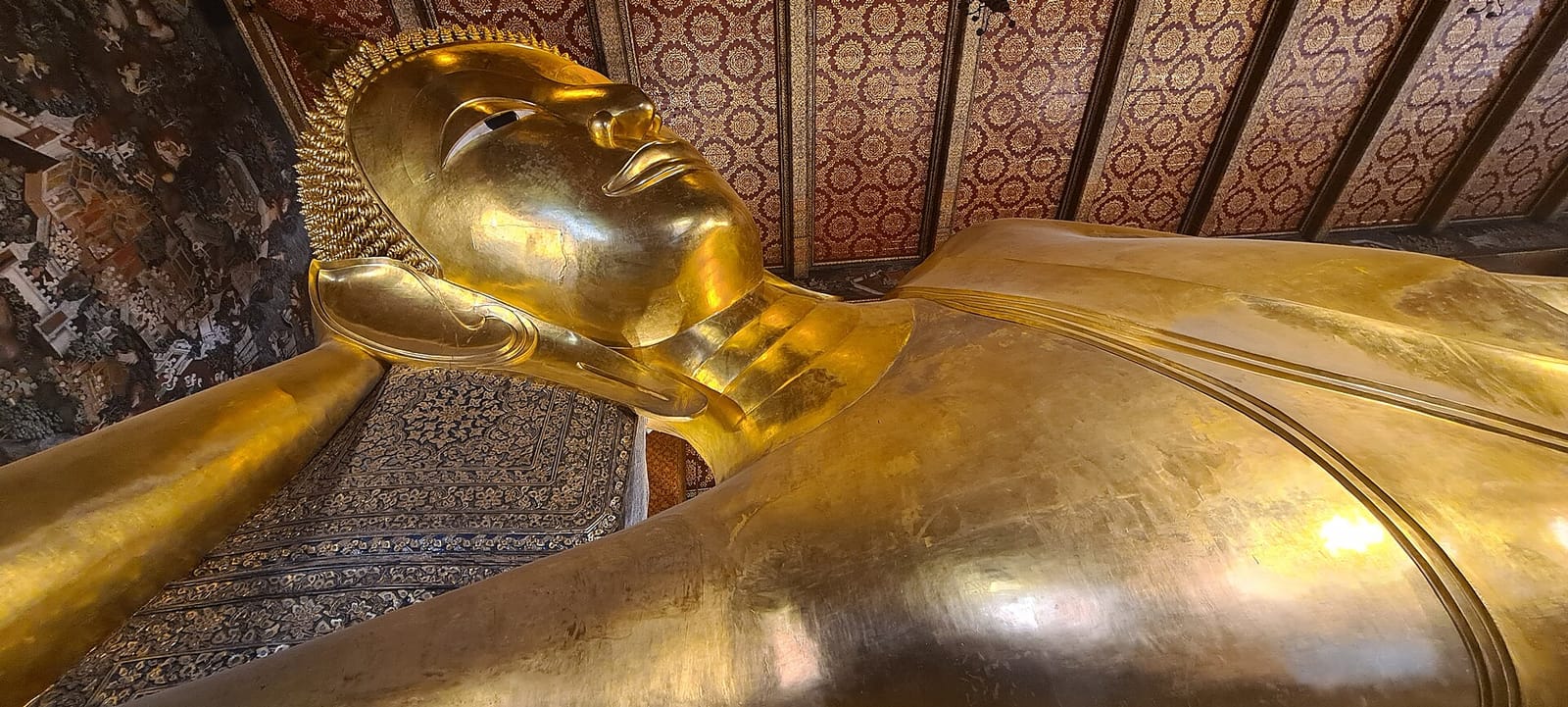
This reclining Buddha is 46 metres long and roughly 15 metres high, gilded from head to toe and tucked into a hall that fits it almost exactly, so you walk alongside it section by section. The detail everyone loves most is the soles of the feet — over 4.5 metres long, inlaid with mother-of-pearl showing the 108 auspicious signs, so finely worked you'll want to stop and look up close.
- Take your shoes off before entering the hall — there are bags so you can carry your shoes in, or leave them on the racks out front
- 108 bronze bowls in a row — buy a cup of coins and drop one in each bowl as you go, an old merit-making custom; the ring of the coins fills the whole hall
- Photo spots — the face and head at the start of the hall photograph best, while the soles of the feet are at the far end
- Dress respectfully — cover shoulders and knees as at any temple; no shorts or short skirts
Wat Pho Thai massage — the real thing, inside the temple
Wat Pho is the original home of Thai massage and runs the Wat Pho Traditional Medical School, which teaches and gives massages right within the temple grounds. The massage pavilions are in the eastern corner of the temple; visitors can walk straight in with no advance booking, though you may have to wait for a spot when it's busy.
- Thai massage — 30 min 340 THB · 60 min 520 THB · 120 min 1,040 THB
- Foot massage — same prices, 30/60/120 min at 340/520/1,040 THB
- The therapists — all trained at the temple's own school, with a firm, serious focus on pressure points
- Service hours — open until around 18:00, closing a little before the temple does
Is the Wat Pho massage worth it?
It does cost a bit more than the street massage shops at 250–350 THB an hour, but here you get the atmosphere of a massage inside the temple and therapists trained at the original institution. If you've walked the temple all morning and your legs are tired, an hour-long foot massage before you move on is something a lot of people say is worth it.
Getting there
Wat Pho sits on Sanam Chai Road and Maha Rat Road in the Phra Nakhon district, right next to the Grand Palace. There's no BTS stop on the doorstep, but the MRT now gets you very close.
- MRT (easiest) — Blue Line to Sanam Chai station, Exit 1, then about a 5–10 minute walk to the temple gate
- Chao Phraya Express Boat (great views) — take the BTS to Saphan Taksin, transfer to the orange-flag boat at Sathorn pier, get off at Tha Tien (N8) and walk in within a few minutes
- Taxi / Grab — just tell the driver "Wat Pho" or "Wat Phra Chetuphon"
- Walking from the Grand Palace — about 10 minutes south along the palace wall
Which pier should you get off at?
If you come by express boat, get off at Tha Tien (N8) — it's close to Wat Pho and it's also the crossing point over to Wat Arun. That lets you do both Wat Pho and Wat Arun on one route without doubling back.
Other highlights you shouldn't miss
The Four Reign Stupas (Phra Maha Chedi Si Rajakan)
Four great stupas clad in different-coloured glazed tiles, built in honour of Rama I–IV — the most colourful photo spot in the temple.
The Ordination Hall (Ubosot)
A beautiful ordination hall housing the Phra Buddha Theva Patimakorn, with carved panels telling the Ramakien epic around the base.
Rishi self-stretching statues
Statues showing old-style body-stretching poses scattered around the temple — a health manual you can actually see in three dimensions.
Chinese stone figures (Lan Than)
Carved stone soldiers and Chinese officials that once served as ballast on trading junks, now standing guard at the gates and corners — fun to photograph.
Where to go next nearby
Wat Pho is right in the middle of Rattanakosin Island, so you can easily carry on by foot or boat. The classic route is Grand Palace → Wat Pho → Wat Arun, which makes for a well-rounded full day of temples.
Grand Palace + Wat Phra Kaew
About a 10-minute walk from Wat Pho, 500 THB entry, with a stricter dress code than most temples — best done in the morning before Wat Pho.
Across the riverWat Arun
A short cross-river ferry from Tha Tien for a few baht; the riverside prang looks beautiful by day and at sunset alike.
Plan a full day of Bangkok's old-town temples in one go
See the old-town temple plan →