🔄 Updated 21 Jun 2026
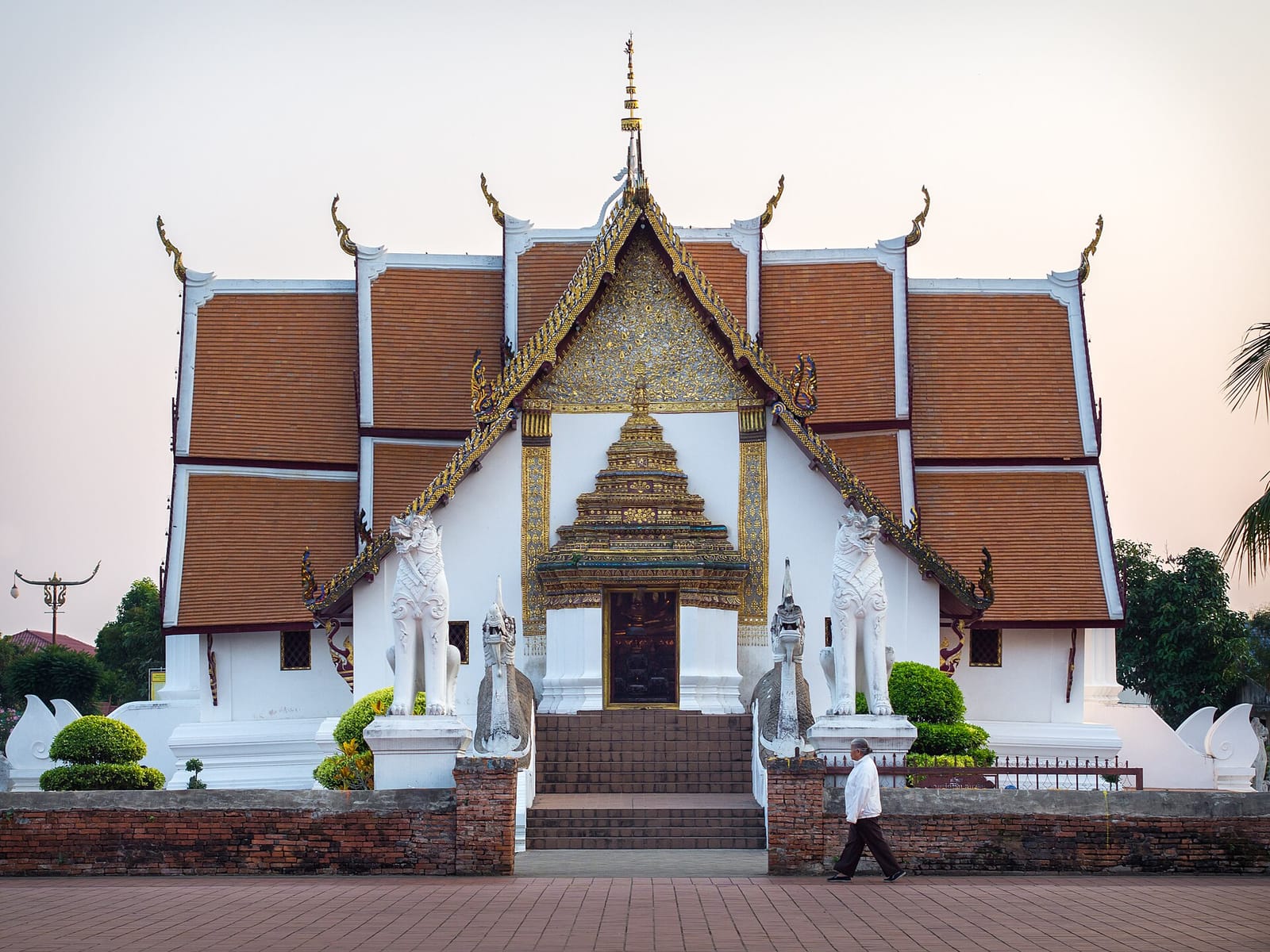
Wat Phumin sits right in the heart of Nan's old town, an easy walk from the town square, the Nan National Museum, and Wat Phra That Chang Kham. What made it famous nationwide is the wall painting of the Pu Man Ya Man couple, nicknamed the 'whisper of love heard around the world,' along with the unusual shape of the ordination hall that once appeared on Thai banknotes and coins. For a lot of people, this is the first pin they drop when planning a Nan trip.
What is the Whispering Lovers (Pu Man Ya Man) mural?
Pu Man Ya Man shows a man and a woman standing side by side. The man has one arm around her shoulder and the other hand cupped to his mouth, as if whispering something into her ear, and both of them wear the look of people sharing a small secret meant only for the two of them. In the local dialect the word 'Man' refers to the Burmese, so the figures are often described as a young Tai Yai (Shan) couple. They aren't characters from a Jataka tale like the other scenes around the wall — they're ordinary people the painter slipped in, and they ended up becoming the most recognized image of all.
The mural is the work of Nan Bua Phan, a local Tai Lue painter, made during the temple's major restoration starting around 1867 (B.E. 2410). One thing many people love is the way the man in the painting seems to look. No matter where you stand, his gaze appears to turn toward you, which is why couples flock here to take photos together — there's a belief that praying for love in front of this mural will keep a relationship steady.
Finding the mural
The Pu Man Ya Man mural is on an interior wall of the ordination hall, not by the main entrance. Plenty of people walk in and can't spot it. Look up and scan the walls around you, or ask a temple staff member — there's usually a small sign pointing it out.
Want more out of Nan? Book tours & activities
Booking online ahead on Klook or GetYourGuide is usually cheaper than the gate and skips the queue. Pick only the experiences you actually want — prices and availability are shown live on each site.
The cruciform hall — what makes it unusual?
The central building is a cruciform ordination hall, meaning it has a porch projecting on all four sides, with identical entrances on each of the four directions — no front or back the way a typical hall has. The Fine Arts Department believes it to be the first cruciform ordination hall in Thailand, and it doubles as both an ordination hall and a wihan (assembly hall) in a single structure. The shape draws clearly on Tai Lue art, which is why it looks nothing like the central-Thailand temples most of us are used to.
- Four Buddha images — At the center of the hall sit four Sukhothai-style Buddha images in the subduing-Mara posture, each facing out toward one of the four doorways with their backs together in the middle, so you can walk all the way around.
- Twin nagas — Outside, two naga serpents flank the entrance staircase. Their bodies run beneath the building and emerge on the far side, as if the nagas are carrying the hall on their backs.
- Murals around the walls — Beyond Pu Man Ya Man, the surrounding walls tell Jataka stories and depict everyday life in old Nan — the clothing, the trade, and people of different ethnicities. It reads almost like a historical record.
A small detail many people don't know: the temple was built around 1596 (B.E. 2139) by Chao Chetbut Phrommin, the ruler of Nan, and was originally called 'Wat Phrommin' after its founder before the name shifted to Wat Phumin over time. The building's shape and the whispering-lovers mural were once printed on Thai currency — if you've ever seen a temple of this shape on a banknote or coin, this is the one.
Opening hours, entry fee, and dress code
- Opening hours — Daily, roughly 6:00 AM–6:00 PM. From late morning into the afternoon the light falls right on the walls, so the murals show up clearly.
- Entry fee — Free, no ticket. There's a donation box for temple upkeep if you'd like to give.
- Dress code — This is still an active temple used for ceremonies, so dress modestly: no spaghetti straps or shorts above the knee, and take off your shoes before entering the hall.
- Photography — You can photograph the murals, but no flash, since it damages the old pigments, and keep your voice down to suit the setting.
When it's least crowded
The busiest stretch is late morning to afternoon, when the tour buses arrive. If you want a shot of Pu Man Ya Man with no one in the frame, try early at opening, around 6:00–8:00 AM, or just before it closes in the evening — it's far easier to shoot then.
Easy add-ons for the same day
The nice thing about Wat Phumin is that it's smack in the old town, so you can walk to almost everything else in a single day without driving anywhere.
Nan National Museum
Directly across from the temple, under a five-minute walk. Home to the city's prized black elephant tusk and the famous frangipani-tree archway, a hugely popular photo spot.
Wat Phra That Chang Kham Worawihan
An ancient temple in the town center right by the square, with a Sukhothai-style elephant-supported chedi. Easy to continue here straight from Wat Phumin.
Kat Khuang Mueang Nan Walking Street
Open Friday–Sunday evenings in front of Wat Phumin, with northern Thai food, khantoke meals, and local souvenirs.
Want a full-day plan for exploring Nan's old town?
See the Nan old town walking route →