🔄 Updated 21 Jun 2026
Wat Poramai Yikawat sits on the headland at the tip of Koh Kret, in Pak Kret district, Nonthaburi. It's a second-class royal temple, and river folk in the old days called it Wat Pak Ao after its spot at the mouth of the river. The temple has stood since the Ayutthaya period, and after it fell into disrepair, Mon people who migrated here under royal protection in the late Ayutthaya to early Rattanakosin era rebuilt it. That's why it still carries a Mon artistic feel to this day.
The name Poramai Yikawat comes from King Chulalongkorn, Rama V, who carried out a major restoration of the temple in 1874 to dedicate it to Princess Sudarat Rajaprayur, who had raised him from a young age. That restoration kept the Mon character intact rather than converting everything to a fully Thai style, which gives the temple an atmosphere different from the other temples in the area.
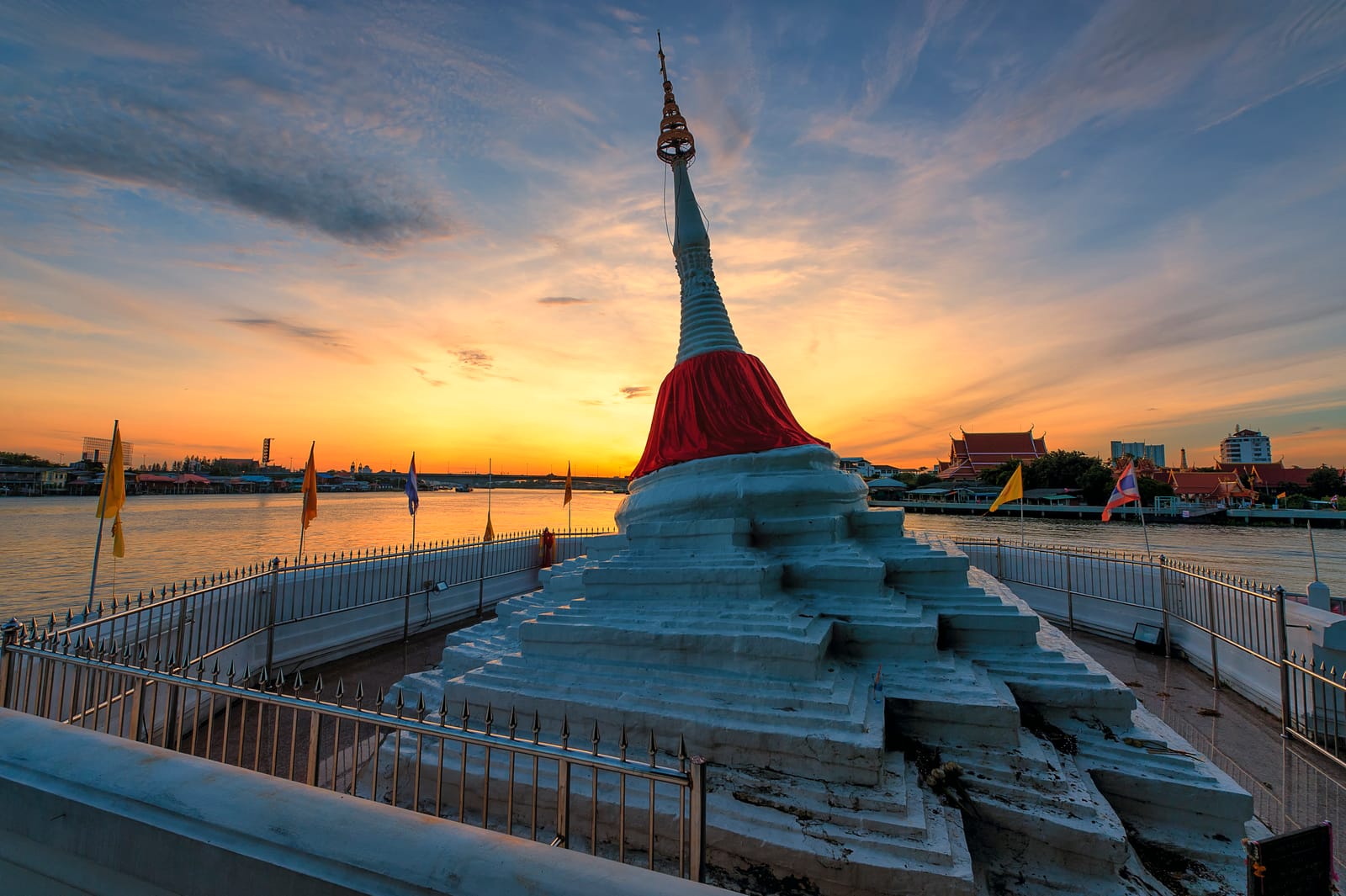
The Mutao Stupa — the leaning chedi that symbolizes Koh Kret
If you remember one image of Koh Kret, it's usually this slightly leaning white stupa. Its real name is the Mutao Stupa, a Raman (Mon) style chedi around 300 years old, built by the Mon migrants. It enshrines relics of the Buddha and has long been revered by Thai-Mon families in the area. A red cloth is tied at the top of the stupa, a custom of Mon culture.
The stupa once stood upright, but it sits right on the eroding riverbank at the tip of the island, where the current has cut at it for a long time. Over the years the base settled and it tilted toward the river, becoming the leaning stupa everyone now calls it, and the most-photographed landmark on Koh Kret. The favourite angle is to stand by the water with the stupa framed behind you, especially in the late-afternoon soft light.
Where to photograph the leaning stupa
The stupa sits right at the water's edge, so if you want the whole thing in frame, walk a little to the right past the pier, where there's a riverside clearing to step back and get your shot. In the late morning the sun lights the front of the stupa; in the evening the light is softer and there are fewer people.
Want more out of Nonthaburi? Book tours & activities
Booking online ahead on Klook or GetYourGuide is usually cheaper than the gate and skips the queue. Pick only the experiences you actually want — prices and availability are shown live on each site.
The reclining Buddha and Nonthaburi's provincial Buddha
Inside the temple grounds, a viharn houses the reclining Buddha, a large old image about 9.5 metres long that many people come specifically to pay respects to. The ordination hall holds a marble principal Buddha said to have been a royal gift, and there are old mural paintings to see as well.
Another image not to miss is Phra Nonthamunin, a Buddha in the Subduing Mara posture that's regarded as the provincial Buddha image of Nonthaburi. Visitors to Koh Kret often stop to pay respects and make a wish before heading on into the market, a nice way to start the trip. All three of these are in the same temple compound and within an easy walk of each other.
- Mutao Stupa (the leaning chedi) — at the water's edge on the island's tip, the main photo spot on Koh Kret
- Reclining Buddha — an image about 9.5 metres long, in the viharn
- Phra Nonthamunin — Nonthaburi's provincial Buddha, open for prayers
- Ordination hall — marble principal Buddha plus old mural paintings
The temple museum and Mon craftsmanship
The temple has a small museum focused mainly on pottery, the craft Koh Kret is known for, passed down from Mon artisans. It has a model kiln and figures of potters at work, along with samples of pottery from different regions of Thailand. If you're into crafts or the history of the Mon community, it's worth a look before you head out to walk the market, which is packed with pottery stalls and Thai sweets.
Koh Kret pottery
Pots, mortars, and planters in Mon patterns, made in the communities around the temple. Easy to pick up as a souvenir in the market.
Traditional Thai sweets
Thong yip, thong yot, Thai-Mon sweets, and snacks at the stalls in the market behind the temple. Easy to graze your way through.
How to get there and opening hours
The easiest way is to head to Wat Sanam Nuea on the Pak Kret side, then take the cross-river ferry over to the tip of the island, which lands you right at Wat Poramai Yikawat. The ferry costs just a few baht each way (around 3 THB during the day) and runs often, so you won't wait long. Wat Sanam Nuea has parking for about 30 THB. If you don't have a car, take the MRT Purple Line and connect by road to the pier.
It's worth checking the hours of the temple's exhibition areas first, because weekdays and weekends differ. Generally, Monday to Friday they open in the afternoon, while Saturday, Sunday, and public holidays they open from the morning. The island and market are busiest on Saturdays and Sundays, so if you want the market in full swing come on a weekend, but if you'd rather walk in peace with fewer people, come on a weekday.
Dress appropriately
This is a temple, so dress modestly and skip tank tops or very short shorts, especially if you're going into the viharn or ordination hall. Take off your shoes before entering where the signs indicate.
Where to go after the temple
The nice thing about Wat Poramai Yikawat is that it's right at the island's gateway. Once you've paid your respects and seen the leaning stupa, you can walk straight into the Koh Kret market. The market has Mon food, Thai sweets, and pottery shops to browse at length. With a half day to a full day you can cycle or walk around the whole island, stopping at other temples and riverside spots along the way.
Plan a full day around Koh Kret and Nonthaburi
See the Nonthaburi travel guide →