🔄 Updated 21 Jun 2026
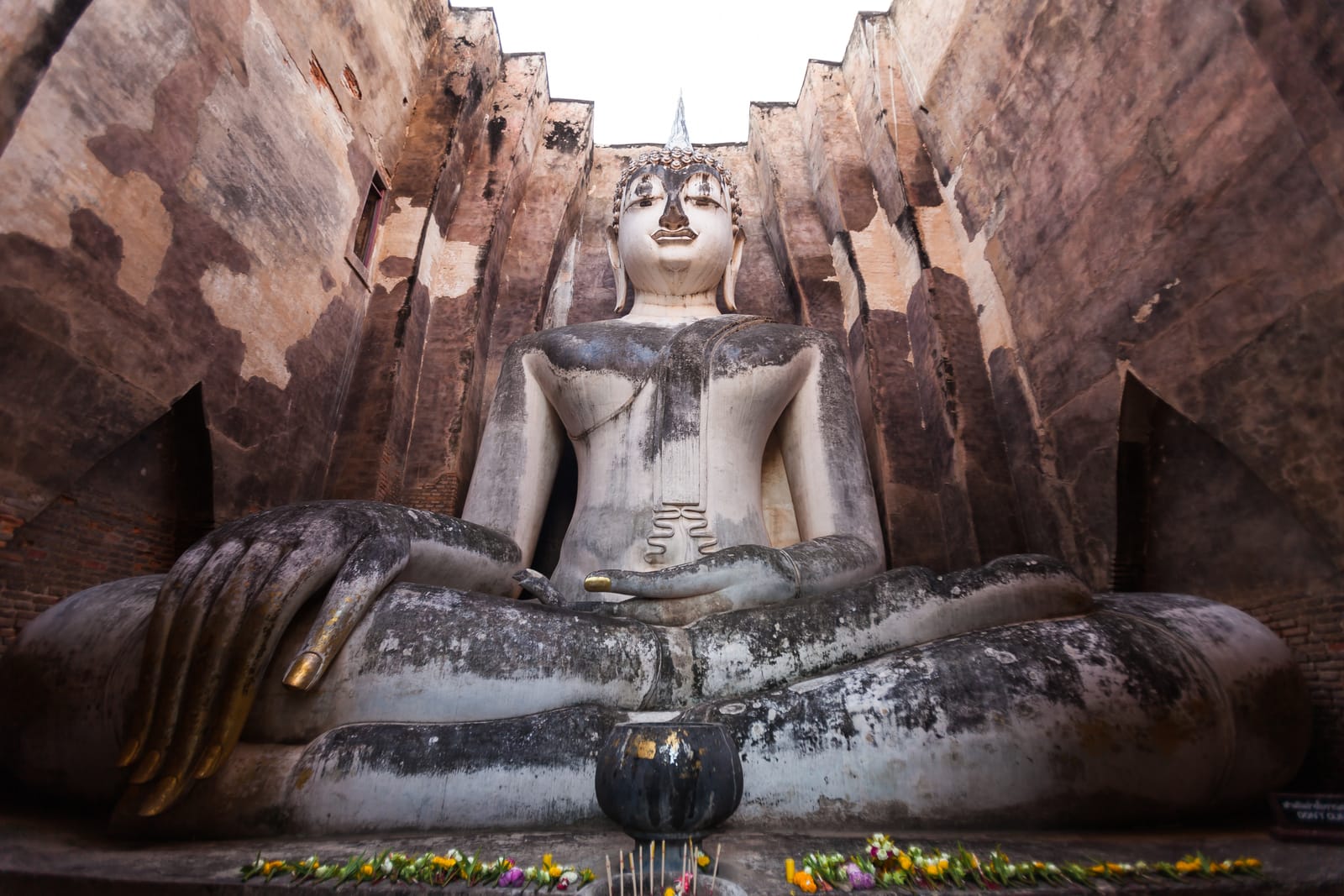
Wat Si Chum sits outside the old city walls to the northwest, within Sukhothai Historical Park. What makes it instantly recognisable across Thailand is the mondop — a square brick structure with thick walls and a tall, narrow doorway cut into its front. Walk into the temple courtyard, look up, and you'll see the face and hand of Phra Achana gradually appear through that slot. It's a simple framing, but a remarkably powerful one.
Who Is Phra Achana, and Why It's Worth Seeing
Phra Achana is a stucco Buddha in the Maravijaya posture (seated cross-legged, right hand resting on the knee), about 11.30 metres wide at the lap and roughly 15 metres to the top. It fills the inside of the mondop so completely that there's almost no room to walk around it. The name Achana means "the unshakeable one." It's thought to date to the early Sukhothai period, around the reign of King Ram Khamhaeng. What sets this Buddha apart from other large images is the way it's 'framed' by the narrow doorway — looking at it head-on, you really feel like you're meeting its gaze.
- Lacquered, gilded hand — the fingers resting on the knee still show traces of gold leaf, and it's the spot people love to photograph up close
- The face through the doorway — the classic shot at this temple; stand in the middle of the entrance and frame the face inside the doorway
- Mondop walls nearly 3 metres thick — there's a stairway passage built into the left wall, but it's now closed to visitors to protect the monument
Want more out of Sukhothai? Book tours & activities
Booking online ahead on Klook or GetYourGuide is usually cheaper than the gate and skips the queue. Pick only the experiences you actually want — prices and availability are shown live on each site.
The Talking-Buddha Legend Comes From This Very Doorway
A story Sukhothai locals love to tell is that 'Phra Achana can speak,' and the legend ties directly to the passage hidden in the mondop wall. As the tale goes, an army once marched out to fight near Sawankhalok and gathered its troops at Wat Si Chum first. When morale among the soldiers sank, the commander had a man climb the stairway inside the wall up behind the Buddha's head and call out words of encouragement through the front opening. Hearing a voice boom out from the image itself, the soldiers took heart.
Worth Knowing
The fun part of this legend is that it can be explained by the actual architecture. The mondop walls are very thick and have a passage concealed inside, so a voice carrying out through the narrow doorway really would sound as if it came from the Buddha. Look for the stairway opening on the left of the entrance and you'll see the story has a basis in something real.
Photo Angles and the Best Light
This temple is easy to photograph, but you need to time it right. The angle everyone comes for is standing dead-centre at the mondop entrance and framing Phra Achana's face neatly inside the doorway. If you come in the harsh midday sun, the inside of the mondop will be fairly dark against the bright exterior, so you'll need to tap to focus on the Buddha to adjust the exposure on a phone camera.
- Morning 07:30–09:00 — fewer people, soft light, cooler air; ideal for photographing the Buddha without anyone in the way
- Late afternoon before closing — light angles into the doorway and gives the face more depth, but the tour crowds start to build around now
- Avoid midday — the sun is straight overhead, shadows are harsh, and the dark interior against the bright outside makes it hard to shoot
Opening Hours, Entry Fees & Rules to Know
Wat Si Chum is in the Northern Zone of Sukhothai Historical Park, which charges a separate entry fee from the central zone. It's open daily from morning to evening. Dress modestly — this is both a historical monument and a sacred site where people still come to pay their respects.
- Opening hours — roughly 07:30–17:30 daily (Northern Zone)
- Entry fee — Thai adults around 20 THB; seniors over 60 and children free; foreigners around 100–200 THB
- Bringing a bike/car in — a small extra fee per bicycle and per small vehicle applies
- Dress code — no tank tops or shorts/skirts above the knee; remove hats and sunglasses when paying respect to the Buddha
A Combined Ticket Is Better Value
If you plan to visit several zones in one day, the park offers a combined ticket covering the central, northern, and western zones. Ask at the central-zone ticket booth first — it works out cheaper than buying separate tickets at each spot.
Getting to Wat Si Chum
Wat Si Chum is about 2–3 km northwest of the old city walls, and roughly 12–15 km from new Sukhothai town (where the hotels and markets are) — about a 15-minute drive. The good news is there are several ways to get there depending on how you like to travel.
Cycle from the Old City
The most popular option. Rent a bike near the park entrance for around 30–40 THB/day, ride out through the northern city gate, and Wat Si Chum is just a few kilometres on. The route is flat and shady.
Rented Motorbike / Car
Rent from new Sukhothai town and follow the park signs. There's a parking area in front of the temple, which is handy if you plan to hit several temples in one day.
Songthaew / Local Hire
A songthaew on the new-town–old-city route runs to the park entrance, where you can switch to a bike or walk; or charter a local tuk-tuk/taxi to drop you off and wait.
Where to Go After Wat Si Chum
Wat Si Chum doesn't take long — around 30–45 minutes covers it — so people usually pair it with other temples in the park, all an easy bike ride apart.
- Wat Mahathat — at the centre of the old city, with its lotus-bud chedi and rows of Buddha images; the heart of the park
- Wat Sa Si — a temple set on an island in a pond, with lovely reflections in the morning and evening; in the central zone near Wat Mahathat
- Wat Phra Phai Luang — in the northern zone near Wat Si Chum, just a few minutes' ride further on
Plan a full day in Sukhothai — temples, food, and where to stay
See the Sukhothai Travel Guide →