🔄 Updated 21 Jun 2026
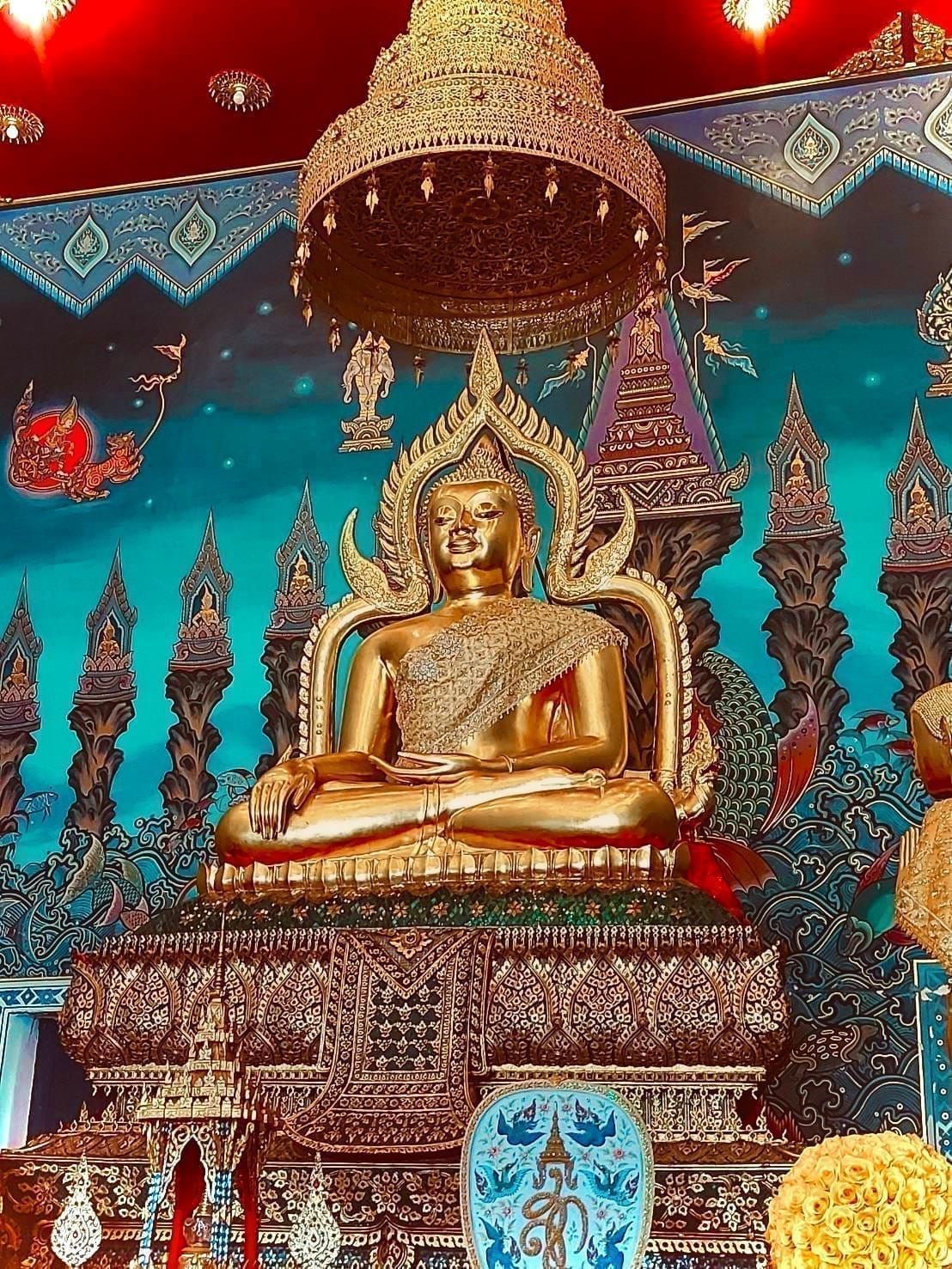
Wat Tha Luang sits in Mueang Phichit district, on the east bank of the Nan River. It's a royal temple and the spiritual heart of the whole province. What sets it apart from an ordinary temple is Luang Pho Phet — a bronze Buddha in the Maravijaya (subduing Mara) posture, made in the Chiang Saen style, that the people of Phichit treat as their guardian image. When there's a major merit-making event in the province, or when someone is starting a new chapter — a new job, an exam, a wedding — they often come here first.
Luang Pho Phet, the province's guardian Buddha
Luang Pho Phet is a cast-bronze Buddha in the Maravijaya posture (seated cross-legged, the right hand resting on the knee). The features are Chiang Saen in style — a full, serene face — set on a lotus-petal base, with a lap width of a little over two sok (roughly a metre across). It looks dignified without being overpowering: the kind of image you kneel before and feel close to, not a towering figure you have to crane your neck to see.
Legend has it that Luang Pho Phet originally came from the north, around Chom Thong in Chiang Mai. In the Ayutthaya era, after the army had marched north to put down a campaign, the governor of Phichit at the time asked to bring a fine Buddha image back with him — so Luang Pho Phet was floated down the river on a bamboo raft before being enshrined in Phichit. That journey by water is part of why the temple, the Buddha, and the Nan River feel so bound together.
Before you go in to pay respects
The ordination hall that houses Luang Pho Phet is only open at certain times on some days. If you want to kneel before the actual image inside the hall, come from mid-morning to afternoon and check with the staff at the temple entrance first. On days with religious ceremonies, the opening and closing times can shift from the usual schedule.
Want more out of Phichit? Book tours & activities
Booking online ahead on Klook or GetYourGuide is usually cheaper than the gate and skips the queue. Pick only the experiences you actually want — prices and availability are shown live on each site.
Why this is the city's number-one temple
Beyond Luang Pho Phet himself, Wat Tha Luang has a long history — it dates back to around the reign of King Rama III. It was originally called Wat Rat Pradittharam, later shortened to Wat Pradittharam, before becoming the Wat Tha Luang of today. The temple sits right in the centre of town, an easy walk from the market and the riverfront, which is why locals and visitors alike tend to make it their first stop.
- The real guardian Buddha — you get to kneel before Luang Pho Phet himself, the image the whole province reveres, not a replica.
- Right in the centre of town — close to the market, the City Pillar Shrine, and the Nan River, so several spots are within walking distance.
- Quieter than you'd expect — even in the middle of town, the grounds are shady and calm, a good place to sit and reset for a few minutes.
- Free to enter — there's no admission fee; you only pay for offerings — flowers, incense, candles — as your faith moves you.
The Luang Pho Phet homage festival
If you want to see Wat Tha Luang at its liveliest, come in late January. The province holds the 'Luang Pho Phet Homage and Phichit City Celebration', the city's big annual festival, roughly from 21–31 January. Around the temple and across town there are religious ceremonies, light-and-sound shows, floating krathong processions along the river, OTOP local-product stalls, and live entertainment. People from Phichit who work away tend to come home for it, and the whole thing feels like a province-wide family reunion.
Allow extra time during the festival
The homage festival draws big crowds, and the parking around the temple fills up fast. If you come during this period, park a little further out and walk in, or come during the day when it's not as packed as it is at night. Hotels in town tend to be fully booked in late January, so reserve ahead.
How to pay your respects to Luang Pho Phet
- Get your offerings ready — flowers, incense, and candles are sold at the temple entrance, just a few tens of baht per set.
- Dress respectfully — this is a royal temple, so skip spaghetti straps and very short shorts.
- Photos are fine, but read the room — avoid shooting while someone is kneeling in prayer, and don't use flash inside the ordination hall.
- Donate as you see fit — there are donation boxes and merit-making points around the temple; no set amount is expected.
Where to go next around the temple
The nice thing about Wat Tha Luang is that it's right in the centre of town, so once you've paid your respects you can keep exploring on foot without driving anywhere far. Pulling together an easy half-day from here isn't hard at all.
The Nan River in front of the temple
Step out of the temple and you're right at the Nan River. In the late afternoon it's a pleasant riverside-town stroll along the bank. Late in the year, when the water is high, there's a traditional long-boat race with boats named after the Chalawan–Kraithong legend.
Phichit City Pillar Shrine
Another spot in the centre of town to make a wish, not far from Wat Tha Luang and easy to add on the same route — good for anyone who wants to tick off the city's temples and shrines in one go.
Bueng Si Fai
The city's natural landmark — a large freshwater lake with a statue of the crocodile-king Chalawan and a cycling path around the shore. It's a few minutes' drive from the temple, ideal to head to in the late afternoon for the sunset.
How to get to Wat Tha Luang
The temple is within the Phichit town municipality and very easy to reach. If you take the northern railway line, get off at Phichit station and catch a ride into town — it's a short hop. If you're driving, take the Asian Highway (AH2) up through Nakhon Sawan; it's about 4–5 hours from Bangkok. Once you reach Phichit town, turn toward the Nan River side and follow the signs. The temple has a parking lot, but it gets packed during the annual festival, so allow a little extra time.
Plan a full Phichit trip, with places to stay
See the Phichit travel guide →