🔄 Updated 7 Jun 2026
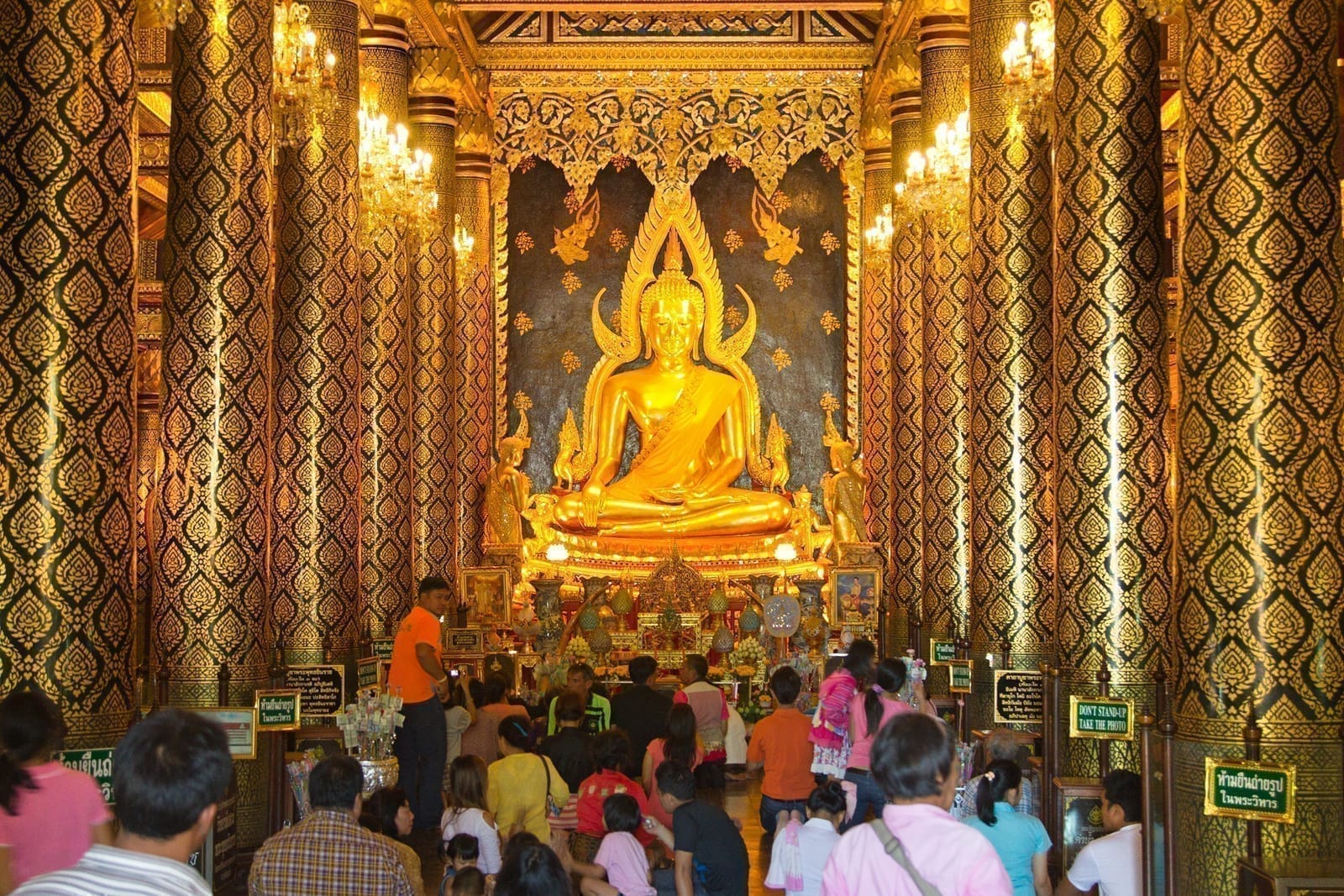
Wat Yai is a first-class royal temple on the east bank of the Nan River, on Phutthabucha Road in central Phitsanulok, directly across from the provincial hall. It's a temple that defines the town, founded back in the Sukhothai era. The Phra Buddha Chinnarat image is cast in bronze in Sukhothai style; what stands out is the soft, flowing line of the figure, the flame-shaped halo, and the carved arch behind it featuring two naga serpents. Thais from all over the country come here to make merit and ask for blessings, and shrine and amulet makers across Thailand often cast replicas of this image to enshrine elsewhere. The grounds aren't huge — you can walk the whole thing in about 1 to 1.5 hours.
Opening hours and admission
- Phra Buddha Chinnarat viharn — open roughly 06:00–20:00 daily. This is the main hall where everyone comes to pay respects, and it stays open later into the evening than the rest of the complex.
- Temple grounds and museum — open roughly 06:30–18:00. The Phra Lueang viharn, the Phra Atthasalat image, and the cloistered gallery close earlier than the main viharn.
- Admission — free; there's no entrance fee. There are donation boxes and merit-making spots if you'd like to give.
- Dress code — this is a temple to be respectful in: no shorts or skirts above the knee, no spaghetti straps, and take your shoes off before entering the viharn.
Best time to go
If you want to pay respects without the crowds, come in the early morning, around 06:30–08:30 — it's cool and still quiet. On long weekends and during festivals it gets very busy from mid-morning on, so if you visit then, allow extra time to queue in front of the image.
Want more out of Phitsanulok? Book tours & activities
Booking online ahead on Klook or GetYourGuide is usually cheaper than the gate and skips the queue. Pick only the experiences you actually want — prices and availability are shown live on each site.
Paying respects to Phra Buddha Chinnarat and what to offer
In front of the viharn, stalls selling offerings line up in a row. A standard offering set has incense, candles, a lotus flower, and gold leaf, priced around 20–50 THB depending on size. Many people buy gold leaf to press onto the base or the replica image at the front, and offer a lotus flower as well. The process is simple: set your intention, bow three times, then apply the gold leaf.
- Offering stalls — found at the viharn entrance, with several to choose from at similar prices. Just tell the vendor you're here to pay respects to Phra Buddha Chinnarat and they'll hand you the standard set.
- Applying gold leaf — press it onto the replica image or the gold panels set aside for it, not the original image, to keep its beauty intact.
- Lamp oil / making merit — there are spots to top up lamp oil and donation boxes that support the temple; give as much as you like.
- Renting amulets and sacred objects — there are spots to rent and revere amulets on the grounds. Phra Buddha Chinnarat amulets are popular with collectors across the country.
Straight talk
Offerings at the temple are cheap, so there's no need to bring anything from home — buying in front of the viharn is easier. And if you'd rather not apply gold leaf or light incense, paying your respects with a simple bow and an honest heart is perfectly fine. Nobody will mind; nothing here is compulsory.
Key sights inside you shouldn't miss
Phra Buddha Chinnarat
The principal image in the main viharn, cast in bronze in the Sukhothai era — a graceful figure, a flame-shaped halo, and an arch carved with naga serpents. This is the heart of any visit here.
Mother-of-pearl doors
The front doors of the viharn, inlaid with mother-of-pearl in an old design, roughly 1 metre wide and 4.5 metres tall. Master craftsmanship — get a close look as you enter the hall.
Phra Atthasalat & the prang
Phra Atthasalat is a large standing Buddha behind the viharn, while the central prang is a Sukhothai-style stupa restored with Ayutthaya features, housing relics of the Buddha.
Museum & Luang Pho Dam / Phra Lueang
The grounds include the Phra Lueang viharn (cast from the bronze left over from the Chinnarat image), Luang Pho Dam, and a small museum where you can keep exploring the temple's art and history after the main viharn.
Getting to Wat Yai
Wat Yai sits in central Phitsanulok on the east bank of the Nan River. It's very easy to reach — close to the train station and the town centre — so if you're staying in town you can practically walk there, or it's just a few minutes by car.
- From Phitsanulok train station — about 1.5 kilometres away. Take a songthaew, a motorbike taxi, or a Grab — just a few minutes. You can walk it too if you don't mind the heat.
- From Phitsanulok airport — about 5 kilometres away. A taxi or Grab into town and to the temple takes roughly 10–15 minutes.
- Driving yourself — there's parking at the temple and along the surrounding streets. It fills up fast on weekends, so be ready to look for a spot on nearby roads.
- Songthaews / local buses — several routes pass the Wat Yai–market area. Just ask the driver if they pass Wat Phra Buddha Chinnarat.
A tip
If you're short on time in Phitsanulok, make Wat Yai your first stop in the morning before the sun gets harsh, then stroll the riverside market or move on to other spots in town. The temple is right in the centre, so wherever you go next is easy to reach.
Where to go nearby
- Markets and restaurants along the Nan River — around the temple you'll find "dangling-leg" noodle shops, the famous flying morning-glory stir-fry, and local Phitsanulok eats to try after paying your respects.
- Other temples in Phitsanulok — there are several more old temples in town, such as Wat Nang Phaya and Wat Ratchaburana, so you can do a temple-hopping run in a single day.
- Sergeant Major Thawee Folk Museum — a collection of old Phitsanulok household tools and everyday objects, a good follow-on for anyone keen on the cultural side after Wat Yai.
Hungry for good Phitsanulok food after the temple?
See the Phitsanulok eats you have to try →