🔄 Updated 21 Jun 2026
People tend to think of Yala simply as a southern border province, but what makes this place different is that three cultures have lived side by side here for a long time, in the same space. It is not just the trilingual signs along the streets — it is the way people eat and live, the places of worship, and the festivals that each community keeps alive and that visitors can cross between. If you keep an open mind and walk slowly, Yala gives you an experience that is hard to find in any other province.
Read before you go
Yala sits in the deep south, an area that has at times been under special security measures. Before you firm up a plan, it is worth checking the latest news and official safety advisories, and asking your accommodation or local people about routes. Most travelers visit Yala town and Betong without any trouble, but updating your information before you set off makes the trip far more relaxed.
Three cultures in one province — the overview
Yala's population breaks down roughly into Malay-descended Thai Muslims as the largest group, followed by Thai Buddhists and Thai-Chinese. What is interesting is that the three groups are not split into separate towns — they mix within the same neighborhoods. You can walk from a mosque to a Chinese shrine in a few minutes. In Betong it is even clearer, because it is a district where Hokkien Thai-Chinese settled densely during the mining and rubber-plantation era, living alongside Malay Muslims in a small town set in a valley.
- Malay Muslim — the largest group; an Islamic way of life, mosques, halal food, and the Pattani Malay dialect
- Thai-Chinese (Hokkien & Hakka) — traders in the town and in Betong; shrines and local Chinese food
- Thai Buddhist — Wat Khuha Phimuk and temples in town; Buddhist traditions such as the Chak Phra boat procession, kathin and Loy Krathong
- Yahya / Baba community — descendants of Chinese settlers who married into Malay families, blending the dress and food of both cultures
Want more out of Yala? Book tours & activities
Booking online ahead on Klook or GetYourGuide is usually cheaper than the gate and skips the queue. Pick only the experiences you actually want — prices and availability are shown live on each site.
Language — trilingual signs that are actually used
The first thing you notice on arriving in Yala is that many shopfront signs carry Thai, Chinese and Jawi script (Malay written in Arabic letters) all at once. Most locals speak the Malay dialect (Pattani Malay) in daily life alongside Thai, while older members of Betong's Chinese community still speak Hokkien and Hakka at home. As a visitor you can get by in Thai throughout the tourist areas, but knowing a word or two of Malay greeting warms up a conversation.
- Assalamualaikum — the Muslim greeting, used widely in Malay communities
- Terima kasih — "thank you" in the local Malay
- Jawi script — seen on mosque and shop signs and in religious books; a hallmark of the area
- The Yala southern accent — Thai Buddhists and Thai-Chinese here speak a southern Thai dialect with its own distinctive accent
The Malay Muslim side — the old market, central mosque and roundabout city plan
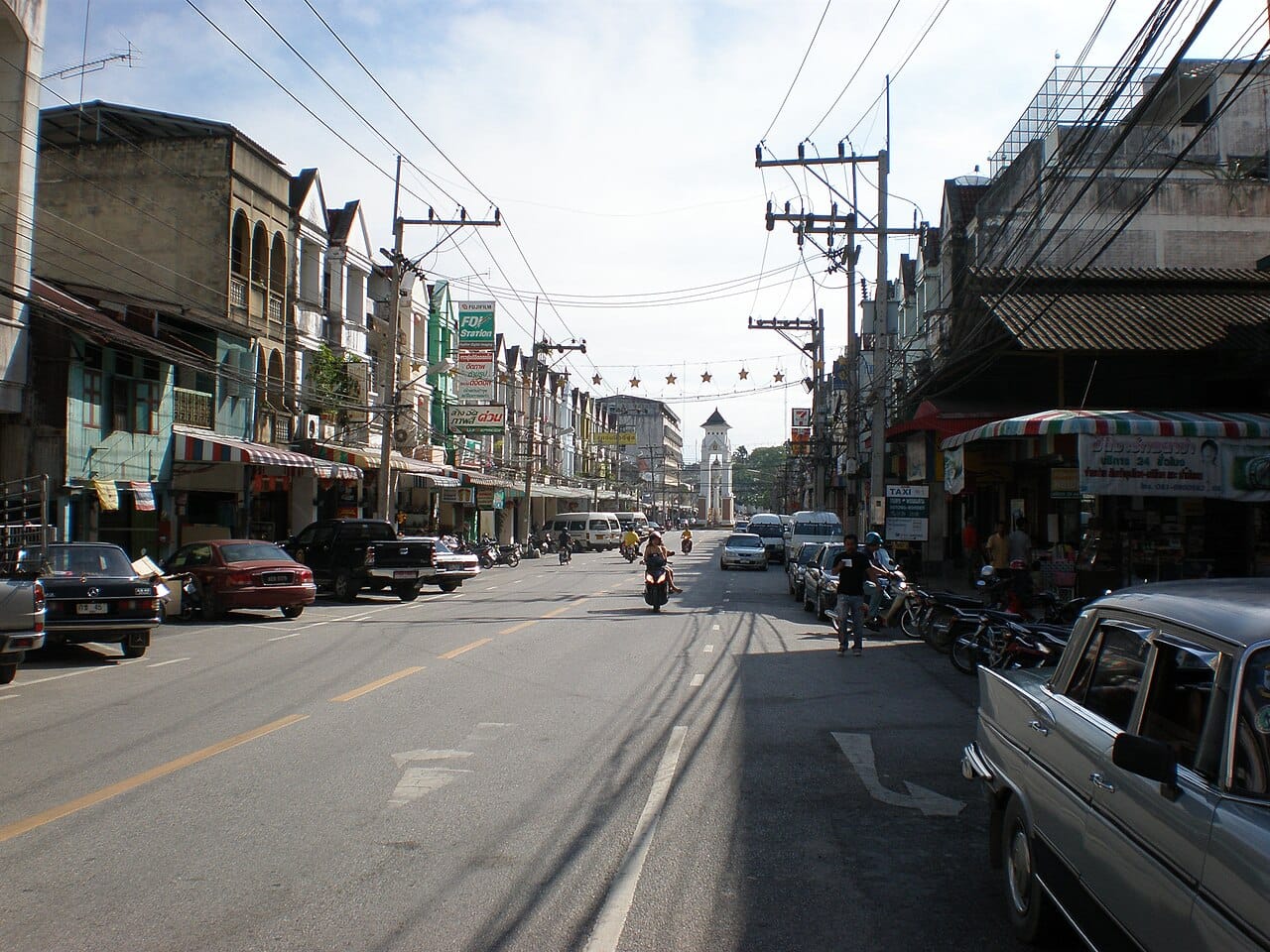
The heart of the Malay Muslim side is the old market district along the railway and the Pattani River, a community of old wooden shophouses with a clock tower as its landmark. The surrounding streets are full of shops selling Muslim fabric and clothing, halal eateries and tea houses. Nearby on Siroros Road stands the Yala Central Mosque (Masjid Rawdatul Jannah), a large mosque that is the spiritual center for the province's Muslims. The architecture is handsome and it is a spot where visitors can stop to take photos from the outside.
Another thing Yala takes pride in is the roundabout city plan of Yala city municipality, with roads laid out in neatly nested circles. It is regarded as one of the best-organized city plans in Thailand. Walking or driving around the big roundabout, you can feel a deliberate approach to urban design that sets it apart from most Thai towns.
Etiquette when visiting a mosque
If you would like to look inside a mosque, dress modestly with shoulders and knees covered; women should cover their hair, everyone removes their shoes before entering, and it is best to avoid prayer times. Ask permission before taking photos inside. Most Muslims are happy to welcome visitors who treat the place with respect.
The Thai-Chinese side — shrines, the trading quarter and Betong
Most Thai-Chinese in Yala are Hokkien and Hakka, settled here from the era of trade, mining and rubber plantations. In town stands the Chao Mae Lim Ko Niao Shrine (Chue Siang Tueng), an anchor for the Chinese community. But it is in Betong that Chinese culture runs deepest. This small valley town is packed with old shophouses, shrines, kopi cafes and Chinese restaurants that have been open for decades. The Chinese-language town sign and the giant mailbox are landmarks plenty of people line up to photograph.
Food is the clearest trace of Betong's Chinese heritage, because the first generation of Chinese settlers took Cantonese and Hakka recipes and cooked them with local ingredients until a distinctive flavor emerged. Think Betong chicken, a crossbred bird with firm meat and crisp skin, and khao yok, Hakka-style pork belly steamed with taro, both of which you can still find at the town's long-running restaurants.
The Thai Buddhist side — Wat Khuha Phimuk and the thousand-year reclining Buddha
About 8 kilometers from Yala town, Wat Khuha Phimuk (the temple at the cave mouth) is an old temple long tied to the local Thai Buddhists. Its highlight is a reclining Buddha inside a cave, believed to be more than 1,000 years old, dating back to the Srivijaya period, with a guardian-giant figure watching over the temple entrance. The air inside the cave is cool and still — it is revered by locals and worth a stop for anyone who wants to see Yala's Buddhist dimension. Buddhist traditions such as the Chak Phra boat procession, Loy Krathong and Songkran are still held in town according to the annual calendar.
Straight talk
Wat Khuha Phimuk is not a grand, ornate temple like the ones in big cities. Its appeal is its age and the reclining Buddha inside the cave. If you are expecting a showy, photogenic temple you may feel underwhelmed, but if you are interested in Srivijaya history and want to understand the area's Buddhist roots, this place has real value — and it is not crowded.
Food of three cultures — eat your way through Yala and Betong
The easiest and tastiest way to understand Yala's culture is to eat, because the food tells you exactly where each group comes from — from the Malay kitchen built on curry pastes and halal cooking, to the Betong Chinese kitchen built on meat and vegetables, all the way to the desserts and tea that blend all three ways of life. We have picked the dishes that best represent each culture and that you can genuinely still find in the area, with rough prices.
Betong chicken
A local crossbred chicken from Betong with firm meat, thin crisp skin and little fat, usually served boiled with a soy or special dipping sauce. It is the dish every famous Betong restaurant has to offer, and the face of Betong's local Chinese cooking.
Khao yok (steamed pork with taro)
Pork belly steamed in layers with taro and topped with a rich sauce — the Hakka dish that points most clearly to Betong's Chinese roots. The meat is meltingly tender, eaten with hot steamed rice, and found in the town's old Chinese restaurants.
Nasi dagang (Malay coconut rice)
Rice cooked with coconut milk and Malay herbs, eaten with fish or chicken curry — a halal breakfast you can find at shops in the old market district and Muslim communities. The flavor is well-rounded, true to a real Malay kitchen.
Chicken or beef biryani (khao mok)
Fragrant yellow spiced rice served with chicken or beef, a popular halal dish at festivals and Muslim eateries across Yala. The spices are gentle and not overpowering.
Betong dim sum
Cantonese-style morning dim sum that has become Betong's breakfast culture. Legendary shops such as Tai See Hee have been open for over half a century, with people queuing for steamed buns, dumplings and steamed rice rolls.
Beef soup (oxtail / stewed beef)
A Malay–Indian Muslim style spiced soup with beef stewed until it falls apart, fragrant with spices. It is a halal dish that warms you up nicely in a cool-weather town like Betong.
Chicken kuai chap / steamed rice rolls
Wide Cantonese-style rolled rice sheets, dressed with sauce or served in chicken broth — a breakfast and snack woven into Betong's Chinese way of life. You can find it at the old kopi cafes.
Betong grass jelly (chui kuai)
A Betong-recipe grass jelly made from grass-jelly herb grown locally, with a chewy, soft texture and a distinctive aroma — a cooling dessert that has become a well-known local souvenir.
Sour fish / steamed Chinese fish
Betong raises Chinese fish (a special tilapia strain) in cool reservoir water, giving firm meat with no muddy smell. It is popularly steamed with soy sauce or made into sour fish — an ingredient tied to the town's cool climate.
Teh tarik / kopi at the old cafes
A tea-house culture that blends both Malay and Chinese: teh tarik pulled hot, sweet and creamy in the Muslim style, and old-school kopi coffee as a Chinese breakfast. Sit and sip while you watch the market go by.
Eating tips
Muslim eateries are halal, with no pork or alcohol, while Betong's Chinese restaurants serve pork and some have alcohol. If you are traveling in a group that includes both Muslims and non-Muslims, planning the right separate venues keeps everyone comfortable. Betong's morning dim sum gets busy, so arriving before 8 a.m. makes it easier to find a seat.
Festivals all year round — a three-culture calendar
Part of Yala's charm is that festivals from all three cultures cycle through the year. If you plan your trip to coincide with one, you will see the town at its liveliest. Here are the main events that are still held.
ASEAN Zebra Dove Singing Competition
A provincial event Yala has held since 1986, drawing bird owners from Malaysia, Indonesia and Singapore. The arena fills with bird cages hung high on poles, reflecting the southern tradition of keeping zebra doves.
Betong Chinese New Year
Betong's Thai-Chinese set up tables to honor deities and ancestors, red lanterns go up across the town, and the shrines come alive — the time when Betong's Chinese culture is at its most intense.
Hari Raya (Eid al-Fitr / Eid al-Adha)
The major days for Muslims after the fasting month: families dress in their finest for prayers, visit relatives and make special halal dishes — a warm atmosphere across the Malay community.
Buddhist traditions — Chak Phra, Loy Krathong, Songkran
Yala's Thai Buddhists still keep their temple traditions — the Chak Phra boat procession, kathin, Loy Krathong and Songkran — held in town each year according to the Thai calendar.
Betong — a Chinese town in a valley, reached by misty mountain bends
Betong is Thailand's southernmost district, about 140 kilometers from Yala town. Most of the drive climbs through winding mountain roads past rubber plantations and green forest, and in the early morning low-lying mist often hangs over the route. The spot most people head for is the Aiyerweng Skywalk, a sea-of-mist viewpoint on a tall tower with a 360-degree view of layered mountains — you have to arrive before sunrise to catch the mist at its best. Betong town itself is a small Chinese town that is easy to explore on foot, with its giant mailbox, the town-name sign and street art to photograph.
Driving to Betong safely
The road up to Betong is dozens of kilometers of continuous mountain bends. If you are driving yourself, check your brakes and tires before setting off, take the curves slowly, and watch for thick morning mist that cuts visibility. Anyone prone to motion sickness should sit up front and bring medication. If you would rather not drive, there are vans and tours from Hat Yai and Yala to choose from.
A cultural trip — a day-by-day plan
If you want to take in all three cultures without rushing, here is a route that splits the trip to cover the Muslim, Chinese and Buddhist sides. Adjust it to match festival dates.
Yala town — three ways of life in one day
Driving up to Betong — a Chinese town in the mist
Aiyerweng sea of mist + the drive home
Respecting the culture — a few quick things to know
- Dress modestly, especially when entering a mosque, shrine or temple — cover your shoulders and knees
- Ask permission before photographing people, especially Muslim women and religious ceremonies
- Respect prayer times and the fasting period — some Muslim eateries adjust their hours during Ramadan
- Check the latest safety news before you travel, and follow local people's advice about routes
Plan a Yala–Betong trip that covers the culture, the food and the sea of mist
See the Yala travel guide →