🔄 Updated 21 Jun 2026
Yasothon was founded around 1770–1776 by the Phra Wo–Phra Ta group, who migrated down from the Lao side of the river. The culture and art in its temples are a Thai–Lao mix with an Isan accent, which you can read in the low-set sim (ordination halls), the scripture libraries set over water, and the hoop taem (mural paintings) that still survive in the older temples. The handy part is that most of the important temples sit close together in the old-town quarter, so you can walk between them, while the out-of-town temples like Phra Phutthabat and Phra That Kong Khao Noi are a short drive and easy to fit into one day.
Wat Maha That — The City Temple and Phra That Anon
Wat Maha That is a royal temple and has been Yasothon's principal city temple since the town was founded. It sits inside the municipal area and was originally called Wat Thung Sawang. The main draw for visitors is Phra That Anon, which locals also call Phra That Yasothon — a square-based stupa whose upper section resembles Phra That Phanom. According to its history it enshrines the bone relics of Ananda, a disciple of the Buddha, which is believed to be the only such enshrinement in Thailand.
Another treasure here is Phra Phuttha Butsayarat, the dewdrop crystal Buddha — a Chiang Saen-style image with a lap width of only about 1.9 inches, so small that it's said to be one of the tiniest votive Buddha images in Thailand. It's a revered image that the people of Yasothon hold in high regard. The temple grounds also have an old scripture library set over water, an Isan-style wooden structure that gets harder to find every year.
- Phra That Anon — the city's stupa; people come to pay respects and ask for blessings of wisdom and memory, following the example of Ananda, who memorized the Buddha's teachings.
- The dewdrop crystal Buddha — a tiny Chiang Saen-style votive image, usually kept somewhere secure; ask the temple ahead of time.
- The scripture library over water — Isan-style timber architecture once used to store palm-leaf manuscripts; it photographs beautifully in the morning light.
Cover the whole quarter on foot
Wat Maha That sits right next to the Ban Singha Tha old-town quarter, close to Wat Singha Tha and Wat Si Thammaram, which both have old sim and hoop taem murals. You can walk all three temples in one morning, then wrap up with a photo stroll around the old shophouses of Ban Singha Tha.
Want more out of Yasothon? Book tours & activities
Booking online ahead on Klook or GetYourGuide is usually cheaper than the gate and skips the queue. Pick only the experiences you actually want — prices and availability are shown live on each site.
Ban Singha Tha Old Town — Temples and Shophouses in One Quarter
Ban Singha Tha is the old trading quarter along the Chi River, lined with brightly painted Sino-European shophouses built by Vietnamese craftsmen who settled here. Its cultural draw is that the quarter packs several old temples close together, so you can string a temple walk together with photos of the old buildings in a single trip — ideal if you want both merit and good pictures.
Wat Singha Tha
An old temple in the heart of the quarter, with an Isan sim and wall murals that still show traces of local folk art. It's the namesake of the Ban Singha Tha quarter.
Wat Si Thammaram
A royal temple of the Thammayut order that was once a residence for forest-meditation masters. People come to pay respects to Luang Pho Phra Suk.
City Pillar Shrine
Set in the middle of the Ban Singha Tha quarter, its quirk is three city pillars rather than the single pillar you see elsewhere. Yasothon locals hold it in high regard.
Phra That Kong Khao Noi — The City's Cautionary Legend
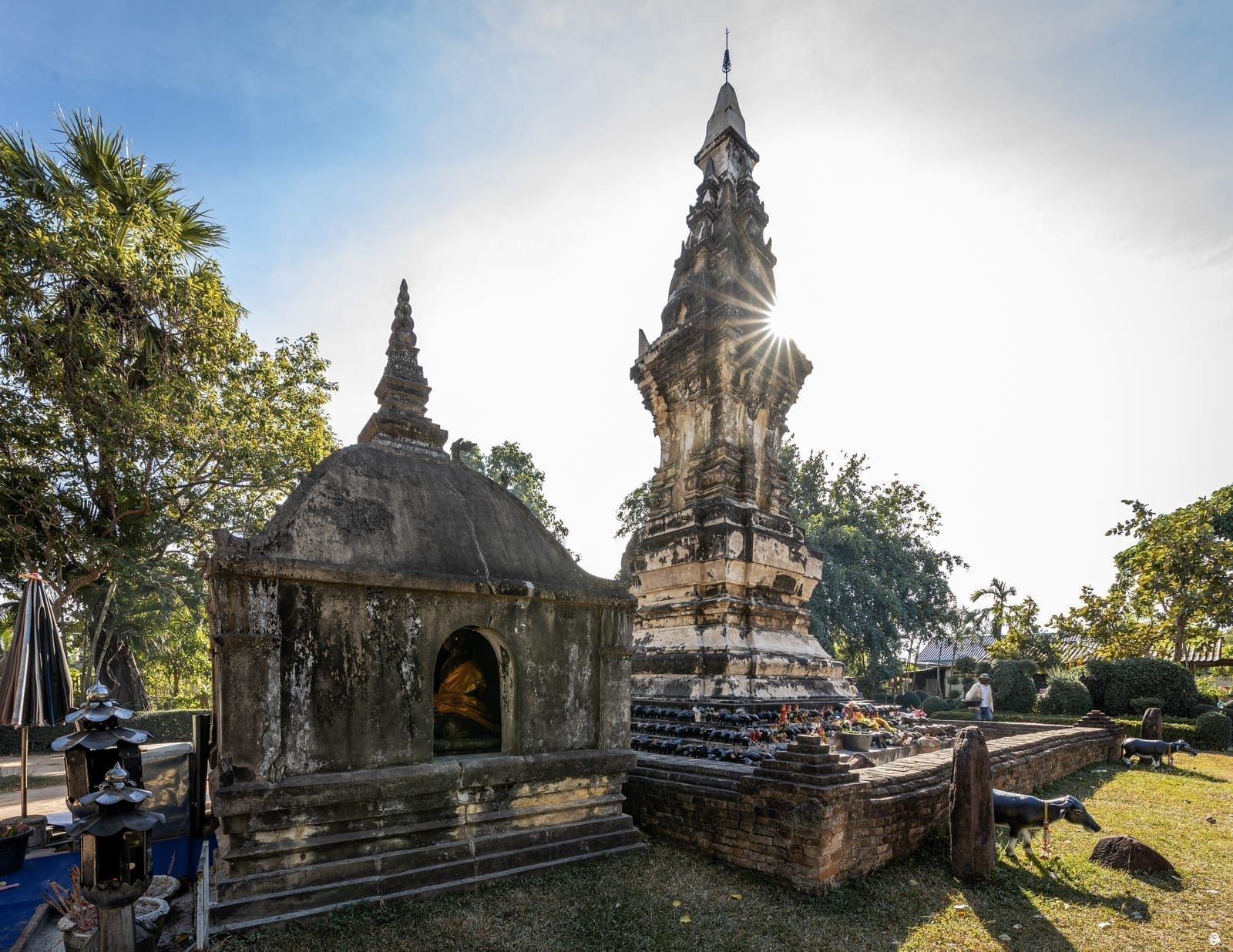
Phra That Kong Khao Noi stands at Ban Tat Thong in Tat Thong subdistrict, Mueang district, not far from town. It's an old redented square stupa with a base about 2 meters on each side and arched-doorway motifs on all four sides. It's thought to have been built around the 18th–20th centuries CE, in the late Ayutthaya period.
What makes people remember it is the folk legend. The story goes that a son was plowing the field and grew ravenously hungry; when his mother brought his rice late and the rice basket looked small, he flew into a rage and struck her dead — only to find he couldn't finish the basket of rice after all. Stricken with remorse, he built this stupa to atone on the spot where his mother died. It's a cautionary tale about gratitude that Isan people know well.
Stop by without rushing
The stupa itself isn't large, and the grounds are shady and quiet — about 30–45 minutes covers it. Entry is free and it's open during the day, so it's a good stop on the way in or out of town. Nearby there's also the Ban Tat Thong archaeological site if you want to add it on.
Wat Phra Phutthabat Yasothon — A White Stupa in the Maha Chana Chai Fields
Wat Phra Phutthabat Yasothon is at Ban Nong Yang in Hua Mueang subdistrict, Maha Chana Chai district, about 40 kilometers south of Yasothon town. It's a temple of the Thammayut order that enshrines a replica of the Buddha's footprint, made in the Ayutthaya-era tradition, and there's an old Buddha image in the Naga-sheltered posture to pay respects to.
The spot most people photograph is the Maha Chana Chai stupa, a large white three-tiered stupa about 45 meters tall. The ground floor displays Isan folk household items and serves as a Dharma study room, and the next level has wax figures of revered teachers — which makes this both a temple to worship at and a cultural learning stop in one.
- Replica of the Buddha's footprint — the temple's main object of veneration; people pay respects and ask for blessings tied to travel and prosperity.
- The white Maha Chana Chai stupa — it stands tall above the fields and photographs well under clear skies or in the evening; you can go inside and up.
- Flood season — some years the water rises around the temple until it looks like an island in the middle of a lake. If you come at the end of the rains, check the road conditions first.
Getting there
The temple is out toward Maha Chana Chai and is best reached by your own car, since public transport barely gets there. The access road is good and sedans can manage it. If you're fitting this temple into your trip, plan it for late morning to afternoon and loop back into town in the evening.
The Yasothon Temple Route — How to Make It Work
Yasothon's main temples split simply into two groups: the old-town cluster you can walk between, and the out-of-town ones that need a drive. Plan it well and you can do the lot in 1–2 days. We've broken it into plans by how much time you have.
Old-town temples + Phra That Kong Khao Noi
Wat Phra Phutthabat Maha Chana Chai (if you have extra time)
Temple Etiquette and Things to Know
- Dress modestly — skip spaghetti straps and shorts above the knee, especially when entering a sim or ordination hall.
- Take off your shoes — before stepping onto a pavilion or into an area where a Buddha image is enshrined, and step over rather than on the door thresholds.
- Photograph respectfully — some spots, like the dewdrop crystal Buddha, don't allow photos; watch for signs or ask staff first.
- Donate as you feel moved — there are donation boxes for temple upkeep; there's no entry fee, so give what you can.
The most comfortable time for temple-hopping is the cool season from late in the year into early the next, when it's cool enough to walk outdoors. But if you want the city's big merit-making atmosphere, try coming for the Bun Bang Fai rocket festival in May, when you'll see Isan culture in full — the processions, the seung dancing, and the Phaya Thaen beliefs woven into the temples around town.
Plan your stay and a full temple-and-sightseeing trip in Yasothon
See the Yasothon travel guide →