🔄 Updated 21 Jun 2026
Ang Thong sits about 100 km from Bangkok, roughly an hour and a half by car. Its appeal isn't big landmarks but the feel of the flat floodplain on both sides of the river: small roads hugging the bank that run past rice paddies, wooden houses, people fishing, and temples that have stood by the water since the Ayutthaya era. If you like slow travel that's all about the small details, riverside Ang Thong is the place.
The backbone of this trip is Highway 309, the Ayutthaya–Ang Thong stretch that runs parallel to the Chao Phraya through Pa Mok district and into Ang Thong town. The two sides of the road alternate between rice fields and riverside communities, with temples and craft villages to stop at along the way. It's an easy drive, or you can cycle it if you set out early to beat the heat.
Riverbank temples worth a stop
Many of Ang Thong's temples sit right on the river, because in the old days people travelled by boat, so temples became both a spiritual anchor and a meeting point for the community. These two are the main markers along the riverside route.
Wat Pa Mok Worawihan
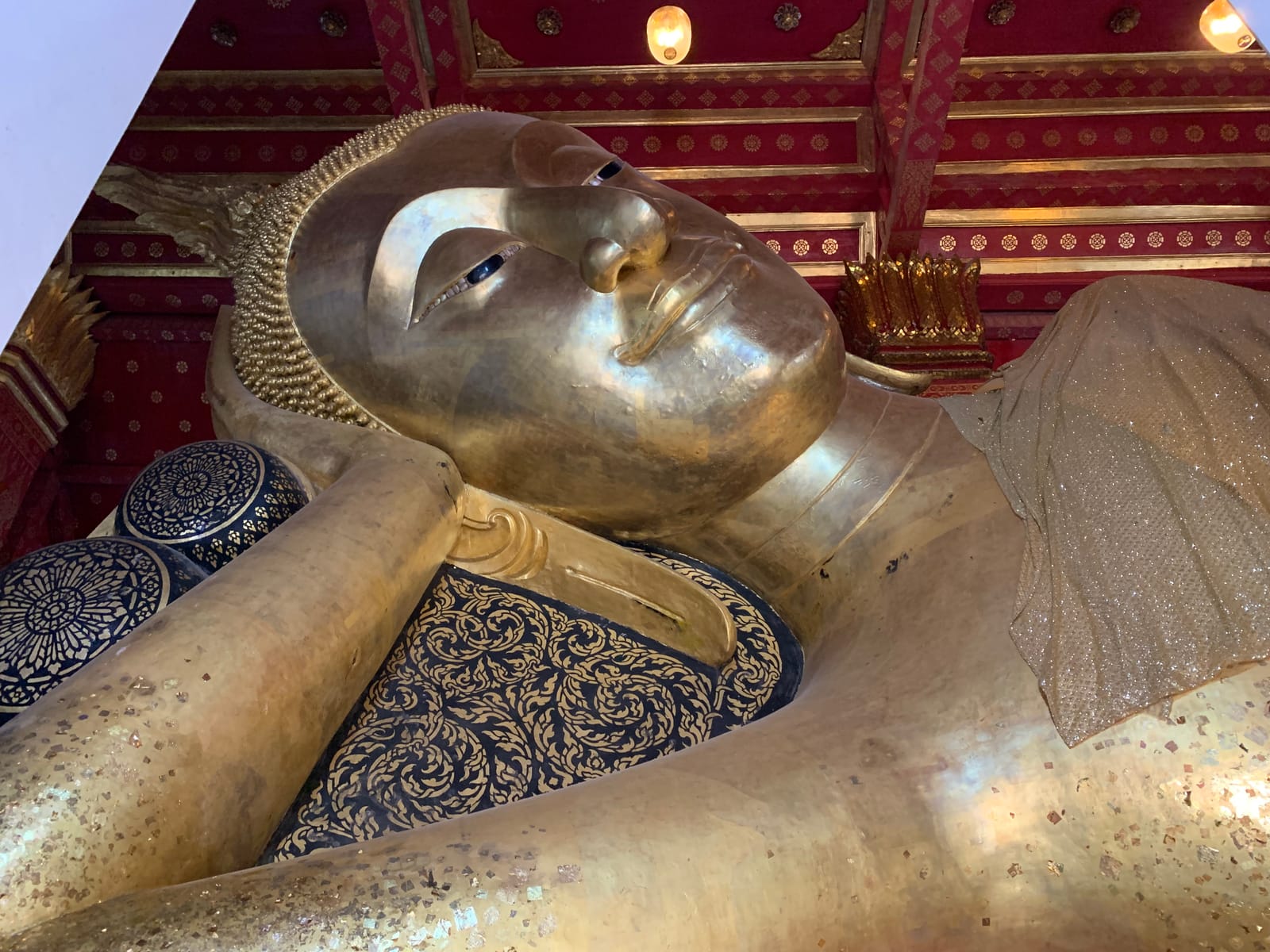
An old temple on the Chao Phraya in Pa Mok district, home to a reclining Buddha (Phra Non) about 24 metres long, believed to date from the Ayutthaya period. The image is beautiful and the grounds are shady; walk out from the temple courtyard and the river is right there. It makes a tidy starting point for the riverside route.
Wat Khun Inthapramun
An ancient temple in the middle of the rice fields, home to one of Thailand's largest open-air reclining Buddhas, around 50 metres long, stretched out amid the paddies. The setting is wide and open with green fields all around. It's best in the late afternoon when the light is soft.
Tip
Wat Khun Inthapramun sits out in the open fields, and by mid-morning the sun is strong and hot. If you want a photo of the reclining Buddha against a nice sky without baking, go at first light or just before sunset for softer light.
Want more out of Ang Thong? Book tours & activities
Booking online ahead on Klook or GetYourGuide is usually cheaper than the gate and skips the queue. Pick only the experiences you actually want — prices and availability are shown live on each site.
Riverside craft villages — still made by hand
What sets Ang Thong apart from other riverside towns is its craft villages, where handwork has been passed down through generations. Following the river around Pa Mok, you'll come across two villages that actually let you watch the process up close, not just shops selling souvenirs.
Ban Ekkarat Drum-Making Village (Pa Mok)
Ekkarat sub-district in Pa Mok is famous for drum-making. Walk into the village and you'll see artisans stretching hides, turning wood, and making drums from small ones all the way up to giants — there to watch and to buy. It has a laid-back, homey feel along the riverside road.
Ban Bang Sadet Clay Doll Village
The clay-doll centre is at Wat Tha Sutthawat on the Chao Phraya in Bang Sadet sub-district, Pa Mok. Villagers hand-mould clay dolls depicting traditional Thai life; the ground floor has demonstrations and sales, and the upper floor is an exhibition. It's craftwork under the SUPPORT royal handicraft foundation.
Both are in Pa Mok district and close together, just a few minutes' drive apart, so you can plan to visit them as a pair in a single morning, then move on into Ang Thong town in the afternoon.
The old market on the Noi River
Besides the Chao Phraya, Ang Thong also has the Noi River, a tributary that flows past the Wiset Chai Chan side. Along the Noi River there's an old market that's still very much alive; come on a Saturday or Sunday and it's especially busy.
Sala Chao Rong Thong Market (Wiset Chai Chan Market)
An old community market over a hundred years old on the Noi River. It was once a Thai-Chinese neighbourhood, named after the shrine (sala chao) and the goldsmith workshops (rong thong) of the past. Today it's a walk-and-eat market of old-style Thai food, sweets, noodles, and souvenirs, set among wooden shophouse rows by the water.
Straight talk
Sala Chao Rong Thong Market is only really lively on weekends. Come on a weekday and many shops are closed and it's quiet. If you want the full atmosphere, plan your trip to land on a Saturday or Sunday.
Drive vs cycle — which to choose
- Driving — the most flexible option. Follow Route 309 from Pa Mok into Ang Thong town with ease, hitting the temples, craft villages, and market all in one day. Good for families or anyone short on time.
- Cycling — for the full riverside feel. The bankside roads in and around town are flat, so the riding isn't hard, but watch out for traffic on the main highway. Set out early to dodge the sun and the cars, and stick to short rides in town or around the temples, which is safer than long stretches on the highway.
- A mix — drive with a bike on board, park at a temple or the market, and ride in short bursts. It's a tidy way to get both the views and the comfort.
If you don't bring your own bike, local rentals are still limited and unreliable, since Ang Thong isn't a mainstream tourist town. We'd suggest bringing your own bike if you're serious about cycling.
A one-day riverside route (planned for you)
Pa Mok — temples and craft villages
Out in the fields — the reclining Buddha at Wat Khun Inthapramun
The old market and the riverside in town
Before you go
- Best season — late rainy to early cool season (Oct–Feb), when the rice fields are green and the weather is just right. The hot season has very strong sun for cycling.
- Sun and water — the riverside and rice fields have little shade, so pack a hat, sunscreen, and plenty of drinking water.
- Cash — many shops at the old market and craft villages mainly take cash, so bring small notes.
- Respect the community — many of these spots are people's homes and real workshops, so it's more polite to ask before photographing anyone at work.
Plan a full riverside trip in Ang Thong
See the Ang Thong travel guide →