🔄 Updated 21 Jun 2026
Ban Khu Bua isn't a single-gate attraction — it's a whole sub-district with its stories spread across several spots: a community museum, a weaving center that's still active, old temples, and earthen mounds that were once Dvaravati-era stupas. So we want to give you the big picture first — what each spot is, how to get there, and how much time to set aside.
Who are the Tai Yuan of Khu Bua?
The Tai Yuan (or Yuan people) are an ethnic group of Lanna descent from the Chiang Saen and Chiang Rai area who were resettled in central Thailand in the early Rattanakosin period. One group of Tai Yuan put down roots here at Ban Khu Bua in Ratchaburi some 200-plus years ago, and they've kept their language, food, and — most famously — their teen jok skirt weaving alive to this day.
What makes this place special is that it isn't staged for tourists. People here still weave, cook, and go about their daily lives as usual. You come in as an outsider here to learn, not to watch a show.
Want more out of Ratchaburi? Book tours & activities
Booking online ahead on Klook or GetYourGuide is usually cheaper than the gate and skips the queue. Pick only the experiences you actually want — prices and availability are shown live on each site.
Antique teen jok skirts — Khu Bua's claim to fame
"Jok" is a weaving technique that uses a porcupine quill or a sharp pointed stick to pick up the threads one by one to build the pattern. That gives teen jok cloth (the hem section of a sarong skirt) far finer detail and denser color than ordinary weaving. A single piece can take weeks or even months to finish, so it doesn't come cheap — but the craftsmanship earns it.
The signature antique Khu Bua patterns still being woven today include:
- Dok Sia (eight-petal flower) — Khu Bua's most prominent pattern, an eight-petalled flower arranged in rows. It's considered the master pattern that every weaver has to learn.
- Na Mon (pillow-face) — a square pattern resembling the triangular pillow faces of the north.
- Kong Keng — alternating diagonal lines that look like they're moving in rhythm.
- Nok Khu and Nok Kin Nam Huam Tao (paired birds) — birds facing each other, symbolizing love and connection.
- Kap — a structural border pattern often used to separate the main motifs.
How to tell real jok cloth
Flip the cloth over and look at the back. If it's genuine hand-picked jok, the back shows loose thread ends hanging along the pattern — it isn't smooth like printed or machine-woven cloth, and the pattern won't be exactly identical on both sides.
Ban Khu Bua Folk Museum (Jipata Phantasathan)
If you're short on time, start here and you'll get almost the whole Khu Bua picture in one stop. The Ban Khu Bua Folk Museum sits inside Wat Khlong Suwankhiri. It's a community museum founded by Dr. Udom Somporn, a conservationist of Tai Yuan descent, completed around 2007 as a striking two-story building in a modern Lanna style.
Inside, it lays out Tai Yuan life in full — from household items and tools of daily work to the star of the place upstairs: a room of antique and newer jok cloths displayed side by side for comparison, with a model loom demonstrating how it's woven and patterns kept for the next generation to study.
- Opening hours — open daily, roughly 9:00 a.m.–4:00 p.m. (sometimes closed on Tuesdays; it's worth calling ahead if you're coming on a weekday).
- Entry fee — free; there's a donation box to help support the museum's upkeep.
- Location — Wat Khlong Suwankhiri, Khu Bua sub-district, Mueang district, Ratchaburi.
- Contact — tel. 032-323197 or 081-763-1989.
Tip
Phone numbers and opening hours for community museums like this can change with whoever's looking after it. If you're coming specifically to see inside, calling a day ahead is the safer bet — especially if you're arriving as a group.
Where to watch weaving and buy real jok cloth
If you want to take jok cloth home, or to watch the weavers actually at work, there are a few spots around Khu Bua to head for.
Tai Yuan Ratchaburi Agricultural Cooperative (Ban Khu Bua jok cloth hub)
Near the front of Wat Khu Bua, this is the largest gathering point for hand-woven jok cloth in the area. It was founded by Dr. Udom Somporn to bring villagers together to make and sell teen jok skirts, and it stocks both finished cloth and weaving supplies.
Kad Withi Chumchon Khu Bua (community market)
A community market in the Wat Khlong Suwankhiri grounds, open only Friday–Sunday, roughly 9:00 a.m.–8:00 p.m. Villagers bring local food and craftwork to sell — a relaxed place to graze and shop with a real community feel.
On price, we'll be straight: genuine hand-picked antique jok cloth isn't a hundred-baht souvenir. A full, finely woven teen jok skirt runs from the low thousands into the tens of thousands of baht depending on the difficulty of the pattern and the thread count. Smaller pieces, scarves, or little keepsakes are much more affordable. We'd suggest asking the current price right at the shop, since each pattern varies a lot.
Affordable souvenirs
If a full skirt is out of budget, look for scarves, bags, or small jok-patterned cloth pieces — same technique, gentler price. You still take a genuine antique Khu Bua pattern home with you.
The Dvaravati-era ruins of ancient Khu Bua
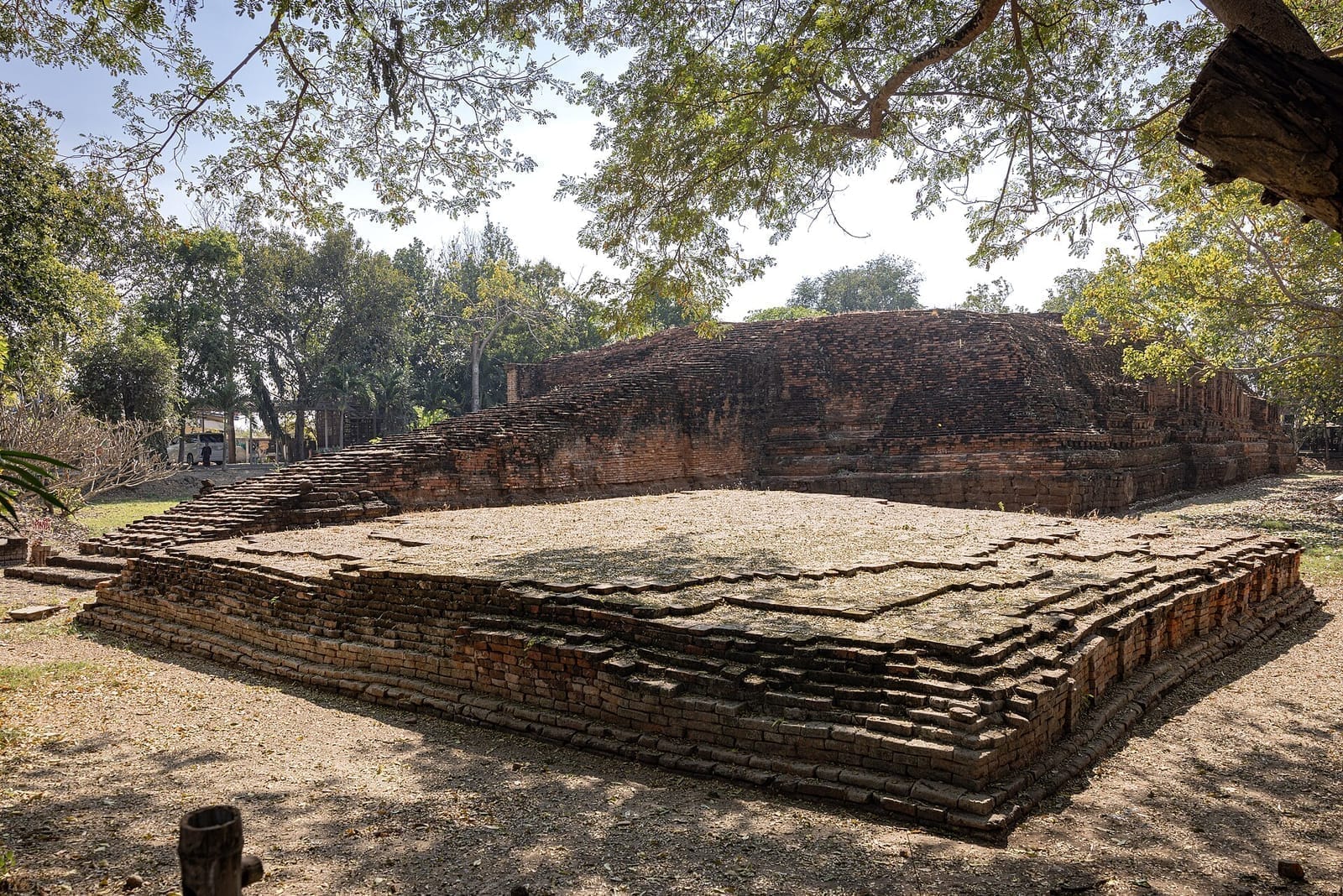
Another side of Khu Bua that many people don't know: this was an important city of the Dvaravati kingdom around the 12th Buddhist century — more than 1,000 years ago. The city was laid out as a rectangle ringed by a moat and earthen ramparts. Surveys by the Fine Arts Department, begun in 1961, have found dozens of ancient monument mounds both inside and outside the old city walls.
We'll be honest: today many of these sites are just earthen mounds and brick foundations, nothing as grand as the big historical parks. Some are mixed in among houses and farm fields, so you'll need a little imagination. But if you're into history, standing on ground that was once a thousand-year-old city has a charm all its own.
- Monuments No. 18 and 40 — a cluster of mounds where the stupa foundations are clearest; these are the most-mentioned main stops.
- Notable artifacts — Buddha heads and stucco figures of deities and dwarves excavated from this city have been moved to the Ratchaburi National Museum, with some kept at Wat Khlong Suwankhiri.
- Set your expectations — what's left today are traces, not intact monuments. Come with the right expectations and you'll enjoy it more.
To see the real artifacts at their best
If you want to see the Dvaravati Buddha heads and stucco work excavated from Khu Bua displayed properly, stop by the Ratchaburi National Museum in town. It gives you a much clearer picture of Khu Bua's golden age than walking among the earthen mounds.
How to plan one day at Khu Bua
Khu Bua is an easy half-day to full-day trip, and it pairs neatly with Ratchaburi town or Pong Yub. Here's a plan that flows smoothly from morning to afternoon.
Soak up Tai Yuan life
On into Ratchaburi town
Getting there and what to know
- Private car — the most convenient. It's just over 10 km from Ratchaburi town to Khu Bua, about 15–20 min. The sights are spread out, so having a car makes getting around much easier.
- Public transport — there are songthaews / local rides from town into Khu Bua sub-district, but they don't run often, so check the return times carefully.
- Best time to go — come in the morning when the weather is good and the cloth shops and museum are all open. If you want the community market too, pick Friday–Sunday.
- What to wear — there are temples and a museum, so dress modestly and wear shoes that are easy to slip off, since you'll be entering religious sites.
- Etiquette — ask permission before photographing weavers or villagers, and buying community products is the best way to help keep this craft alive.
Plan a full Ratchaburi trip from start to finish
See the Ratchaburi travel guide →