🔄 Updated 21 Jun 2026
Most people who come to Ratchaburi head straight for Damnoen Saduak Floating Market or Suan Phueng and skip the town center entirely, even though the town itself hides some good things. The Ratchaburi National Museum is one of them. It sits on Woradet Road, close to the clock tower and the old Koey Kee market, all within walking distance of each other. It's a great morning stop before the heat sets in, then you can carry on through the markets afterward.
The old city hall — the building is the biggest exhibit
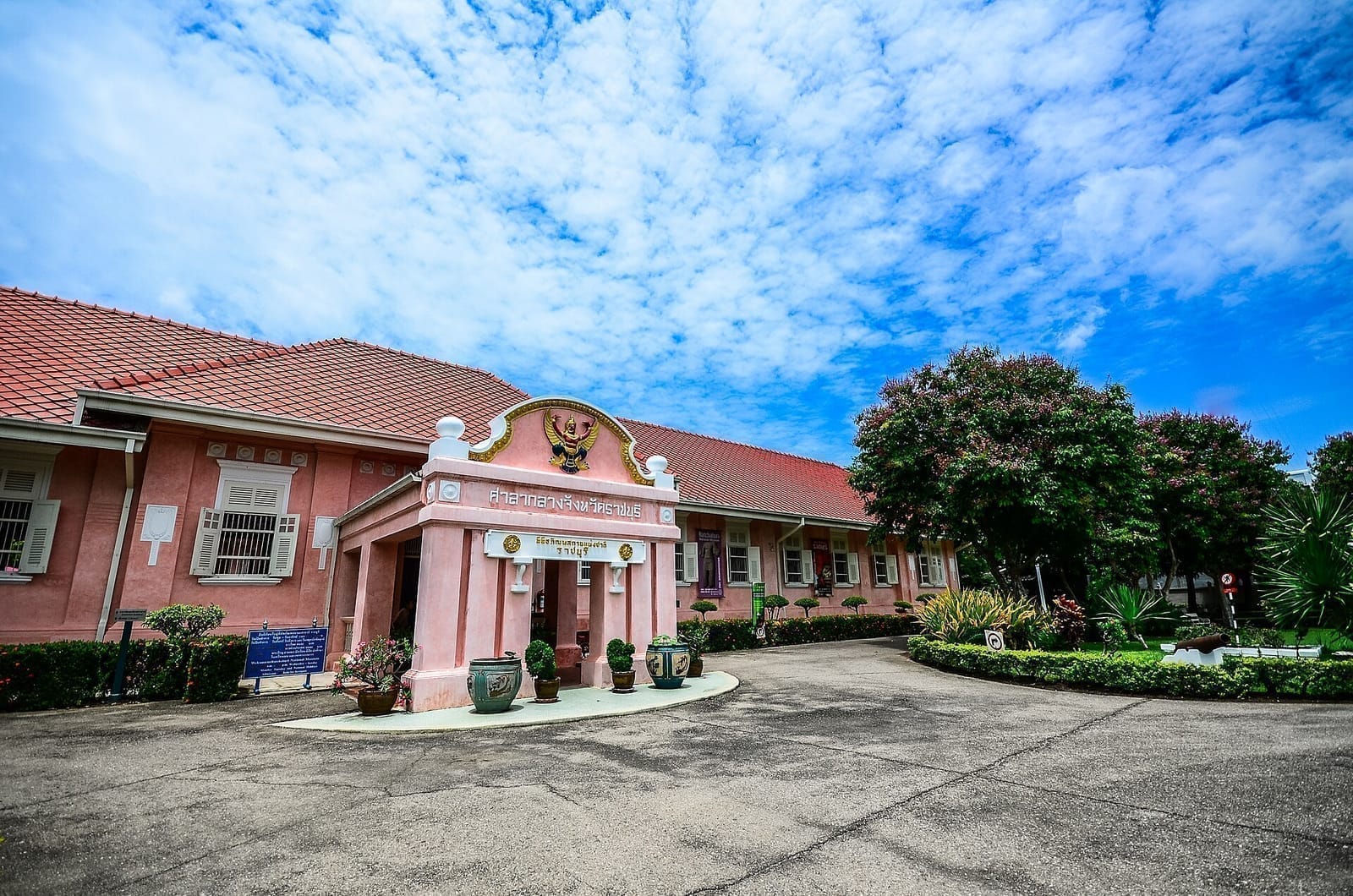
The building itself is over a hundred years old, built in 1922 during the reign of Rama VI to serve as Ratchaburi's provincial city hall. It's a two-story brick-and-plaster structure in a Western-Thai mix, painted yellow with white trim, with arched verandas and tall windows. When the provincial offices moved to a new site, the Fine Arts Department took over the building for a museum, and HRH Princess Maha Chakri Sirindhorn officially opened it in 1991.
Before heading in to see the collection, a lot of people stop to photograph the building first, because the facade and the Mae Klong River view behind it work well together. In the morning the low sun brings out the yellow of the walls.
Want more out of Ratchaburi? Book tours & activities
Booking online ahead on Klook or GetYourGuide is usually cheaper than the gate and skips the queue. Pick only the experiences you actually want — prices and availability are shown live on each site.
Highlights in the galleries — artifacts from ancient Khu Bua
The heart of the museum is the collection from the ancient city of Khu Bua, a Dvaravati-era town that flourished around the 7th to 11th centuries CE, just a few kilometers south of the modern town. Archaeologists unearthed a large number of terracotta and stucco sculptures there, and they're now displayed together in the museum.
- Stucco and terracotta sculptures — figures of deities, yakshas, animals and stupa decorations that once adorned the monuments at Khu Bua, the work of Dvaravati craftsmen with surprisingly fine detail.
- Avalokiteshvara Bodhisattva, Khmer Bayon style — a standout piece that gets talked about a lot, one of the few found in fairly complete condition.
- Buddha heads and Bodhisattva fragments — tracing how the art developed from Dvaravati onward into later periods.
- Prehistoric stone tools — laying out the story of the Ratchaburi area from the Stone Age up.
Make the most of it
The labels are in both Thai and English, but some are small. If you're genuinely interested, snap photos of the labels to read later, or just ask the staff — they're happy to tell you more, especially about Khu Bua, which has a lot of detail behind it.
Not just old objects — the ethnology room and Ratchaburi life
What sets this museum apart from others is the room that tells the story of Ratchaburi's ethnic groups. This is a province where many communities live side by side — Lao Song (Thai Song Dam), Karen and Tai-Yuan — and the displays cover traditional clothing, work tools and everyday household items.
There's also a corner on pottery and the dragon jars the town is known for, plus sections on geology and folk art. By the time you've made the loop, you get a real sense of how deep and varied Ratchaburi's roots run.
History & archaeology room
Runs from the Stone Age through Dvaravati Khu Bua to the Rattanakosin era, all on one floor.
Ethnology room
Lao Song, Karen and Tai-Yuan — real traditional dress and ways of life.
Jar & folk-art corner
The dragon jars and crafts that put Ratchaburi on the map.
Opening hours, entry fees and getting there
- Opening hours — Wednesday to Sunday, 9:00 AM to 4:00 PM. Closed Monday and Tuesday and on public holidays (check the museum's page before going on a long weekend).
- Entry fee — around 20 THB for Thais, around 100 THB for foreigners. Students in uniform and monks and novices enter free.
- Location — Woradet Road, Na Mueang sub-district, Mueang Ratchaburi district, beside the Mae Klong River, near the clock tower.
- Parking — you can park along the nearby streets or by the clock tower square, only a short walk away.
- Time needed — around 45 minutes to an hour is about right, more if you read every label closely.
Straight talk
This is a small museum, not a flashy one like the big institutions in Bangkok. If history isn't your thing you might feel you've finished quickly, but if you like old towns and archaeology it's well worth the few baht, and the ethnology room is something you won't easily find elsewhere.
Plan a half-day around Ratchaburi's old town
The nice thing about the museum is that it sits where you can keep exploring on foot — the clock tower, the old market and a cafe in a former Chinese shrine are all within walking distance, which makes for a tidy morning.
Walking the old town by the Mae Klong
If you have a full day and you're curious where the museum's artifacts came from, drive on to the ancient city of Khu Bua just a few kilometers away. You'll see the real Dvaravati ruins, a fitting way to close out a trip that ties together.
Plan a full Ratchaburi trip covering both the old town and Suan Phueng
See the Ratchaburi travel guide →