🔄 Updated 21 Jun 2026
Ask a local what Chaiyaphum is known for and they'll say it in one breath: Ban Khwao silk. Mudmee weaving here has been passed down for nearly 200 years. The story goes that the technique came over from the Vientiane side long ago, and villagers developed their own patterns until it became something distinct. Ban Khwao silk started getting national attention around 1980, and became even better known after it was entered into the SUPPORT arts-and-crafts competitions and won awards. Today it's an OTOP product the province is proud of.
The good thing about coming to the village itself is that you see the real thing — not just finished cloth on a shelf, but the weaver's hands, a loom still moving, and a chance to ask straight up how many days this piece took and what the pattern is called. That's an atmosphere you just can't get buying online.
Where Ban Khwao is and how to get there
Ban Khwao district is west of Chaiyaphum town, about 13 kilometres away. Take Highway 225 (Chaiyaphum–Nakhon Sawan) and it's an easy 15–20 minute drive. It's on a road you can stop at on the way out or the way back, so if you're already touring Chaiyaphum town it doesn't take you out of the way.
- Own car / rental — by far the easiest. From town take Highway 225 toward Ban Khwao, around 13 km. Your first stop is the silk promotion center in Ban Khwao subdistrict municipality.
- No car — there are songthaews and vans on the Chaiyaphum–Ban Khwao route from town, but they don't run often, and after you get off you'll need another ride into the weaving village. If you go this way, leave plenty of time and ask locals about getting back.
- Pair it with town sights — the Phaya Lae monument and Prang Ku are on the town side. Plan your route so Ban Khwao comes near the end, so you can grab your souvenirs and drive straight home.
Want more out of Chaiyaphum? Book tours & activities
Booking online ahead on Klook or GetYourGuide is usually cheaper than the gate and skips the queue. Pick only the experiences you actually want — prices and availability are shown live on each site.
Ban Khwao Silk Promotion Center — start here
If it's your first visit and you don't know where to begin, start at the Ban Khwao Silk Promotion Center in Ban Khwao subdistrict municipality. It gathers the whole silk story in one place, with 18 patterns on display, including old ones like the Kho Naree pattern said to be over 200 years old. Walk through it and you'll get the big picture before heading out to the houses where people actually weave.
The part a lot of people like is the demonstration of the full silk-making process, from raising the silkworms to reeling the thread, tie-dyeing, dyeing, and finally working the loom. It makes you understand why a single piece of mudmee silk can take a week or a month. To be honest, the full demonstration is usually arranged for groups who contact ahead. If you're going with just a few people and really want to see the demo properly, calling to book first is the safer bet.
- Opening hours — the center is open roughly 08:30–16:30. Some sources say Monday–Friday, others say daily. If you're set on visiting on a weekend, call to check first.
- Entry — free, no ticket.
- Book ahead — to see the full weaving demonstration or come as a group, call the center at 044-891-097 before your trip.
Call to check before you set out
Opening days and hours for the center and the weaving houses aren't as fixed as a normal government office, especially on long weekends or during merit-making festivals when weavers may be away at the event. A quick call to the silk promotion center on 044-891-097 first means you won't make the trip for nothing.
Watching the weaving in the village
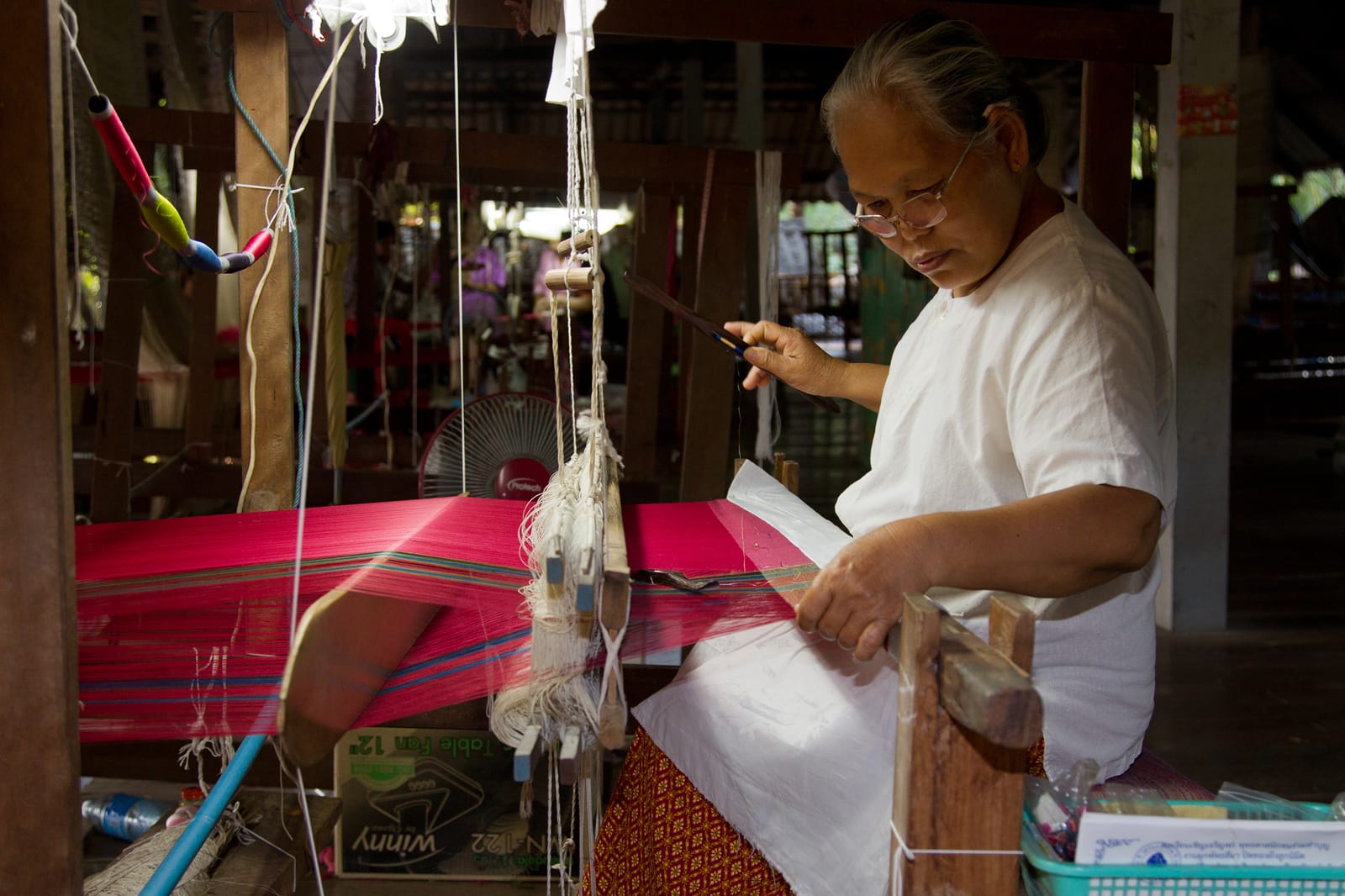
The real charm of Ban Khwao is walking into a village that still weaves. Many houses keep a loom under the house or out front, and from late morning into the afternoon you'll often see the local women sitting and weaving, the loom clacking in rhythm. Ask politely and most are happy to let you watch and tell you about it — some will even let you try tie-dyeing or working the loom yourself.
What makes mudmee different from ordinary cloth is that the pattern comes from tying off sections of the silk thread before dyeing. The tied parts don't take the colour, so when you untie them and weave, the pattern slowly appears across the cloth. It's work you have to plan out before dyeing — one small slip and the pattern shifts. Once you've seen the process you understand why genuine silk costs what it does.
- Best time to see weaving — late morning to afternoon. Weekdays usually have more weaving going on than weekends. Avoid midday when people break for lunch.
- A little etiquette — ask before photographing a weaver, and don't touch the cloth on a loom that's being worked. Buying something from a house that lets you watch is a nice gesture.
- Ask away — weavers here are easy to talk to. Ask the pattern name, how long a piece takes, and how to tell real silk — it's all useful when you're choosing what to buy.
Patterns worth knowing
Ban Khwao silk has plenty of patterns, but only a few are famous and commonly asked for. Knowing them a little makes it easier to talk to the shops and pick something you'll actually love.
Mee Khan Kho Naree
Ban Khwao's signature pattern and the one people talk about most — a fine mudmee weave with hook motifs spaced through it, simple-looking but detailed. It's the pattern many people come specifically to buy.
Kho Naree
An old pattern said to be over 200 years old, the root of the many Kho Naree-family patterns you see today. It's on display at the silk promotion center.
Natural-dye mudmee
Cloth dyed with colour from bark, leaves, and lac — softer tones and a higher price than chemical dyes. Good for anyone who loves genuine craft work.
Where to buy and roughly how much
Ban Khwao has both community shops run out of weavers' own homes and stalls at the silk promotion center. The upside of buying on the spot is that prices are usually better than buying second-hand in town, and you get to pick from the actual pile — some pieces are one-offs with no duplicate. Among the shops people often recommend are Mae Thongsuk Thai Silk and Orawan Silk, in Ban Khwao subdistrict.
On price, here's a broad picture to set expectations, because it depends on whether it's pure silk or a blend, chemical or natural dye, and how detailed the pattern is. What you'll find on the market ranges from a few hundred baht up to tens of thousands for special pieces.
- Chemical-dye mudmee — around 400–500 THB per metre, the affordable tier and good for first-timers.
- Natural-dye mudmee — around 1,000–1,200 THB per metre, softer tones and more of a craft piece.
- Silk scarves — around 600–900 THB each, a small souvenir at an easy price, good for buying several.
- Finished mudmee silk by the piece — everyday work starts around 1,900 THB and up; finely patterned or competition-grade pieces run much higher.
Check before you buy to get the real thing
Real silk, when burned, smells like burnt hair and crumbles to soft ash — it doesn't melt into a hard bead like synthetic fibre. To the touch it feels soft and cool. If you're not sure, ask the shop straight: is it pure silk all the way through, or silk mixed with cotton? And compare prices across a few shops before deciding. Most community shops are easy to talk to and will let you see the weaving for real.
The festival where people come for the silk
If you want to see Ban Khwao silk all in one go, the liveliest time is the Phaya Lae monument celebration and Ban Khwao's Lom Khao Yai merit festival, held every year around early February (in 2026, on 1–5 Feb). The event has silk stalls from weaving groups across the district, a silk fashion show, local food, and entertainment — a good moment to see many patterns and talk to several weavers at once.
- When it's held — around early February each year, the district's annual event. Check that year's dates on the district page or TAT before you go.
- What you get out of it — many weaving groups in one place, prices competing, easy to choose, plus special pieces that don't usually come out for sale.
- Plan for crowds — it's busy on event days and parking fills up. Going in the morning or on a weekday makes for an easier stroll.
Making the most of Ban Khwao in a day
Ban Khwao isn't somewhere you need a whole day for — half a day is plenty to enjoy it and shop. It slots in nicely as a stop on a Chaiyaphum town trip.
- Start at the silk promotion center to get the overview and see the different patterns, then head out to the houses that weave for real.
- Watch the weaving in late morning, when the most weavers are working — plenty of time for photos and questions.
- Finish with souvenir shopping — pick a scarf or a length of cloth to suit your budget, then drive back into town for dinner.
- Pair it with town sights — the Phaya Lae monument and Prang Ku are close by, easy to add on the same day.
Plan a full Chaiyaphum trip — where to stay, eat, and explore
See the Chaiyaphum travel guide →