🔄 Updated 21 Jun 2026
Mention Surin silk to anyone in the trade and Ban Tha Sawang usually comes up before any other name. This is home to the Chansoma ancient gold-brocade weaving group, founded by Ajarn Veerathum Trakulngernthai, a National Master of Art, who revived the old royal-court technique of gold-brocade weaving and brought it back into view. It's also the group that wove the silk used for world leaders' outfits at the 2003 APEC summit, which Thailand hosted.
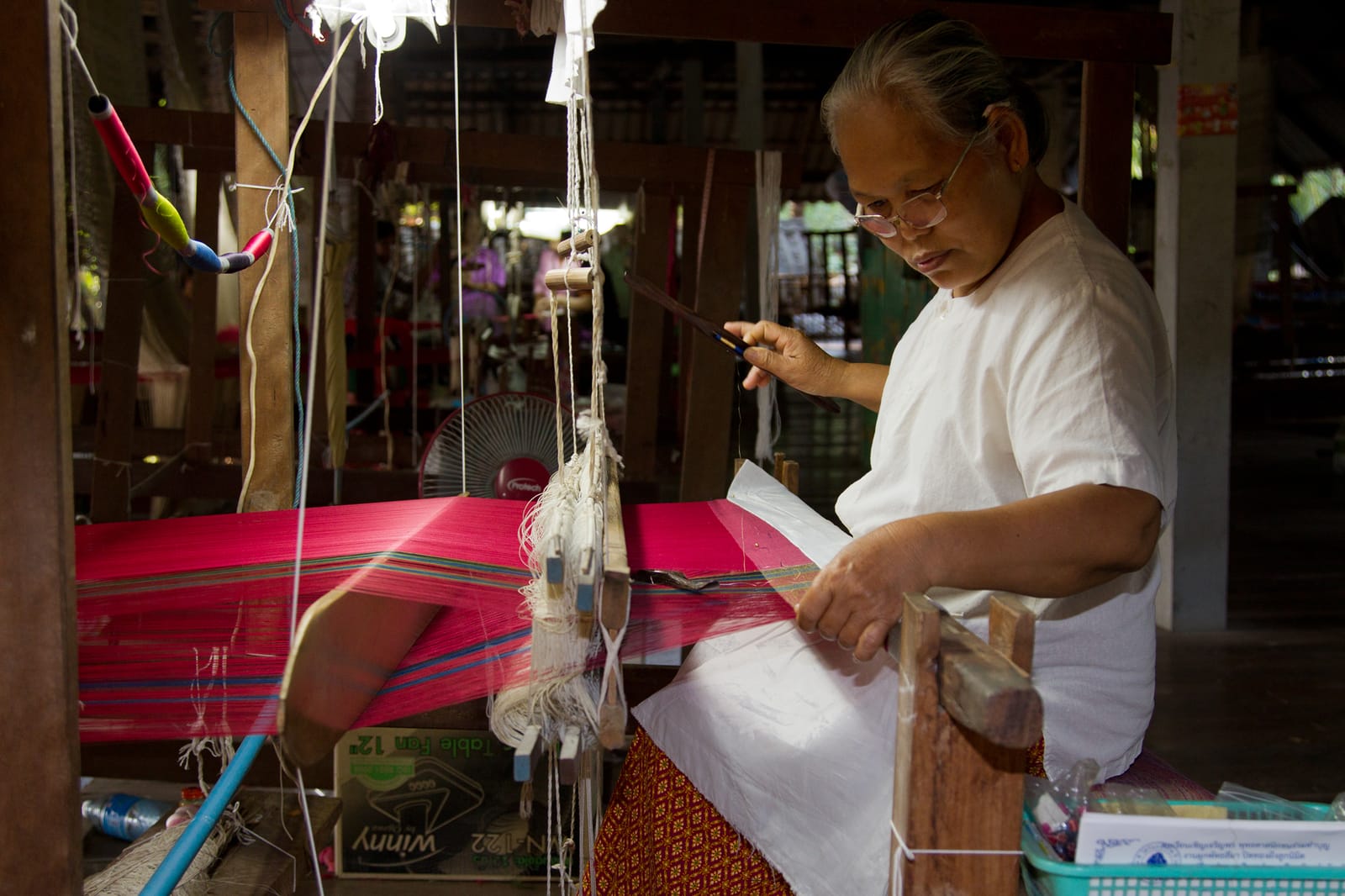
The good thing about this place is that it isn't a souvenir shop staged for photos — it's a working weaving house running every day. You'll see weavers at the loom right in front of you, see the silk threads, see the real looms, and if you're lucky you'll get to chat with the people doing the weaving. To be straight with you: if you're here to shop for cheap fabric, this probably isn't the place. But if you've come to see real craftsmanship and understand what makes silk valuable, it's well worth it.
Just how hard is ancient gold-brocade silk to weave
The heart of Ban Tha Sawang is its gold-brocade silk, woven from fine, thin silk threads tied to a special loom with as many as 1,416 heddles. That number isn't just for show — each set of heddles is part of the instruction set for the pattern. The more heddles, the finer and more intricate the design. One loom takes four people working together: one weaves, one helps lift the heddles, all coordinating by hand to keep the pattern straight.
- Silk thread — fine, thin, hand-reeled silk for cloth that's light and crisp in detail
- Natural dyes — red from lac, yellow from khae heartwood, indigo from indigo seeds, then blended into further shades from those three base colors
- Gold and silver threads — woven in as raised patterns on the surface, which is where the name "gold brocade" comes from
- The 1,416-heddle loom — a special loom for royal-court patterns, worked by 4 weavers at a time
The slowness is what makes this cloth expensive. One sarong length of about 3 meters takes four weavers roughly 3 months, because they can only weave around 5 centimeters a day. Once you see a real loom and multiply that time out, it's easy to understand why fine gold-brocade silk runs from tens of thousands into the hundreds of thousands of baht per meter — and why many pieces have to be ordered and reserved months ahead.
When to come to see the weavers
Weekdays from late morning into the afternoon are usually when you'll see weavers clearly at work. Avoid the lunch break and long holidays, when weavers may take time off. If you want to see the big loom worked by a full team, calling the group ahead of time is the safer bet.
Want more out of Surin? Book tours & activities
Booking online ahead on Klook or GetYourGuide is usually cheaper than the gate and skips the queue. Pick only the experiences you actually want — prices and availability are shown live on each site.
What you can walk around and see in the village
Ban Tha Sawang isn't a single spot — it's an area where you can follow silk-making from start to finish. Take it slowly and you can see most of it in about 1–2 hours.
Chansoma weaving house
The heart of it all — you'll see the many-heddle looms and weavers actually at work. This is where most people take their photos.
Silk museum
Displays Ajarn Veerathum's masterpiece cloths and personal collection, with rare ancient patterns that are hard to weave.
Reeling and dyeing area
See silk reeled from the cocoons and natural dyeing in action, so you understand where the colors on the cloth come from.
Fabric and souvenir market
Shops in the village carry silk, scarves, and keepsakes across a range of prices — pick to suit your budget.
How to buy silk without getting it wrong
The thing people really worry about is price and authenticity. To be straight with you: master-level gold-brocade silk at tens of thousands of baht per meter and up is normal here, and some pieces have to be made to order. But the village also has more affordable cloth to choose from — scarves, mudmee ikat fabric, even silk trousers from a thousand-odd baht.
- Check the cloth — real silk is soft, densely woven, and has a soft sheen, not the slippery shine of synthetic fiber
- Ask about the pattern — ancient patterns and gold-brocade pieces differ a lot in price, so ask clearly whether it's fully handwoven or a blend
- Set a budget first — if you're on a budget, just tell the seller; they'll pull out pieces in that range, no need to feel awkward
- Master pieces can be ordered ahead — large gold-brocade lengths usually need to be reserved and waited for, so if you have your eye on one, sort out the queue and deposit
- Keep the receipt / business card — in case you want to order more later or confirm where the cloth came from
Straight talk on prices
Don't expect to haggle much off master-level gold-brocade silk — it's handwoven work that takes months. But for scarves or small keepsakes you can usually still negotiate a little, and they make for souvenirs with a far better story than the mass-produced stuff.
Getting there and opening hours
The village is in Tha Sawang sub-district, Muang Surin district, about 8 kilometers from town. Drive northwest out of the city; there are clear signs pointing to the village entrance. It takes around 15–20 minutes.
- Private car / rental — most convenient, with parking in the village; just search the map for "Ban Tha Sawang Chansoma"
- Tuk-tuk / motorcycle taxi — chartering a round trip with wait time runs about 400–500 THB; agree on the price before you get in
- Opening hours — open daily around 08:30–17:00 (some sources note it's closed on public holidays, so check before coming on a long weekend)
- Admission — free to enter
Pair it up to make the trip count
Ban Tha Sawang can be done in a morning, leaving the afternoon for downtown Surin — a café stop, a bowl of khanom jeen nam ya, or a wander through the souvenir market. If you want to go deeper into silk, Surin has other weaving villages you can follow up with too.
Want to see all of Surin — the elephants, the Khmer temples, and the silk
See the Surin travel guide →