🔄 Updated 21 Jun 2026
The good news for first-timers in Bangkok is that the city has solid public transport that cuts out almost all the traffic headaches — the BTS skytrain, the MRT subway, the Chao Phraya express boats, and the Grab ride-hailing app. If you plan around those three, you barely have to deal with haggling over fares or sitting through long red lights. First, let's go through what you should know, one topic at a time.
From the airport into town — get it right the moment you land
Bangkok has two airports. Suvarnabhumi (BKK) handles most international flights, while Don Mueang (DMK) is mainly for low-cost carriers. The way into town differs a little, but the principle is the same: avoid the traffic whenever you can.
- Suvarnabhumi → Airport Rail Link The train into the city is fast with a fixed fare of 15–45 THB depending on distance. To the end of the line at Phaya Thai (where you connect to the BTS) it's about 45 THB and takes around 30 minutes, with no traffic to worry about. It's the best-value option if your hotel is near a skytrain line.
- Suvarnabhumi → metered taxi Join the official queue on Level 1 (not the people who walk up to you inside the terminal). The fare runs on the meter, plus a 50 THB airport surcharge and any tolls you pay yourself — roughly 300–450 THB into the inner city. Good if you're in a group or have a lot of luggage.
- Don Mueang → SRT train / A1–A4 buses / taxi The A1 bus to BTS Mo Chit is about 30–50 THB; a taxi into town runs roughly 250–400 THB including the surcharge. Don Mueang doesn't have a direct rail link like Suvarnabhumi yet, so most people use Grab or a metered taxi.
- Any airport → Grab Book through the app, the price shows up front, and there's no haggling. There are dedicated pickup points (follow the Grab/Pick-up signs), and fares are usually close to a metered taxi once you add everything up. Good if you'd rather not discuss price at all.
The golden rule at the airport
Don't take a ride from anyone who walks up to you in the terminal asking "Taxi? Private car?" Those are unmetered black-plate cars charging inflated flat rates. Go to the official metered-taxi stand on Level 1, or book a Grab — nothing else. And every time you get in a taxi, confirm "meter, please" before you set off.
Book the activities in your Bangkok trip ahead
Booking online ahead on Klook or GetYourGuide is usually cheaper than the gate and skips the queue. Pick only the experiences you actually want — prices and availability are shown live on each site.
Getting around the city — BTS, MRT, boats and Grab
The key to seeing Bangkok without wasting time is to use the trains and boats as your backbone, and only use Grab or taxis when the trains don't reach. Traffic is brutal from about 4–7 pm, so taking a taxi across town in the evening can eat up an hour even when the distance isn't far.
BTS Skytrain
Elevated trains running through Siam, Sukhumvit, Silom and Sathorn, linking the main malls and hotels. Fares are about 17–62 THB per trip. Buy a single-trip ticket at the machine, or tap a Rabbit card or a supported credit card.
MRT subway
Connects Hua Lamphong, Yaowarat, Sam Yot and Chatuchak, with several BTS interchanges. Good for the old city around Yaowarat–Talat Noi and the weekend markets. Fares are about 17–45 THB.
Chao Phraya express boat
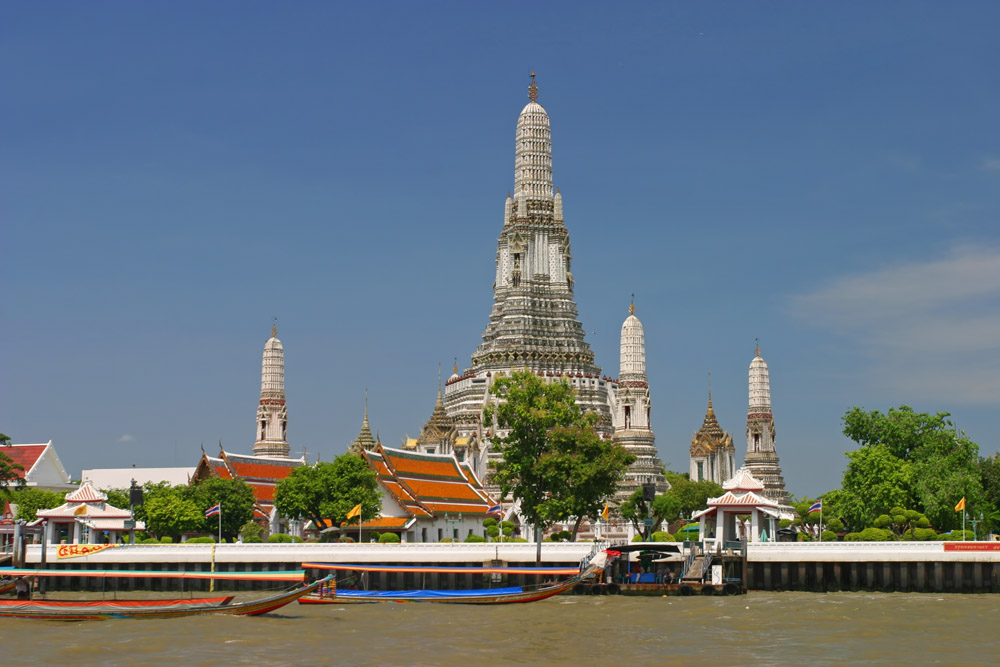
Runs along the river with stops near Wat Pho, Wat Arun and ICONSIAM, clearly faster than the roads. The orange-flag boat is about 16–20 THB; the cross-river ferry is just 5 THB. Great for a temple day.
Grab / metered taxi
Grab is booked through the app with the price shown up front and no haggling. You can flag a taxi on the street too, but insist on the meter. Best for late nights or spots the trains don't reach.
Tickets and paying
If you're staying several days and using the BTS a lot, a top-up Rabbit card is handier than buying single tickets each time. The MRT uses tokens you buy at the machine. Many stations now accept credit/EMV tap and QR scan, but keep some coins and small notes on you in case a machine won't take a foreign card.
Money — cash, cards and QR
Bangkok takes credit cards at malls, hotels and most larger shops, but street food, markets, transport and most small shops still run on cash or PromptPay QR scans (the local payment system). Some foreign visitors can already scan Thai QR codes using their home bank app, but if you're not sure it'll work, carrying cash is the easiest bet.
- Withdraw at an ATM Easy enough, but ATMs in Thailand charge a foreign-card fee of about 220 THB per withdrawal. Taking out a bigger amount at once works out better than withdrawing little and often.
- Exchange money In-town exchange counters (like Super Rich or Vasu) give noticeably better rates than the airport or your hotel. Change just enough at the airport to get by, then change a bigger amount in town.
- Small notes Keep plenty of 20s, 50s and 100s. Small shops, transport and markets often struggle to break a 1,000-baht note.
- Tipping It's not expected the way it is in the West. At regular restaurants, leaving the loose change is plenty. At upscale spots or spas, a tip of 20–100 THB is a nice gesture.
SIM and data — get online the moment you land
Mobile data really matters here because you'll need it for Grab, maps and checking opening hours. If you already have a Thai SIM you can skip this, but if you're coming from abroad or want a separate travel SIM, there are three main carriers — AIS, True and DTAC — that cover the whole city, with strong 4G/5G almost everywhere in Bangkok.
- Tourist SIM Buy one at the carrier counters in either airport. Packages start at around 49 THB (1 day) and go up to unlimited 7–15 day plans in the few-hundred to low-thousand THB range. Bring your passport to register.
- eSIM The most convenient option if your phone supports it. Buy online before your trip and activate it the moment you land, with no physical SIM to swap. Unlimited multi-day plans start from around 300–400 THB.
- Wi-Fi Hotels, cafés and malls have free Wi-Fi all over, but don't rely on it alone — you'll need data constantly when you're on the move or booking a ride.
Temple dress code — the rules you can't skip
Major temples like the Grand Palace + Wat Phra Kaew enforce the dress code strictly — wear the wrong thing and you simply won't get in, no exceptions. Plenty of people end up buying or renting a cover-up at the gate for a steep price (sellers nearby charge 200–400 THB). It's much easier to dress right before you leave your hotel.
- Cover your shoulders Wear a sleeved top. No tank tops, spaghetti straps or bare shoulders.
- Cover knees to ankles Long trousers or skirts. No shorts, short skirts or cropped trousers.
- Footwear Fine within the temple grounds, but you'll need to take them off before entering the ordination hall or shrine — slip-on styles are easiest.
- Opening hours The Grand Palace sells tickets 8:30 am–3:30 pm. Entry is 500 THB for foreign visitors; free for Thais showing a national ID. Go early to dodge both the heat and the crowds.
Common tourist scams to watch for
Bangkok is safer than a lot of people fear, but there are recurring tourist scams that have been around for years and still pop up. Most aren't physically dangerous — they just cost you money for nothing. Know them in advance and you can avoid all of them.
- "The temple is closed today" A respectable-looking person tells you the temple or Grand Palace is closed for a ceremony, then offers to take you on a boat tour or to a gem shop instead. In reality these temples are open every day — just walk in the main gate and check for yourself.
- 20–40 THB tuk-tuk tours A price that's suspiciously cheap, because the driver will detour to gem or tailor shops where he earns commission, eating up your whole day. If you do take a tuk-tuk, agree on the destination and price clearly first, or just use Grab.
- Taxis that won't use the meter You flag one on the street and the driver wants a flat fare. Decline and flag another, or use Grab where the price is shown up front.
- The free bird-feed / freebie trick Around Sanam Luang and the Grand Palace, someone hands you bird feed; once you take it, they demand a few hundred baht. If anything "free" is handed to you, decline first.
- Strangers who get overly friendly Fluent English, chatting you up, then slowly steering you toward a tour or shop. Ordinary Thais rarely strike up that kind of conversation, so treat it as a warning sign.
An easy way to stay scam-free
Remember two short red flags: "a price that's suspiciously cheap" and "someone offering unprompted." Those cover nearly all of it. If you use Grab, visit temples on your own, and check opening hours on official sites first, you'll almost never run into these tricks.
When to visit Bangkok
Bangkok has three seasons. Pick the one that matches your travel style and your trip will be a lot more comfortable.
- Cool season (Nov–Feb) The best weather — clear skies, gentler sun — and the best time for temple-hopping and market walks. But it's high season, so it's busier and hotels cost more than usual, especially December to early January.
- Hot season (Mar–May) Seriously hot; April can hit 36–40°C. But it's also when Songkran (13–15 Apr) happens, which is a blast if you're into water fights. Hotels are pricey and fill up fast over Songkran.
- Rainy season (Jun–Oct) Showers come in bursts in the afternoon and evening, with the heaviest rain from September to early October. But it's low season, so hotels and flights are clearly cheaper. Plan some indoor options and pack an umbrella and you can still have a great time.
Suggested plan — Bangkok in 3 days for first-timers
This plan is built for first-timers, grouping activities in the same area on the same day to avoid traffic. Day 1 is old riverside temples in the morning; Day 2 is city life, cafés and malls; Day 3 is markets plus a rooftop to close out the trip. Every day connects by train or boat — no taxis across town needed.
Old Rattanakosin temples along the Chao Phraya
Temple-day tips
Bring an umbrella or hat and water — the late-morning sun really is strong. Wear slip-on shoes since you'll be taking them off at several shrines. And remember these temples are open every day: if anyone tells you it's "closed today," don't believe it — just walk in the main gate.
City life, cafés and malls — Sukhumvit & Siam
Markets + a rooftop to end the trip
Rooftop tips
Check each bar's dress code before you go (most ban shorts, tank tops and flip-flops). High drink prices are the norm, so if you're on a budget, a mid-range rooftop or happy hour gives you a similar atmosphere. And during the rainy season, open-air bars may close temporarily if it rains — have a backup plan.
Daily checklist before you leave your hotel
- Power bank + data You'll use Grab and maps all day, so don't let your battery die.
- Small bills in cash Small shops, transport and markets mostly don't take cards.
- Umbrella/hat + water Bangkok's sun and rain both come fast — bring both.
- Modest clothes if you're visiting a temple that day Shoulders and knees covered, so you don't get turned away at the gate.
- Apps to have Grab (rides) · Google Maps (routes + opening hours) · your bank or wallet app for QR scanning, if supported.
In short, a first trip to Bangkok is barely anything to be nervous about. Just use the trains and boats as your backbone, carry small cash, stay connected, dress right for temples, and remember the red flags around suspiciously cheap prices and people who approach you unprompted. Do that and you can enjoy the city to the fullest.
Pick a well-located hotel near a train line, by the river, or in the old town to make this plan easy to follow
See the Top 10 Bangkok hotels →