🔄 Updated 21 Jun 2026
The key to an easy time in Bangkok is to plan your day around the trains and boats first, and treat cars as a backup. The big draws — Siam, Asok, Thonglor, Chatuchak — sit almost entirely on the BTS/MRT lines, while the old town, temples and Chinatown hug the Chao Phraya, where boats beat cars by a mile. Traffic genuinely seizes up in the late afternoon, so hopping off the train or boat and taking a Grab for the last leg is usually faster and better value than sitting in a long ride through the jams.
BTS & MRT — the arteries that beat the traffic
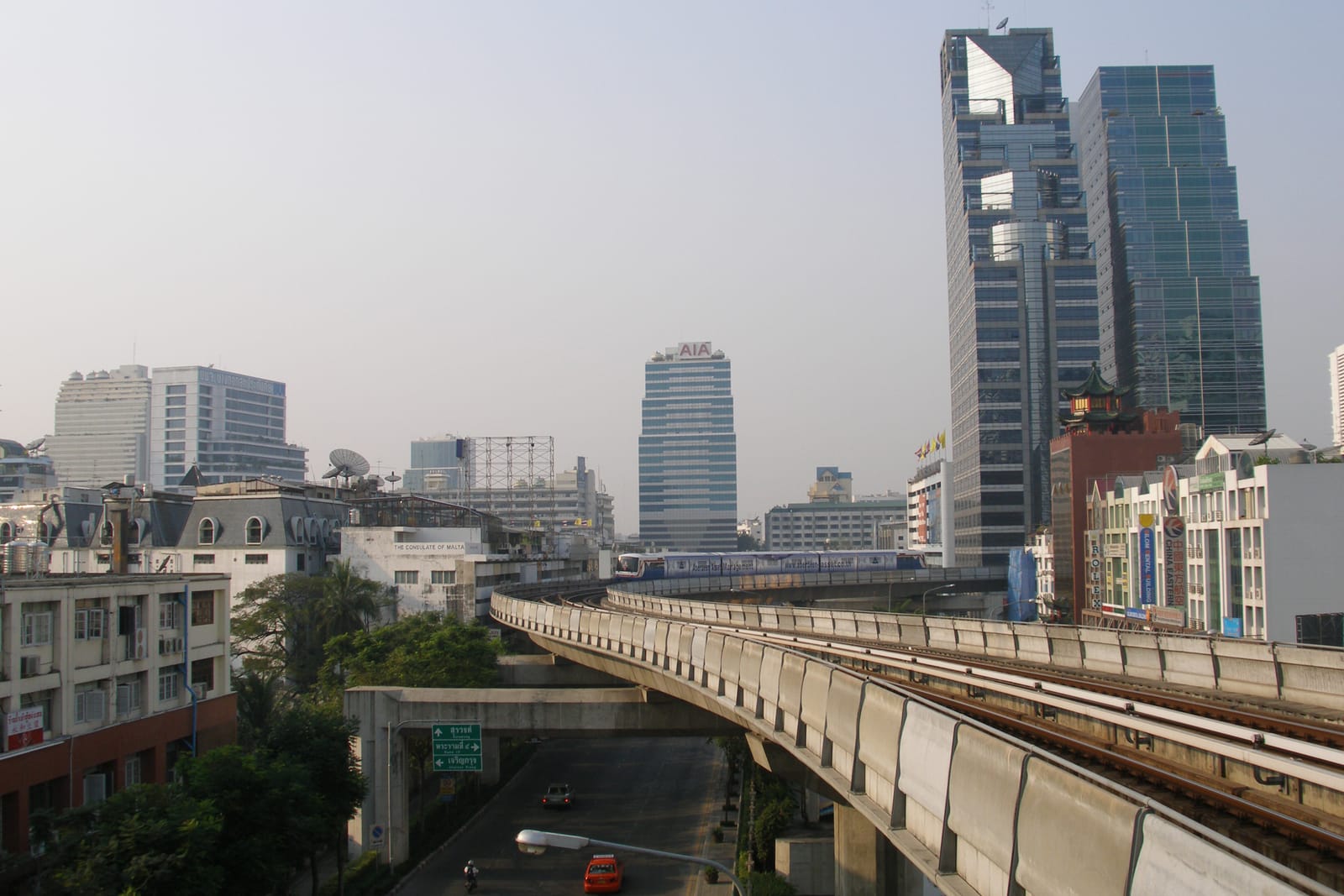
The trains are the heroes of Bangkok: on time, nicely air-conditioned, and immune to traffic. The BTS (the elevated Skytrain) has the Sukhumvit and Silom lines, running through Siam, Asok, Thonglor, Ekkamai and Chong Nonsi. The MRT (the underground) Blue Line loops through Hua Lamphong, Sam Yan, Silom, Sukhumvit, Rama 9 and Chatuchak, and reaches into the old town at Sanam Chai–Itsaraphap (near Wat Pho and Wat Arun). Both run from roughly 06:00 until around midnight.
- BTS fares — from about 17 THB up to around 47 THB depending on distance. Buy a single-trip ticket from the machines (they take coins and notes) or just tap a Rabbit card.
- MRT Blue Line fares — about 17–45 THB by distance. The machine dispenses a black token; tap it to enter and drop it in the slot when you exit.
- Key interchanges — Siam (switch BTS lines), Asok–Sukhumvit (BTS↔MRT), Mo Chit–Chatuchak Park (BTS↔MRT, right by Chatuchak Weekend Market), plus Bang Wa and Silom–Sala Daeng also connect.
- Easy top-ups — if you're here several days and riding often, a Rabbit card (BTS) saves you queuing for tokens every time. The MRT still mostly runs on single-trip tokens.
Skip rush hour
From 07:30–09:30 and 17:00–19:30 the BTS/MRT get packed, especially at interchange stations like Siam and Asok. If you're carrying luggage or travelling with kids, avoiding those two windows makes life much easier. Many stations only have up-escalators, and lifts aren't at every exit — check the right Exit number before you go up so you're not dragging a bag around in circles.
Airport Rail Link (ARL) — Suvarnabhumi into town
The Airport Rail Link is the train connecting Suvarnabhumi Airport (BKK) to the city. It runs from Suvarnabhumi station beneath the terminal, stopping at Makkasan (transfer to the MRT Blue Line) and ending at Phaya Thai (transfer to the BTS Sukhumvit line). Fares run about 15–45 THB by distance — cheap and traffic-free, ideal if you're not hauling much luggage and your destination is near a train line.
- Suvarnabhumi → Phaya Thai — about 45 THB, roughly 30 minutes. Get off at Phaya Thai and hop straight onto the BTS for Siam or Asok.
- Suvarnabhumi → Makkasan — about 35 THB; connect to the MRT Blue Line at Phetchaburi (short walk) for Sukhumvit, Silom or the old town.
- Operating hours — roughly 05:30 until midnight, with trains every 10–15 minutes. Signs from the arrivals hall down to the station level are clear.
When the ARL makes sense
The ARL is best value if there are just 1–2 of you, you're not loaded down with bags, and your hotel is near a BTS/MRT station. But if you're a bigger group, lugging large suitcases, or your hotel is deep down a side soi, a door-to-door taxi or Grab is worth the extra cost and effort saved — no hauling bags up and down stairs.
Chao Phraya & Saen Saep boats — the watery shortcut
Heading for the old town, Wat Pho, Wat Arun, Chinatown, or ICONSIAM and Asiatique? The boats are fun and usually faster than driving. There are two main types and they work quite differently. The Chao Phraya Express Boat runs north–south along the river, while the Saen Saep canal boat cuts east–west through a canal, slicing from Pratunam–Siam toward the old town with surprising speed.
- Chao Phraya Express Boat, Orange Flag — the main line most people use, running from Nonthaburi Pier (N30) down to Wat Rajsingkorn (S3) for a flat 20 THB, paid to the conductor on board. It stops at key piers like Tha Chang (Grand Palace–Wat Pho), Tha Tien (Wat Pho, with a cross-river ferry to Wat Arun), Ratchawong (Chinatown) and Sathorn (transfer to the BTS at Saphan Taksin).
- Chao Phraya Tourist Boat, Blue Flag — has English commentary and stops at the most popular tourist piers. Single trip about 40 THB, or a hop-on hop-off all-day pass for around 150 THB — handy if you're hitting several riverside spots in one day.
- Cross-river ferry — small boats crossing the river, e.g. Tha Tien ↔ Wat Arun. Fare is around 5–6 THB, paid at the pier — the cheapest, fastest way over to Wat Arun.
- Saen Saep canal boat — runs along the canal, about 16–26 THB by distance. The stretch travellers use most is from Pratunam Pier (near Pratunam Market) toward Phan Fa Lilat Pier (near the Golden Mount and Khao San Road), blasting straight through the central-city traffic.
Boarding boats smoothly
The Chao Phraya and Saen Saep boats stop fast and don't wait long, so move toward the front or back before your pier comes up. Staff at the pier call out the stop names and help with the ropes. The Saen Saep boats have side tarps that get raised and lowered — watch your hands during that, and if it's raining, canal water can splash in, so a seat in the middle of the boat stays drier. Check the operating hours: boats stop early in the evening (around 19:00–20:00) and don't run late like the trains.
Taxis & Grab — door to door
For spots the trains and boats don't reach, or when you've got a lot of luggage, a private car is the answer. Bangkok has both metered taxis you flag on the street and ride-hailing apps like Grab, Bolt and InDrive. Both work day and night, but they differ in how you pay and how much haggling is involved.
- Metered taxis — the meter starts at 35 THB, then charges by distance and time. A typical in-city trip runs about 60–150 THB. The rule is the meter must always be on — if a driver wants to negotiate a flat fare, decline and flag another cab. On expressways, you pay the tolls yourself.
- Grab / Bolt / InDrive — you see the price before booking, no haggling, pay by card or cash. Fares tend to be a little higher than the meter (in-city trips around 100–200 THB), but you trade that for certainty and not having to explain your destination. Great for travellers, especially at night or in the rain.
- Motorbike taxis / GrabBike — the fastest option in traffic. Win motorbike taxis (riders in numbered vests) wait at the mouths of the sois; short hops within a soi run about 15–30 THB. Agree the price before getting on. Best solo with no luggage — and wear the helmet they hand you.
Avoid refusals and overcharging
When it's raining or rush hour, street taxis often refuse or ask for a flat fare — if that happens, just open an app instead. Don't take taxis parked outside malls or attractions touting a fixed price; walk out and flag one driving past, or use an app, to get the normal fare. And if you're paying cash, carry small notes — drivers often can't break large bills.
Tuk-tuks — fun to ride, but know the price
A tuk-tuk is an experience plenty of people want to try at least once — the breeze through the open sides is good fun. But be honest with yourself: tuk-tuks have no meter, so you negotiate every time, and they're usually pricier than a metered taxi over the same distance. They suit short rides for the atmosphere rather than being your main money-saving way to get around.
- Real prices — short in-city hops usually start at 100–200 THB. Around the Grand Palace and Khao San, drivers love to open at 300 THB or more. You can and should bargain, and always lock in the price before you get on.
- Watch the scam tours — if a driver offers a suspiciously cheap all-day tour (say 20–40 THB), it usually comes bundled with stops at gem or suit shops to earn commission. Just say no if you don't want to waste your time.
- Compared to Grab — if you want cheap and comfortable, Grab or a metered taxi is usually cheaper and cooler. Save the tuk-tuk for one short joyride to get the feel of it.
From Suvarnabhumi Airport (BKK) into the city
Suvarnabhumi is on the east side of the city, about 30 kilometres from the centre — travel time depends on traffic. There are several options to suit your budget and luggage.
Airport Rail Link (ARL)
Cheap and traffic-free. Head down to the station level beneath the terminal and ride to Phaya Thai (transfer to BTS) or Makkasan (transfer to MRT). Fares 15–45 THB by distance. Best for 1–2 people without much luggage whose destination is near a train line.
Grab / ride-hailing app
The most comfortable, door to hotel front. The Grab/Bolt pickup point is on Level 2 (departures), follow the signs. You see the price before booking — around 350–500 THB depending on destination and time, tolls included on some routes. Great with luggage or in a group.
Public metered taxi (Level 1)
Go down to Level 1 to the taxi service point, take a queue ticket and board the assigned car. It's metered + a 50 THB airport surcharge + tolls, so into the city totals about 300–450 THB. Always confirm the driver runs the meter.
Public bus / hotel shuttle
On a tight budget, public buses leave from Level 1 to various city points for about 30–60 THB, but they're slow and take a while. Or if your hotel offers a shuttle, give them your flight details ahead of time and you won't have to sort out transport yourself.
From Don Muang Airport (DMK) into the city
Don Muang is the low-cost-carrier airport, on the north side of the city. It still doesn't have a train running straight into the terminal like Suvarnabhumi, so the main options are the airport buses, taxis and Grab.
A1 / A2 bus
The cheap, straightforward choice. Fare is 30 THB, paid on board. The A1 goes to BTS Mo Chit–Mo Chit Bus Terminal; the A2 goes to Victory Monument (via Mo Chit). From there, connect to the BTS/MRT into town. Buses leave every 10–15 minutes — good if you're not carrying much.
Grab / ride-hailing app
Most comfortable, no haggling. The pickup point is outside the terminal, follow the signs. Into the inner city runs about 250–400 THB depending on destination and tolls. Great with luggage or in a group.
Public metered taxi
Take a queue ticket at the taxi service point on Level 1. It's metered + a 50 THB airport surcharge + tolls, totalling about 250–400 THB into the city. Confirm the meter is running every time.
SRT Red Line train
There's a Don Muang station on the SRT Red Line commuter train (walk from the terminal across the connecting bridge). Ride to Krung Thep Aphiwat Central (Bang Sue), then transfer to the MRT. Cheap, traffic-free, and good if your destination is near an MRT line.
Sample trips: how to mix it all together
To show how people actually mix transport across a day in Bangkok, here are sample days built around the trains and boats with Grab filling the gaps. Adjust them to your hotel and your interests.
Built around the Chao Phraya boat
Built around the BTS/MRT
Quick guide: which one suits your trip
Shopping & café trip
Stick to the BTS/MRT corridor and get a Rabbit card for easy tapping. Add a Grab when you're loaded with bags or heading deep into a soi.
Old town & temples trip
Build around the orange-flag Chao Phraya boat at a flat 20 THB, take the cross-river ferry to Wat Arun, and switch to Grab in the evening.
Group / lots of luggage
Door-to-door Grab is worth the effort and time saved; split between you it's not pricey, and no dragging bags up and down stairs.
Plan your whole Bangkok trip — where to stay, what to see, what to eat
See the Bangkok travel guide →