🔄 Updated 21 Jun 2026
If it's your first time in Kanchanaburi, the Bridge on the River Kwai is the stop almost everyone makes first. The bridge sits in Tha Makham subdistrict, Muang district, just a few kilometres from the town centre. It's easy to reach, parking is simple, and the area around it has riverside restaurants and souvenir markets, so you can easily spend half a day here.
A short history: why this bridge matters
The Bridge on the River Kwai was part of the Thailand–Burma Railway, built by the Japanese army during World War II to move troops and supplies. It's better known as the Death Railway, because construction relied on tens of thousands of Allied prisoners of war — British, American, Australian, Dutch and New Zealander — along with a far larger number of Asian labourers. Working in brutal conditions and ravaged by disease, many of them died during the build.
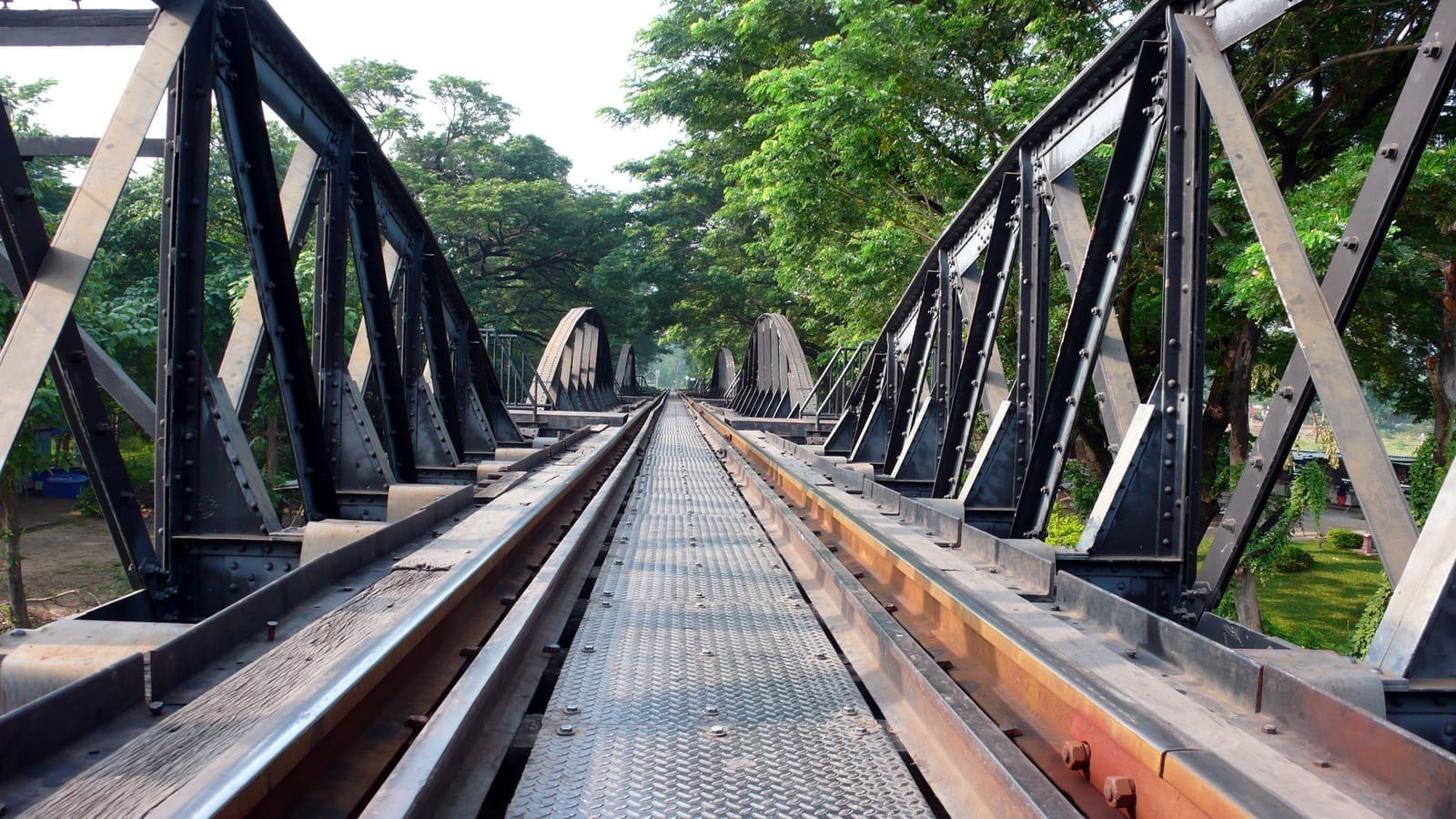
The bridge you see today is a steel structure, alternating curved half-circle spans with squared-off ones. The angular steel sections in the middle are the parts that were rebuilt after the war, when the Thai government took over the line and restored it to working order. That's why this spot is both a historical memorial and a working railway at the same time.
To understand it better
Before or after walking the bridge, it's worth stopping at the museums and the Allied war cemetery in town. They give you the bigger picture of the railway line and make the origin of the name "Death Railway" much clearer.
Want more out of Kanchanaburi? Book tours & activities
Booking online ahead on Klook or GetYourGuide is usually cheaper than the gate and skips the queue. Pick only the experiences you actually want — prices and availability are shown live on each site.
Walking the bridge: what you can do
The highlight here is getting to walk the actual railway tracks across the bridge — roughly 300 metres. Along the way there are pull-out bays that stick out to the side at intervals, where people step aside when a train comes through. As you walk you'll see the Khwae Yai River right beneath your feet, with a cool breeze and distant mountains — an image that sticks with a lot of visitors.
- Walk across to the far side — the opposite bank has a coffee shop and riverside seating. It's an easy there-and-back that doesn't take long.
- Mind the gaps between the sleepers — the surface is real railway track with spaces between the ties, so closed-toe shoes are more comfortable, and keep a firm hold of small children.
- Step aside in time when a train comes — when a train is signalled, staff have everyone move into the pull-out bays along the bridge. Wait for it to pass, then carry on walking.
Riding the train across the bridge: times and fares
The one thing you can't get anywhere else is riding a train that actually crosses the bridge. The ordinary Thonburi–Nam Tok service runs through here every day. Many people board at Kanchanaburi station in town, ride the short stretch across the bridge, and continue on toward Tham Krasae station — another section with gorgeous views as the line hugs the cliff face.
- Ordinary train fare — around 25 THB per trip (about 13 THB for children), which is next to nothing for the view you get.
- Two main services a day — the trains from Thonburi leave in the morning and the afternoon, crossing the Khwae Yai bridge around mid-morning and again in the late afternoon.
- Always check times first — the timetable shifts from season to season. Call the State Railway hotline on 1690 or Kanchanaburi station on 034-511-285 before you plan.
An easy train-ride plan
If you'd rather not work around the timetable from Bangkok, board the train at Kanchanaburi station instead. Ride across the bridge, get off at Tham Krasae station, walk the cliffside stretch of track, then take a car back. You get both highlights in a single loop.
The photo spots people love most
Mid-bridge, looking down the tracks
Stand in the middle of the bridge and shoot straight down the rails so the curved steel spans stretch into the distance. It's the classic shot that captures this place best, and early morning means fewer people and an easier frame.
Riverside, the whole bridge in frame
Head down to the riverside terrace below the bridge and shoot the full span reflected in the water. Best in the late afternoon when the light goes soft.
From a raft or boat on the Kwai
Several riverside restaurants and floating rafts look right out at the bridge. Eat and shoot at the same time for an angle you won't get from up on the span.
The prettiest times are early morning and just before sunset: the sun isn't harsh, there are fewer people than midday, and the light gives the steelwork and the water some depth. Come at midday and the sun is pretty fierce, so bring a hat and water.
River Kwai Bridge Week
Once a year Kanchanaburi holds River Kwai Bridge Week alongside the provincial Red Cross fair, from late November into early December, around the bridge and the grounds beside the Provincial Administrative Organisation in Tha Makham subdistrict. The highlight is a light-and-sound show telling the story of the bridge and the Death Railway, closing with fireworks, plus markets, food, and activity booths throughout the event.
- When it runs — roughly late November to early December each year (for example, in 2025 it ran 27 Nov–7 Dec). Confirm the exact dates with the provincial page before you travel.
- Expect big crowds — it's one of the province's major festivals, so accommodation fills up fast. If you're coming during this window, book your hotel several weeks ahead.
- Catching the fireworks and light show — there are usually several show times per night, so arrive early to grab a riverside spot with a clear view of the bridge.
Avoiding the crush
If you're not specifically coming for the festival, try to skip the weekends during the event, because both the bridge and the surrounding streets get packed and parking is hard to find.
Getting there, opening hours, and what to know first
- Location — Tha Makham subdistrict, Muang Kanchanaburi district, just a few kilometres from town. You can drive, cycle, or arrive by train.
- No entry fee to walk the bridge — walking the bridge itself is free, open from daytime into the evening. Your only costs are if you ride the train or eat at a riverside restaurant.
- Dress comfortably — closed-toe shoes, a hat, and drinking water, since the middle of the bridge has no shade.
- Combine it with other sights — spend half a day at the bridge, then add Tham Krasae, Erawan Falls, or the in-town museums in the same trip.
Plan the rest of your Kanchanaburi trip in full
See the Kanchanaburi guide →