🔄 Updated 21 Jun 2026
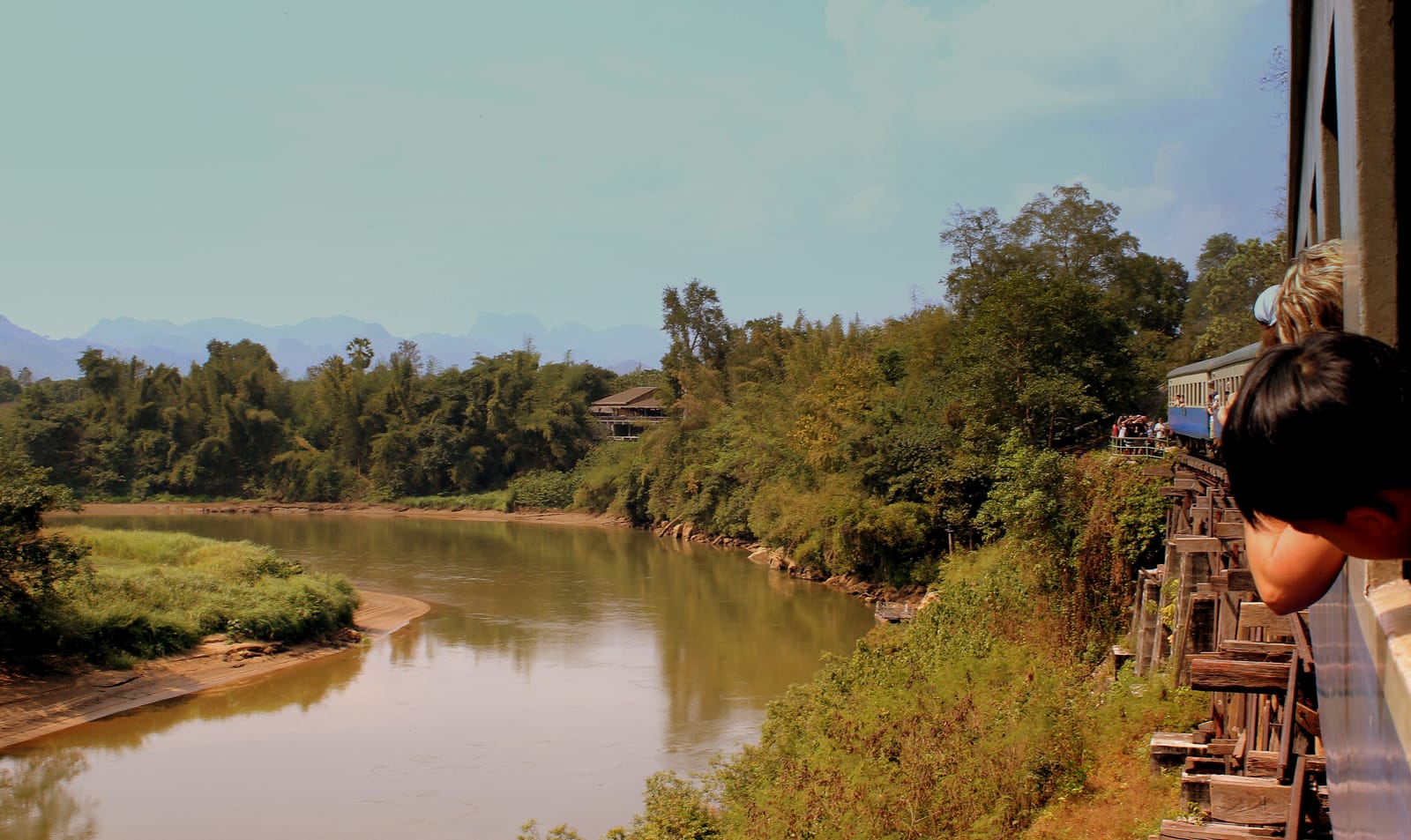
Tham Krasae sits in Wang Pho subdistrict, Sai Yok district, about 50 kilometres from Kanchanaburi town heading toward the waterfall. Here the railway has to skirt the mountainside along the Khwae Noi River, so it was built as a long curved wooden trestle hugging the cliff — most people call it the Tham Krasae bridge or the Wang Pho Viaduct. It runs roughly 400 metres, and it's the image of the Death Railway that a lot of people come specifically to see with their own eyes.
You'll find two kinds of visitors here: people riding the train through, and people who drive in, walk out onto the bridge, and wait for a train to pass. Both are fun in their own way. We'll walk you through each one so you can decide which suits you.
A bit of history before you go
The Death Railway was built during World War II, around 1942–1943, by the Japanese army to link Thailand and Burma as a supply and troop route. The line ran more than 400 kilometres and was built by huge numbers of Allied prisoners of war and Asian labourers, working through harsh weather, disease, and starvation. Tens of thousands died, which is how the line earned its name.
The Tham Krasae stretch was especially gruelling to build, because the crews had to cut into the mountain and lay track along the cliff right above the water. The cave next to the track was once used as shelter for the prisoners. Today there's a Buddha image enshrined inside, and you can still see the Khwae Noi River from the cave mouth. Coming here isn't just about a pretty photo — it's standing in the real place where all of this happened.
Want more out of Kanchanaburi? Book tours & activities
Booking online ahead on Klook or GetYourGuide is usually cheaper than the gate and skips the queue. Pick only the experiences you actually want — prices and availability are shown live on each site.
Riding the train through Tham Krasae — which way is best
There are two main ways to experience this stretch. Pick whichever fits your schedule and the style of your trip.
The long ride from Kanchanaburi to Nam Tok
Board at Kanchanaburi station or the Bridge over the River Kwai and ride all the way to Nam Tok. Along the way you cross both the Bridge over the River Kwai and the Tham Krasae stretch, so you get the full journey end to end.
A short hop around Tham Krasae
Plenty of people drive themselves, park near one of the trackside resorts, and hop on for a short stretch just to see the cliffside trestle. Good if you're short on time or travelling with family.
If you want the full experience, ride the long service at least once. The moment the train slows down on the wooden trestle along the cliff and you look down at the river — that's when everyone on board turns to face the same window at once.
Train times (always check first)
The main service travellers use is the ordinary train on the Thonburi–Nam Tok Sai Yok Noi line, which runs through Kanchanaburi. The times below are roughly when the train passes the Tham Krasae/Wang Pho stretch, based on the latest schedule — but Thai trains often run off-time, so build in a buffer and double-check with the station.
- Outbound (toward the waterfall), passing Tham Krasae — around 07:28 / 11:40 / 17:48
- Return (toward Kanchanaburi–Thonburi), passing Tham Krasae — around 05:47 / 13:28 / 16:00
- Departing Kanchanaburi station (heading to the waterfall) — around 06:02 / 10:20 / 16:19
- Arriving at Nam Tok station — around 08:00 / 12:05 / 18:15
- On weekends and public holidays there are extra special services for tourists, and the trains get far more crowded than on weekdays.
A tip on timing
Thai trains are famous for running late. If you're coming specifically to photograph the train on the bridge, get there 30–45 minutes before the scheduled time and ask the station staff or locals again, since the timetable shifts with the season.
Fares and buying tickets
- Foreigner fare — this line charges a single flat rate of 100 THB per trip.
- Thai nationals — charged by distance at ordinary-train rates, in the tens of baht, so much cheaper.
- Short sightseeing hop near Tham Krasae — at some points the short stretch costs only a few baht.
- Buying tickets — sold at the station only, usually about 1–2 hours before departure. You can't buy in advance online.
Straight talk
The train seating is open-air with no air-conditioning, and you won't always end up by a window on the view side. If you want the cliffside-trestle angle, take a seat facing out toward the river — and brace yourself for crowds and heat during peak times.
Viewpoints and photo spots
- On the wooden cliffside trestle — you can walk the path beside the track when no train is coming, looking out at the long curve of the bridge hugging the cliff with the Khwae Noi River below. It's the classic shot here.
- The mouth of Tham Krasae — there's a Buddha image inside and a view out over the river. Be respectful here, as it's both a place of worship and a historical site.
- The train on the bridge — photographers tend to wait for the train to round the curve so they can frame the carriages, the bridge, and the cliff all in one shot.
Safety
When you're walking on the bridge, listen and watch for the train. As soon as one approaches, step into a trackside refuge bay right away — don't get so caught up taking photos that you stand on the tracks. Some sections of the wooden decking have gaps, so keep an eye on small children and anyone in heels.
More to see nearby
- Bridge over the River Kwai — in Kanchanaburi town, the starting point of the same railway's story. You can walk out onto the bridge.
- Hellfire Pass — past Tham Krasae toward the waterfall, with a museum telling the story of the railway's hardest stretch to build.
- Sai Yok Waterfall / Sai Yok National Park — the end of the line, good for a day of swimming or a riverside stay.
Plan a full Kanchanaburi trip — where to stay, where to eat, and where to go.
See the Kanchanaburi travel guide →