🔄 Updated 21 Jun 2026
Before the details, a quick picture of why Bueng Kan takes more prep than most places. First, the three main sights — Naka Cave, Three Whale Rock and Phu Thok — are spread across separate districts in the south of the province, tens of kilometres from town and from each other. Second, two of those three you can't just walk up on a whim: Naka Cave needs a registered slot, and Three Whale Rock means riding a local villagers' truck. Get your head around those two facts and plan from there, and the trip goes a lot more smoothly.
When is the best time to visit Bueng Kan?
If you're asking when Bueng Kan is most comfortable, the answer is the cool season, roughly November to February: cool air, hikes that don't punish you, clear skies, and a decent shot at a sea of fog over Three Whale Rock in the early morning. Each part of the year has its trade-offs, so pick based on what matters most to you.
- November–February (cool season) — the best window overall. Cool, comfortable air, so the Naka Cave and Phu Thok climbs don't wear you out, plus a chance at the Three Whale Rock fog. The catch is the crowds — this is peak, especially New Year through February when Naka Cave gets very popular and slots fill fast.
- March–May (hot season) — fewer people, but brutally hot. Climbing in the midday heat is miserable, so you have to start very early. Naka Cave usually closes for trail restoration around May–June, so always check the announcements first.
- June–October (rainy season) — green rice fields, the waterfalls in Phu Wua running full, and Bueng Khong Long looking lovely. The downsides: slippery climbs, rain that can shut viewpoints on short notice, and Naka Cave still possibly closed for restoration in parts of this stretch.
Skip the long weekends if you can
Over New Year, Chinese New Year and other long holidays, Naka Cave slots fill very fast and the wait for a Three Whale Rock truck drags out. If you can take a weekday mid-week, there are far fewer people, the atmosphere is better, and booking a slot is much easier.
Reaching Three Whale Rock by local truck — what to know
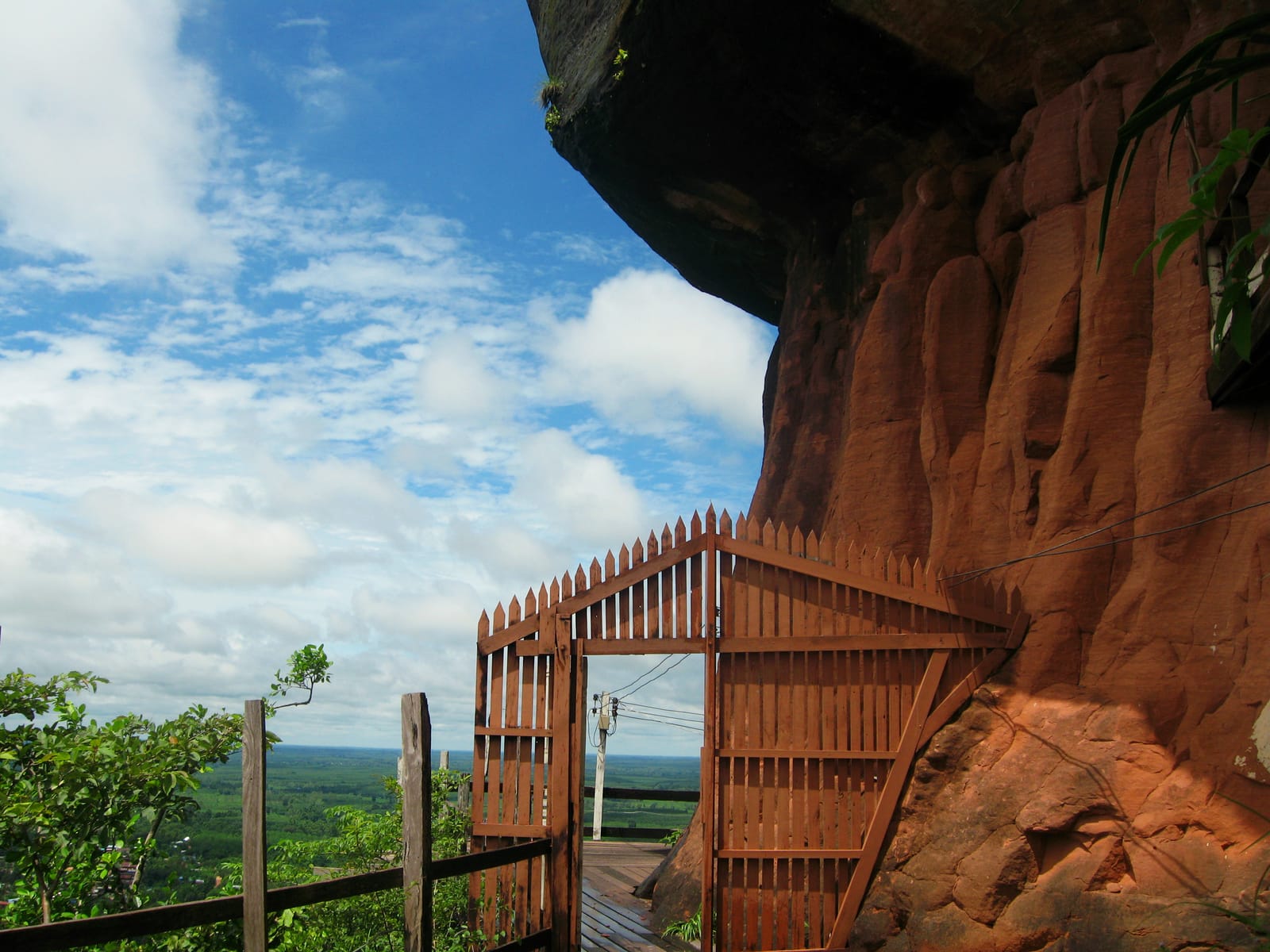
Three Whale Rock is a trio of cliff formations lined up like a pod of whales, set in the Phu Sing National Reserved Forest in Bueng Khong Long district. The key thing a lot of people don't realise: you can't drive your own car up to the viewpoint. The road is dirt and very steep, so the only way up is on a truck run by local villagers. Here's how the system works.
- Truck fee is 500 THB per vehicle (round trip) — these are registered local pickup trucks that hold about 10 people each. If you're a small group, you can share a truck with other travellers to split the cost, which works out much cheaper.
- Entry fee is 20 THB per person — collected separately from the truck fee. Seniors aged 60 and over are often exempt; ask on site.
- The driver stops at several points — the truck doesn't go straight to one spot. It stops at Lan Tham Phu Sing (the crouching-lion rock), the Tham Ruesi viewpoint, then finishes at the Three Whale Rock highlight. Many drivers will take photos for you too.
- Drone photo rental is available for around 1,000 THB — those gorgeous overhead shots of Three Whale Rock you've seen have to be taken from a drone. If you want that kind of image, ask about the service on site. It's optional.
- Go at dawn for the fog and to beat the sun — leave your accommodation before first light for the best atmosphere. Come late and the sun is harsh and the fog has burned off.
Mind the cliff edge — shoot photos with your wits about you
The most popular photo spots on Three Whale Rock are high cliff edges, and many have no railing. There have been falls. Don't walk backwards to frame a shot, don't strike risky poses near the edge — have someone shoot you from a safe angle instead. Safety before a good photo.
Registering for Naka Cave — how to book a slot
Naka Cave sits within Phu Langka National Park and is the sight most people come to Bueng Kan specifically to see — but you can't go up without registering. The park caps the number of visitors per day to protect the trail and for safety, roughly 1,000 people a day total, split between an advance booking quota in the app and a walk-in quota on site. Here's how it works.
- Book ahead through the QueQ app — download QueQ, select Naka Cave at Phu Langka National Park, then pick your date and time slot. You have to enter the real full name of each person going so it matches who actually climbs — you can't send someone else in your place. This is the most reliable route for weekends and long holidays.
- There's a walk-in quota on site too — if you didn't book in the app, there's still a sizeable walk-in quota to claim each day. On quieter weekdays you'll usually get a slot easily, but holidays risk selling out, so if you're travelling a long way, lock in a slot in the app first to be safe.
- Fee is around 30 THB per person — that covers entry and life insurance; children are a little cheaper. At times there's a refundable rubbish deposit you get back when you bring your trash down.
- You go with a volunteer guide — you must climb with a volunteer the park assigns. The fee is by donation; people commonly give around 500 THB per group. The volunteers guide the way, share the stories, and take photos for you.
- Open from morning to early afternoon — roughly 06:00–14:00, split into several time slots. You should start walking no later than 8am, as the trail is long and takes a while.
- Closed for restoration around May–June — and may close more if the rain is heavy. Check the Phu Langka National Park page before you plan, every time.
Naka Cave is a longer walk than you'd think
The Naka Cave trail is about 7 km round trip, mostly steel staircases climbing up, and takes roughly 4–7 hours depending on your fitness. It's not technically hard, but it is genuinely tiring. If you don't exercise much, leave yourself extra energy and time, carry enough water, and start early to dodge the afternoon sun.
Don't fall for tours that claim to book a slot with no proof
The park warns that if you use a group or company that claims to have booked your slot but can't show a valid booking in your own name, you may not be allowed up the cave. If you do use a tour, ask plainly whether it's booked through QueQ in your name, and ask to see the booking proof.
What's the weather like in Bueng Kan month by month?
Bueng Kan sits on the Mekong at the far upper edge of Isan, with three clear seasons like the rest of the region — but the cool season is colder than many provinces because it's the northernmost and right on the river. Knowing the weather ahead helps you pack right and time your hikes well.
- Cool season (Nov–Feb) — daytime around 25–30°C and comfortable; mornings and nights cool to about 15–18°C, sometimes lower, especially up on the hills at dawn. Bring a light jacket.
- Hot season (Mar–May) — very hot, daytime touching 35–40°C with strong sun. Hiking midday is miserable, so start early and carry plenty of water.
- Rainy season (Jun–Oct) — rain in spells and humid air. The rice fields and waterfalls look great, but the climbs get slippery — pack a rain jacket and shoes with good grip.
How much does a Bueng Kan trip cost?
Bueng Kan is an inexpensive province on the ground — accommodation and food are easy on the wallet. The real chunk of the budget is getting there, since it's far and you need a vehicle to move between the sights. Here's a per-person estimate for a 2-day, 1-night trip, not counting travel from Bangkok.
- Accommodation in town — typical hotels and resorts run about ฿500–1,200 a night; split between two people it's only a few hundred each. Options range from budget guesthouses to riverside resorts on the Mekong.
- Three Whale Rock — 500 THB truck fee per vehicle (split it) plus 20 THB entry. Fill the truck and it's under a hundred each.
- Naka Cave — fee around 30 THB plus the volunteer donation (commonly about 500 THB per group, split among you).
- Phu Thok — free, no entry fee; just the fuel and transport to get there.
- Food — roughly ฿50–150 per meal. Isan dishes, Mekong river fish, Vietnamese kuai chap, mookata — all reasonably priced. About ฿300–500 a day will keep you full.
- Local transport — the part to think hardest about. Renting a car to drive yourself is around ฿1,000–1,500 a day plus fuel, or a chartered car with driver runs about ฿1,800–2,500 a day depending on distance.
All in, just for on-the-ground costs over 2 days and 1 night, if you come as a group and split the car and room, it works out to roughly ฿1,500–2,500 per person. Travel from Bangkok (flying into Udon Thani plus a car rental, or a coach) is a separate cost that depends on how you choose to get there.
What to wear and what to pack
Bueng Kan is a hiking trip more than a stroll-around-town trip — Naka Cave, Phu Thok and Three Whale Rock all take effort. So what you wear and pack really shapes how much fun you have. Sort these out and the trip gets a lot more comfortable.
- Trainers or hiking shoes — the single most important item. Naka Cave and Phu Thok are real climbs and some surfaces are slippery. Absolutely no flip-flops.
- Breathable clothes plus a light jacket — wear thin, sweat-wicking fabric in the day; mornings and the hilltops in cool season are chilly, so bring a layer to throw on.
- Modest dress for temples — Phu Thok is a temple area (Wat Chetiya Khiri Wihan) and Naka Cave carries religious significance. Skip spaghetti straps and very short shorts; keep things reasonably covered.
- Hat, sunscreen, sunglasses — the Isan sun is strong, especially in hot season and at viewpoints with no shade.
- Water and snacks — Naka Cave is a long 4–7 hour walk, so carry enough water and some snacks for energy. There are no shops along the trail.
- Cash — the Three Whale Rock truck, the volunteer donation, and many local shops take cash only, and the outlying sights have no ATM nearby. Bring enough.
- Power bank plus offline downloads — phone signal in the park areas is patchy. Download maps, slot info, and your QueQ booking before you set off.
- Personal meds plus something for aches — two days of hiking will leave you sore for sure, so pack inhalers, balm and basic remedies in your bag.
Pre-departure checklist
- Pick your travel dates, avoid May–June when Naka Cave usually closes, and check it's not a crowded long holiday.
- Check the Phu Langka and Phu Wua national park pages to confirm the spots you want are open.
- Book your Naka Cave slot in QueQ ahead of time if you're going on a weekend or holiday.
- Sort out transport — rent a car from Udon Thani and drive yourself, or charter a car with a local driver.
- Bring enough cash for the Three Whale Rock truck, the volunteer donation, and local shops.
- Pack hiking shoes, a light jacket, and modest clothes for the temples.
- Download maps and slot info offline in case the signal is weak in the park areas.
Once you're prepped, check out the full Bueng Kan guide or lock in a well-placed place to stay in town for the night.
See the full Bueng Kan guide →